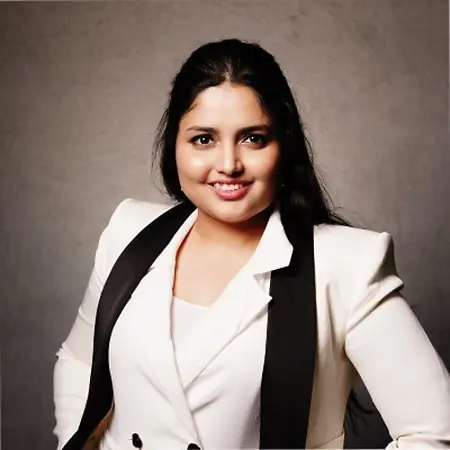
Her Story
About Rupsa
I'm a scientist by profession, very much committed to solving problems where we don't have solutions, especially infectious diseases that have no vaccines or treatments available. I wanted to be that scientist who could create something more economical, easily accessible, and solve the problem without just thinking about the business side. That's what led me to do my PhD in viral vaccine creation, where I worked on creating vaccines against different infectious diseases that cause pandemics or epidemics. I've been through pandemics myself and worked across COVID vaccines, flu vaccines, and HPV, which is very rampant in women. Throughout my PhD, I created multiple vaccines that could have been into the market, but there's a difference between academia and industry. I created vaccines, published a lot of good papers, and contributed to the scientific community. Then I decided I wanted to bring these products into the market, which is why I made the decision to come into startups where I can actually work from the ground up and get products out in the market. I worked in creating vaccines against universal flu, then when the COVID pandemic hit, I created vaccines there and solved the issue. From there, I moved into my next startup where I worked in creating an immune-boosting first baby formula, which was an innovative product by itself, but I was still missing my core technical piece, which is the viruses that I work with. That made me switch into my current company, Humane Genomics, where we create very precision-enabled good viruses, oncolytic viruses, that will only infect cancer cells and will leave out the healthy ones completely. You can see it's such a good target - you can make use of viruses which can go and treat cancer completely and not be just another band-aid solution to this problem. My technical expertise is my main area where I still contribute towards science. I'm very passionate about it, so solving cancer is my mission, my passion, and creating any treatments which are more accessible is what I'm working towards. While working in this field, I also realized that as a woman in science and in STEM field, we are not represented enough, which is why I started working as a volunteer in Healthcare Business Women Association, where I work with similar scientists in the field and kind of push them to become leaders and create a seat for ourselves where our voices need to be heard.
Her Interview
Ten minutes with Rupsa
01What do you attribute your success to?
I would say training the next generation of women scientists who want to break the barriers and come out from this glass ceiling and understand that there is a world outside where you can push your limits and shine upon in science. Science is one of those languages where we can all work together and still achieve what we are meant to achieve. My leadership and bringing women in STEM, shining upon and solving the real root cause of problems is what my strength is. I get most of my inspiration from my mom. She's never been in the scientific field, but what she has is a rock star player who has faced several challenges in her life in terms of breaking barriers and societal pressures. I'm her only child, and what she has shown me is nothing is impossible if you have the grit to do it. That's why, as an immigrant, I could come here on my merit, and I'm still working on my merit, and constantly trying to contribute to this economy, to this country. I'm super proud of it, and I would give all the lessons learned from her, completely.
02What advice would you give to young women entering your industry?
Don't try to go as per the prototype or the standard operating procedure. As women in STEM, what we are often told is, this is what you're supposed to do - get a degree, go into college, and then you pursue that, and then eventually you land a job, and that's about it. What I have learned is, yes, degrees and qualifications, they are great, and I am a big believer of that. I've gotten several. But apart from that, don't just get a degree for the sake of getting one. Really learn from it, see whether you are interested and passionate about that. Yes, it is about doing a job and getting your salary and leading a life, that is important, but if you're not passionate about it, then you are quickly going to be burnt out, and that is going to feel like you're dragging yourself for the rest of the life. For scientists in STEM, you really need to find your own passion and then work towards it, even though it's not going to pay you that amount that really you want to get paid. Eventually, you're going to shine, and that's not going to be an issue.
03What are the biggest challenges or opportunities in your field right now?
The scientific community is usually very large, but everybody is inputting a plethora of data in the scientific community. The challenge is now finding them and making use of the meaningful ones so that you're not repeating the mistakes as others have done. I wish the scientific community would be more open and would openly share all the findings, especially where you failed at, so that it would be available for every new researcher in the world, and you know exactly, this is what you have failed at, so let me try into something else so that we can all succeed together. The scientific data finding is a big bottleneck. With the publications and everything, it is really helpful. Whatever I'm seeing online as a publication, I can learn from that, but what I'm not seeing, of course, I don't learn from that. With the AI introduction, of course, you can understand that it's able to gather information very fast, so it's now a little bit easier here for the researchers, and I am super enthused about AI, too. I feel that it can really help scientists or people in the medical field in general, to assist them more, not take their work, but to assist them.
Join Influential Women and start making an impact. Register now.