Discover how executive leaders create lasting impact by bringing order to complexity, building systems that work, and enabling their organizations to succeed without relying on extraordinary individuals.
Her Story
About Simone
Some leaders solve today's problems. Others build organizations that are equipped to solve tomorrow's.
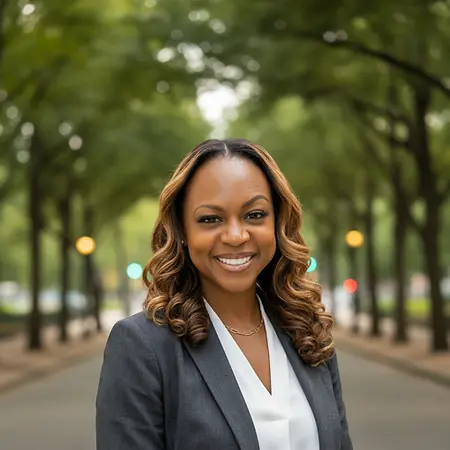
D. Simone Jackson is an executive finance and operations leader whose work sits at the intersection of strategy, operational excellence, and organizational transformation. She is known for helping organizations bring order to complexity by creating the financial, operational, and governance systems that enable better decisions, stronger accountability, and sustainable growth.
As Treasurer and Finance Director for the Village of Thornton, Illinois, Simone leads financial strategy, treasury management, budgeting, compliance, reporting, and internal controls while partnering with executive leadership and elected officials to strengthen organizational performance. Her work extends well beyond finance. She designs processes, modernizes operations, develops performance frameworks, and implements practical solutions that improve transparency, reduce risk, and position organizations for long-term success.
Throughout her career, Simone has partnered with organizations across local government, healthcare, financial services, nonprofit organizations, legal services, and private business.
Regardless of industry, she is consistently drawn to environments experiencing growth, change, or operational complexity. Her ability to quickly understand interconnected systems allows her to identify opportunities, align stakeholders, and build structures that make organizations more effective.
Her expertise includes strategic operations, financial leadership, organizational design, process improvement, data analytics, treasury management, governance, risk management, performance measurement, and continuous improvement. She believes that exceptional leadership is not measured by how much knowledge one person possesses, but by the systems they create that allow entire organizations to succeed long after individual leaders have moved on.
Simone earned a Bachelor of Science in Economics from Northern Illinois University and a Master of Arts in Economics from Roosevelt University, where she focused on quantitative analysis, applied statistics, and decision science. She also completed Harvard Business School Online's Management Essentials program in 2023, further strengthening her foundation in enterprise leadership and organizational management.
Outside of her professional career, Simone is deeply committed to civic leadership and community impact through Sigma Gamma Rho Sorority, Inc., Lambda Chi Sigma Alumnae Chapter. She has served as Fundraising Chair, Youth Symposium Lead, and organizational modernization efforts while serving as Treasurer and as a founding director of the Golden Leaders Foundation.
Whether leading financial strategy, modernizing organizational processes, or building governance frameworks, Simone's work is guided by one principle: the executive skill no one talks about is bringing order to complexity. She believes organizations achieve their greatest impact when leaders create clarity, build resilient systems, and empower people to perform at their highest level.
Her Interview
Ten minutes with Simone
01What do you attribute your success to?
I attribute my success to a systems-thinking mindset and a genuine curiosity to understand how organizations work beneath the surface. Rather than treating challenges as isolated problems, I look for the underlying processes, relationships, and structures that shape outcomes. That perspective allows me to bring clarity to complexity, strengthen governance, and design practical, sustainable solutions that improve decision-making and organizational performance.
I also believe the best leaders don't become indispensable—they build systems that enable others to succeed. Whether leading financial strategy, improving operations, or guiding organizational change, my goal is always to leave an organization stronger, more resilient, and better equipped for the future.
02What’s the best career advice you’ve ever received?
The best career advice I've ever received was to understand the difference between being right and being influential. Early in my career, I believed that having the right answer was enough.
Over time, I learned that lasting change happens when people understand the vision, feel included in the process, and are willing to move forward together.
That lesson reshaped how I lead. Today, I know that leadership isn't about having all the answers—it's about building trust, aligning people around a common purpose, and creating the conditions for meaningful progress. The greatest impact comes not from proving a point, but from helping others succeed alongside you.
03What advice would you give to young women entering your industry?
My advice to young women entering this industry is to never underestimate the value of your perspective or limit yourself to the boundaries of your job description. Develop deep expertise in your field, but also take the time to understand how the entire organization operates. The leaders who create the greatest impact are those who can connect people, processes, strategy, and purpose.
Stay curious, ask thoughtful questions, and never stop learning. Confidence is important, but so is humility—the willingness to keep growing, seek new perspectives, and embrace challenges that stretch your abilities. Every experience, whether it's leading a project, solving a complex problem, or serving your community, builds leadership skills that will prepare you for opportunities you may not even see yet.
04What are the biggest challenges or opportunities in your field right now?
One of the biggest challenges—and opportunities—in my field is aligning diverse stakeholders around a shared vision. Whether in government, healthcare, nonprofit organizations, or the private sector, leaders are often navigating competing priorities, limited resources, and differing perspectives. Success requires more than technical expertise; it requires the ability to build trust, communicate clearly, and create alignment that moves organizations forward.
At the same time, I believe we're entering an exciting era where organizations are recognizing the value of operational excellence. Leaders are increasingly looking beyond individual problems and asking how to build better systems, improve decision-making, and create organizations that are more resilient, transparent, and adaptable. Those who can bring order to complexity by connecting strategy, people, processes, and data will be well positioned to lead the next generation of organizational transformation.
05What values are most important to you in your work and personal life?
The values that guide both my professional and personal life are integrity, accountability, service, and compassion. I believe leadership begins with taking ownership of your responsibilities, treating people with dignity and respect, and making decisions that serve the greater good rather than personal recognition.
I also value emotional intelligence because meaningful leadership is built on understanding people as much as understanding problems. Whether I'm working with colleagues, community partners, or volunteers, I strive to lead with empathy, listen before acting, and create environments where people feel valued, empowered, and able to do their best work.
Her Content Hub
Articles by Simone
The Executive Skill No One Talks About: Bringing Order to Complexity
How the best leaders bring order to complexity by focusing on systems, not symptoms.

The Executive Skill No One Talks About: Creating Clarity
When people imagine executive leadership, they often picture someone making bold decisions, delivering inspiring speeches, or solving high-profile problems.
I've learned that much of executive leadership looks very different.
Whether I was rebuilding a budget, redesigning an approval process, leading a strategic initiative, or helping an organization improve its operations, I found myself doing the same thing over and over again:
I was bringing order to complexity.
The higher leaders advance, the fewer problems have straightforward answers. Instead, they are asked to navigate competing priorities, limited resources, organizational politics, changing expectations, and uncertainty—all at the same time.
Technical expertise may earn you a seat at the table, but it is not what keeps you there.
The leaders who create lasting impact are the ones who can create clarity when everyone else sees confusion.
What System Produced This Outcome?
Throughout my career, I've discovered that complexity is rarely caused by people alone. More often, it is the result of disconnected systems, unclear expectations, competing priorities, or processes that no longer support the organization's goals.
That's why I no longer begin by asking, "Who's responsible?"
I begin by asking, "What system produced this outcome?"
That single question changes everything.
When leaders focus on systems instead of symptoms, they stop reacting and start building organizations that perform consistently—not because extraordinary people are holding everything together, but because the organization itself is designed to succeed.
Create Clarity. Build Systems. Enable People.
Whether I'm working on financial strategy, governance, budgeting, operations, or organizational improvement, my objective is always the same:
Create clarity. Build systems. Enable people.
Because leadership isn't measured by how many problems you personally solve.
It's measured by how many problems your organization no longer has because of the systems you created.
To me, that's the executive skill no one talks about.
Join Influential Women and start making an impact. Register now.