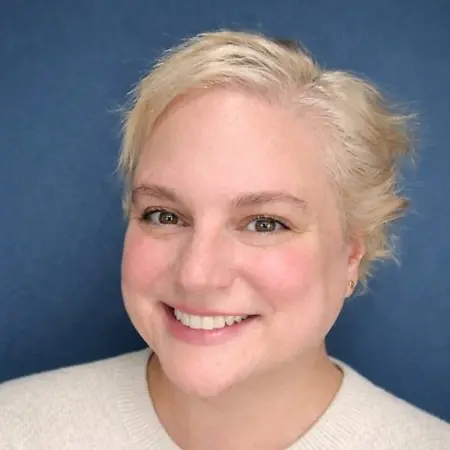
Influential Woman · Advertising
Stefanie Gunning
Creative Director, McKinney
New York, NY
Her Story
About Stefanie
I’m a writer and creative director who has always been interested in how people make meaning—at work, in culture, and with one another. I’m energized by stories that feel honest and nuanced, and by environments where curiosity, responsibility, and care are taken seriously.
I’ve been a Brooklynite since before it was cool, I'm married to a New York City tour guide, and I’m the mom of an extraordinary young woman who keeps me grounded, curious, and honest. I’m also deeply besotted with my dog—a one-eyed street rescue whose daily lessons in resilience, joy, and trust are far more effective than any leadership book.
Professionally, my career has moved through entertainment, advertising, and brand storytelling, but my enduring interest is people: how teams work, how leaders show up under pressure, and how creative ambition either flourishes or fractures depending on the conditions around it. I’ve seen firsthand how clarity, trust, and thoughtful leadership shape not just the work, but the human experience of making it.
I’m a mentor by instinct and by choice. I care deeply about helping people grow into their authority, find their voice, and do work they’re proud of without losing themselves in the process. I believe creativity is strongest when it’s supported by clear expectations, honest communication, and systems that respect human limits.
Outside of work, I’m a lifelong reader, an essayist, and someone who believes most things can be improved by a walk outside followed by a nap.
Her Interview
Ten minutes with Stefanie
01What do you attribute your success to?
I attribute my success to curiosity, enthusiasm, and the confidence I was raised with. My parents, especially my mother, encouraged every idea I had, no matter how far-fetched. Her motto is, “You know who fails? People who try.” That belief made risk-taking feel natural and failure feel survivable. Paired with my total lack of coolness and real care for the work and the people behind it, that mindset has guided my writing, leadership, and creative judgment throughout my career.
02What’s the best career advice you’ve ever received?
Honestly, I’ve learned as much from bad bosses as I ever did from good ones. But the best advice I received came from a wonderful leader who promoted me from Associate Creative Director to Creative Director. He told me, “You’re not in charge of anyone. You’re accountable to them and responsible for them. When they succeed, you succeed. When they fail, you fail.” That reframing shaped how I think about leadership to this day.
03What advice would you give to young women entering your industry?
The most important thing I would tell young women is this: you cannot optimize yourself out of a broken system. No amount of over-preparing, over-delivering, or self-correcting will fix an environment that isn’t designed to support you. If something consistently makes you feel small, confused, or exhausted, that’s not a personal failure. Pay attention to patterns, not just moments. Build your skills, yes, but also learn how healthy organizations actually function. Knowing when to grow and when to leave is as important as knowing how to perform.
04What are the biggest challenges or opportunities in your field right now?
The biggest opportunity in my field right now is reclaiming storytelling as a connective force, not just a delivery mechanism. We’re living in a moment where attention is fractured and people are overwhelmed, which means brands don’t win by being louder or faster. They win by being clearer, more human, and more intentional about the stories they tell and how those stories show up in real life.
The biggest challenge isn’t talent or tools. It’s the systems creative work lives inside. Too many organizations rely on creativity to solve problems that are actually structural. When authority is unclear and accountability is diffuse, creative teams end up absorbing pressure that should be handled upstream. The result is noise instead of meaning.
AI only sharpens this divide. Used thoughtfully, it can create space for better thinking and better craft. Used carelessly, it accelerates sameness. The work that lasts will come from judgment, taste, and restraint, not novelty for its own sake.
What gives me optimism is that people are starting to name this. There’s a growing appetite for leadership that protects creative energy instead of exploiting it, and for work that feels grounded, generous, and considered. That’s where I see the future of this field heading — and where I’m most interested in contributing.
05What values are most important to you in your work and personal life?
Integrity, honesty, and kindness are the values that anchor both my work and my life.
Integrity means doing what you say you’ll do and taking responsibility for the outcomes, especially when things are hard or uncomfortable. I believe trust is built through consistency, accountability, and clear ownership, not performance or optics.
Honesty matters because it creates real alignment. In my work, that means telling the truth about what’s working, what isn’t, and what a situation actually requires. In life, it means being clear about my limits and my intentions, and respecting the same in others.
Kindness is not softness or avoidance. It’s how I approach people with care, curiosity, and respect while still holding high standards. I believe the best creative work happens in environments where people feel seen, supported, and challenged — where excellence and humanity are not in conflict.
These values shape how I lead, how I collaborate, and how I move through the world. They’re not aspirational for me, they’re non-negotiable.
Join Influential Women and start making an impact. Register now.