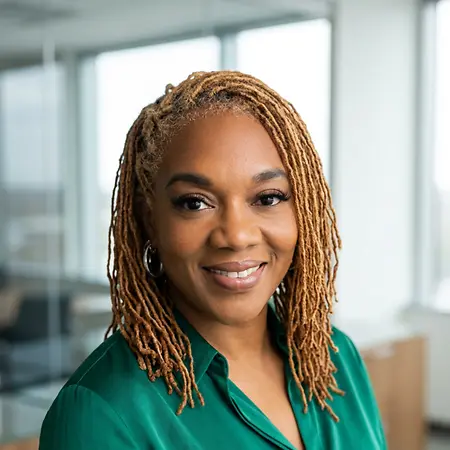
Her Story
About Tanisha
Tanisha Ryans is an IT leader and cybersecurity professional based in Fayetteville, North Carolina, with more than 15 years of experience in local government technology operations and infrastructure management. She currently serves as an Information Technology Manager for Robeson County Government, where she oversees enterprise IT services supporting hundreds of users across multiple departments. In this role, she leads teams responsible for network operations, cybersecurity, Microsoft 365 administration, and infrastructure reliability while aligning technology strategy with countywide operational needs.
Tanisha’s career spans a broad range of technical and leadership roles shaped by both formal education and hands-on experience. She began her professional journey in the United States Air Force as a signals intelligence analyst, developing a strong foundation in disciplined technical analysis and problem-solving. After transitioning into civilian life, she built deep experience in systems administration and IT support through roles in private organizations, faith-based institutions, and local government. She later formalized her expertise with an associate degree in Networking Technology and a bachelor’s degree in Information Technology Management and Security from Campbell University, all while continuing to work in the field. Over time, she advanced into leadership roles, including contributing to the development of a countywide data center built from the ground up.
Throughout her career, Tanisha has focused on strengthening cybersecurity, modernizing infrastructure, and improving public-sector technology resilience. She has participated in regional cybersecurity response efforts through state-level strike teams, helping local governments recover from cyber incidents and restore critical services. Beyond her professional responsibilities, she is also committed to community service, volunteering her technical skills to support churches and small organizations that lack access to enterprise IT resources. Her leadership style emphasizes practical problem-solving, service-driven impact, and building secure, reliable systems that support both government operations and the communities they serve.
Her Interview
Ten minutes with Tanisha
01What do you attribute your success to?
My path into technology began with service in the United States Air Force, which taught me discipline, problem-solving skills, and how to perform under pressure. Those lessons became the foundation for everything I do today. After the military, I spent about 10 years providing technology and audio-video support for my church, which really helped me develop my skills and passion for this field. When I realized I wanted to make this a career, I pursued formal education, earning my associate's degree in networking technology and then my bachelor's degree in information technology management and security in 2015. Working with my peers has been incredibly impactful, especially being part of the Strike Team, a cybersecurity task force with the state of North Carolina where we volunteered to help counties, schools, and cities across the state that were hit by cyberattacks. My most significant achievement was leading the development of a new county data center from the ground up, designing and implementing infrastructure to support the entire county, which took about 6 months to a year to complete. I've been in my current position for 5 years, supervising a team of 4 employees and overseeing everything from server management to network infrastructure to cybersecurity initiatives. I absolutely thrive on the chaos because every day is different, it could be anything from a downed server to complete network issues to telephone problems, and I love that it's never the same. I'm also passionate about helping local churches and small businesses who can't afford huge IT companies, supporting them with their technology needs, social platforms, and video streaming.
02What advice would you give to young women entering your industry?
I would tell someone pursuing this field to focus on the education aspect first, and then focus on your certifications. That would really help make someone a stronger candidate when they're looking for a job in this field, because it's tough. It is a very competitive field, and it's definitely male-dominated. The hard part that I realized was that every place you look, even if you have a degree, they want you to have experience. It's like, how can I get experience if everybody's requiring experience? The county I worked for gave me a chance, and I felt very privileged and lucky to have that, because not everyone gets that. You have to start somewhere, and the more education and certifications you have will help. But here's what I want you to know: anything that you do can go on your resume. If you've built computers at home or tinkered around with different equipment at home, that's experience. Take everything that you've done in life and convert it to experience to add to your resume. A lot of people do have the experience, they just don't know how to put it on paper. Even if it wasn't at an actual company, take what you've done personally and turn that into experience. People don't realize that they do have experience just because it's not in an actual business or job.
03What are the biggest challenges or opportunities in your field right now?
The biggest challenge in my field right now is that it's very competitive and oversaturated. It's also definitely a male-dominated field, which presents its own challenges. One of the major contradictions I've experienced is that most jobs require you to have both a degree and experience, but how can you get experience if everybody's requiring experience? That's a catch-22 that makes it really difficult for people trying to break into the field. A degree alone will not get you a job. You need to also have the experience, but the challenge is finding someone who will give you that chance to gain the experience in the first place. I felt very privileged and lucky that the county I worked for gave me that opportunity. The field is constantly evolving, and I believe the most effective leaders are those who remain curious, adaptable, and committed to lifelong learning.
04What values are most important to you in your work and personal life?
I absolutely thrive on chaos and love that every day in my work is different. It could be anything from a downed server to a complete network issue to someone's computer not working to telephone problems. That variety and unpredictability is why I love it so much, because it's never the same. Adaptability is crucial to me. I'm also really passionate about helping people, especially getting involved with local churches or small businesses who can't afford the huge IT companies to help support them. I want to help those kinds of organizations get started with either IT or their social platform or video streaming, things that they can't pay the huge companies to do for them. Throughout my career, I've been committed to supporting organizations that may not have access to extensive technical resources, whether that was spending 10 years doing all the technology and audio-video for my church or volunteering with the Strike Team to help counties, schools, and cities across North Carolina that were hit by cyberattacks. I believe in giving back and using my skills to make a difference for those who need it most.
Join Influential Women and start making an impact. Register now.