Her Story
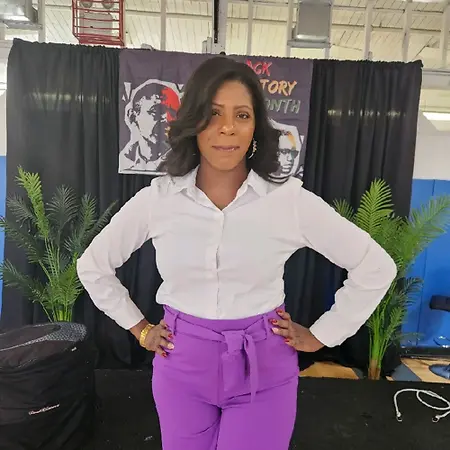
About Tasha
I've been working in the education field for about 20 years now, and my journey has been quite unexpected. I originally went to school to become a lawyer right out of high school, but after finishing my four years, I realized I wanted to help people in a different way. I got my first real job in a school during my freshman year of college, and I kind of stuck with it - now it's 20 years later and I'm still here. I've been a director for over 10 years now, and prior to my current role, I ran middle school after-school programs in the city and worked as a director at Boys and Girls Club. Currently, I serve as a community school director at Antonio Pandora Preparatory Academy in the Bronx, where I oversee a program serving about 400 students. My role involves running various components of a community school model, including student integrated support, family engagement, collaborative leadership with the principal, and expanded learning opportunities like after school programs, tutoring, and SAT prep. I manage a team that supports kids individually in classrooms, and we contract with a clinician to help students with social-emotional and mental health issues. I earned my Master's in public administration, focusing on working with people, leadership, and management. About three to four years ago, I decided to start my doctorate journey, and I'm almost done now - hopefully finishing in another month. It's been a long journey with personal stuff happening in my life, and it took longer than I expected, but I'm glad I'm almost done with this chapter. Throughout my career, I've been involved in meaningful international work, including helping build libraries in Zimbabwe in 2018 and Ghana in 2021 through African Library Products, where we send thousands of books and work directly with schools and communities. I've also run Youth of the Year scholarship programs for five years, and in my fourth year, I was able to mentor a student who received almost $60,000 in scholarships and is now on her way to take her MCAT for medical school.
Her Interview
Ten minutes with Tasha
01What do you attribute your success to?
I attribute my success to being humble, making mistakes, and not getting too down about it. I think sometimes when you're going through that journey and working hard, we beat ourselves up and feel like we didn't meet that milestone at the same time, or we didn't complete a certain goal that we thought we would have, and life kind of detours you. At the end of the day, that's life, and we have to be accepting of it, but also know how to pivot. If we have plan A, B, and C, sometimes plan A worked out, but just not as fast as you thought it would, so B kind of just curtailed behind it. You just gotta figure out how you go through the journey called life, but also make sure that you're not swept away by just mistakes, because that's going to help you succeed and grow. Failure is something that happens on your way on the road to success, so I think just learning to be okay with that, and keep pushing past that feeling of uncertainty or feeling of stress, and just keep going. I've learned to fear regret, not failure, because it's okay to fail. It's regret that eats away at people - that regret of not getting to do something at a certain time or never finishing a goal you had. When you have a failure and you say, listen, I got past it, I'm still here, I can do it over, I can do something even better, I think that's the journey in it.
02What’s the best career advice you’ve ever received?
The best career advice I've ever received is to do what you love and don't do it for the paycheck. Do what you love and what makes you happy. I've had some mentors over the years who always say, do what you love, because it's not work - it's something that you like to do. It's what wakes you up in the morning, what gets you out of bed. I think that's important, and I feel like being in this field has taught me that it is more about that sense of belonging, that sense of purpose, versus going to a job you don't like. When you love what you do and you're passionate about it, it's more than work. It's a passion, and you feel more impactful.
03What advice would you give to young women entering your industry?
My advice to young women entering this industry is to learn from others. Be humble and learn, be a sponge. Learn from someone that's been in the field longer than you, because I think that's where a lot of the treasures come from. Many years ago, I always remember a teacher named Ms. Spencer who gave me my first real leadership experience and showed me how to become a leader and how to be confident in my own abilities. I remember being a freshman in college, and I was a teacher's assistant. She said she needed me to command the classroom, and I was like, I can't do it, I'm scared. She literally just walked out and left me. She would do that every two to three weeks, and after a while, I started getting comfortable. She helped me build that level of confidence in leadership and public speaking. I appreciate her up to this day. So learn from those who have been there before you and let them help you build your confidence.
04What are the biggest challenges or opportunities in your field right now?
I would say one of the biggest challenges in my field right now is that there's so much red tape. I feel like if you don't go a certain route in certain areas, you cannot elevate, so you have to pivot or go another route. I wish that there wasn't a one-size-fits-all type of thing, where if you don't go this specific route, you can't be in a certain level of leadership or you can't pivot into another field. You have to kind of do one track, if you will. I think with education, we need to understand that things are evolving and changing - there are new charter schools, there are more nonprofits and for-profits, so it shouldn't be just one way of becoming more in that field. It should be other areas or other ways to kind of get to that level. I think that's kind of a deterrence too.
05What values are most important to you in your work and personal life?
The values most important to me in my work and personal life are integrity and character - being an honest person and showing up when no one's looking. Being true to yourself and doing what you feel is right. I think that's very important for anyone. I always tell students, be a good human, be a good person. You may not always remember what someone said, but you'll remember how they made you feel and how they showed up through different situations. I think being empathetic and passionate is crucial - understanding that everyone has their days and that people go through things. You want to be empathetic and try to be understanding. I always say this: I don't judge, I try to understand. Maybe something that's different from what you're used to or the norm - it doesn't make it bad or weird, it just means that you don't understand. Just trying to come from a space of understanding gives us more empathy for others. I like to keep that in both my personal and professional life.
Join Influential Women and start making an impact. Register now.