Breaking the cycle of intimidation in healthcare: How psychological safety, mentorship, and supportive leadership transform clinicians from fearful survivors into confident, innovative practitioners who prioritize patient care above all else.
Her Story
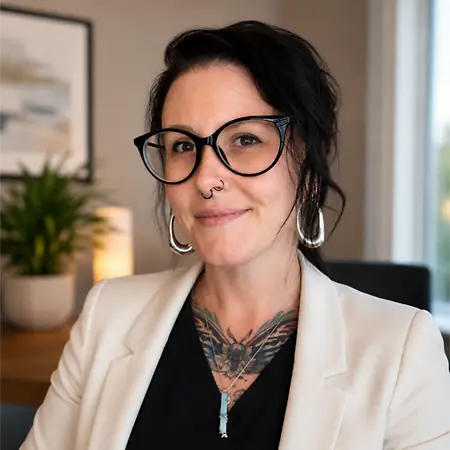
About Teri
Teri Nicholson, PMHNP-BC, FNP-C, APRN, ME, BSN, RN, is an experienced advanced practice nurse with more than a decade of experience in healthcare and a strong background in psychiatric and mental health services. During her career, she worked with WVU Medicine, where she gained extensive experience conducting emergency room psychiatric evaluations across diverse patient populations and conditions, including individuals experiencing substance use disorders and detoxification. Her clinical background has also included cardiac care and outpatient psychiatric services, providing her with a broad foundation in both physical and behavioral healthcare. Teri earned her master's degree in nursing from Carlow University and completed a Post-Master's Psychiatric Mental Health Nurse Practitioner program at Maryville University of Saint Louis in 2026. Her areas of expertise include outpatient psychiatry, psychiatric evaluations, behavioral health nursing, mental health nursing, medication management, and substance use disorders. Building on her clinical experience and entrepreneurial goals, she is now launching Nicholson Health & Wellness, a mobile healthcare business offering convenient Department of Transportation physical examinations. Outside of healthcare, Teri values family, creativity, and lifelong learning. She has been married to her husband Steve for 14 years, and together they enjoy spending meaningful time with one another. Her husband has not only taught her to believe in herself but has helped guided her in life and woodworking, while Teri enjoys reading, particularly murder mysteries, and listening to medical mystery podcasts while relaxing in her hammock. As she begins this new entrepreneurial chapter, Teri brings together her years of healthcare experience, passion for helping others, and commitment to providing accessible services through Nicholson Health & Wellness.
Her Interview
Ten minutes with Teri
01What do you attribute your success to?
I did not become a Psychiatric Mental Health Nurse Practitioner simply because I wanted a career in healthcare. I became one because I know what it feels like to have something to say and feel as though no one is truly listening.
Throughout my own journey, there have been times when I have felt dismissed, underestimated, or unheard. I have experienced environments where leadership did not always feel like leadership—where criticism, intimidation, and bullying could speak louder than encouragement or mentorship. Those experiences were difficult, but they also taught me something incredibly important: the way we make people feel matters.
I learned what kind of leader I never wanted to become. More importantly, I learned what kind of person I wanted to be. I wanted to be someone who listened. Someone who noticed the person sitting quietly in the room. Someone who asked, “What is really going on?” and stayed long enough to hear the answer. I am very hard-headed and have gone through a lot of negativity when it comes to leadership, and instead of allowing that to bring me down, I use it to my advantage and push myself to succeed in spite of others. My husband Steve has been with me for 25 years. Not only is he my best friend, he is my number one supporter who believes I can do anything. Without him, I would not be where I am.
02What’s the best career advice you’ve ever received?
"Always question everything and never just assume or take what others tell you. If it feels wrong in your gut and they can't back it up, stand firm because it is your responsibility to make sure that patient is safe and alive when you leave."
03What advice would you give to young women entering your industry?
As a PMHNP's, we have the privilege of meeting people during some of the most vulnerable moments of their lives. Many have spent years feeling misunderstood. Some have been told they are difficult, noncompliant, dramatic, lazy, or simply “too much.” Others have become so accustomed to not being heard that they have stopped expecting anyone to listen. I want my patients to know that when they sit across from me, they are more than a diagnosis, a medication list, an appointment slot, or a number on a schedule. They are people. And people deserve to be heard.
That philosophy has also changed the way I think about my future. For a long time, success meant continuing down the path that was already in front of me. Over time, I realized that sometimes growth means having the courage to create a different path. When you put yourself in the patient's position and trust yourself, you connect with patients on a level where they trust you. Ask questions, be interested in the person not just the diagnosis. It's not hard to be a good person.
04What are the biggest challenges or opportunities in your field right now?
The biggest challenge is sometimes connecting a little bit more with patients who have had similar experiences, and it's hard not to jump in and share, but remembering it's not my story, it's their story. I have learned that difficult experiences do not have to define the rest of your story. Sometimes they clarify your purpose. Being underestimated taught me to believe in my own abilities. Being unheard taught me how important it is to listen. Experiencing poor leadership taught me the kind of leader I want to become.
And encountering systems that could work better gave me the courage to start building something of my own. I do not want my career to be defined only by the letters behind my name or the positions I have held. I want it to be defined by the people who can say, “She listened to me. She treated me like I mattered. She helped me when I needed someone in my corner.”
05What values are most important to you in your work and personal life?
The values that are most important to me are compassion, integrity, authenticity, advocacy, resilience, independence, and treating people with dignity. At the center of all of them is a very simple belief: people deserve to feel heard, respected, and valued.
Those same values are influencing my decision to become an entrepreneur and develop a mobile DOT physical service. I want to build something that is accessible, efficient, ethical, and genuinely useful to the people it serves. Bringing services directly to drivers and businesses is another way of practicing something I strongly believe in: meeting people where they are.
Ultimately, whether I am caring for a psychiatric patient, performing a DOT examination, building a business, or simply interacting with someone in my personal life, I want people to leave the interaction feeling that they were treated fairly, listened to, and respected. Success matters to me, but how I achieve it matters just as much. I want to build a career and a life that demonstrate that kindness and strength can coexist, that leadership does not require intimidation, and that you do not have to lose who you are in order to become successful. Above everything else, I want to be someone for the people—someone who listens, advocates, follows through, and uses the opportunities I have been given to make things a little better for the people around me.
Her Content Hub
Articles by Teri
It Happened to Me, but It Will Not Happen Through Me
Breaking the cycle of fear in healthcare: How psychological safety transforms clinicians and patient care.

I still remember my first day of nursing clinicals.
I was standing in an elevator when an experienced nurse asked me why I wanted to become a nurse. Like so many people entering healthcare, I gave the answer that felt most natural to me:
I wanted to help people.
I expected encouragement. Maybe a smile. Maybe even a story about why she had chosen nursing herself.
Instead, she told me that nursing was a hard job and that I probably should have thought my decision through more carefully.
I remember being confused. Was wanting to help people somehow not a good enough reason to become a nurse?
That was also the day I first heard the phrase:
"Nurses eat their young."
I thought it was crazy.
Why would the people who had already walked this road discourage those who were just beginning it?
At the time, I assumed it was an isolated experience. Maybe she was burned out. Maybe she had simply had a bad day.
More than a decade later, I understand that the problem is much larger than nursing.
I have moved through healthcare from nursing assistant to registered nurse, working in areas including cardiology and neurocritical care, and eventually continued my education to become both a family nurse practitioner and psychiatric mental health nurse practitioner. After more than four years working in psychiatry, I have learned that "eating our young" does not stop when someone earns another degree, changes roles, or gains a new title.
Sometimes, providers eat their young, too.
But I have learned something else along the way—something I believe is far more important:
It happened to me, but it will not happen through me.
We Can Demand Excellence Without Creating Fear
Healthcare should demand excellence.
Our decisions affect people's lives. New clinicians should be challenged. We should be expected to defend our clinical reasoning, recognize what we do not know, accept correction, and continually improve.
Patient safety requires accountability.
But accountability and humiliation are not the same thing.
There is an enormous difference between being challenged and being diminished.
Education says, "Walk me through your reasoning."
Mentorship says, "Here is what you missed. Let me show you how to recognize it next time."
Healthy leadership says, "I disagree with this decision, and I want you to understand why."
Fear-based leadership communicates something entirely different:
You should already know this.
You should be afraid to ask.
Your ideas are not worth hearing.
Do not make a mistake.
Eventually, the learner stops learning and starts surviving.
What Fear Does to a Clinician
When clinicians are repeatedly made to question their competence rather than develop it, the effects do not necessarily end when the interaction is over.
You begin second-guessing decisions you were once capable of making.
You rehearse a question in your head before deciding whether it is "safe" to ask.
You hesitate to offer an idea.
You become more concerned about how someone will respond to your clinical decision than about discussing the clinical reasoning behind it.
Eventually, even asking a reasonable question can create a knot in your stomach.
Work becomes something you dread instead of a place where you are excited to learn.
For some people, that anxiety follows them home. Confidence deteriorates. Tears become common. Panic replaces curiosity.
Then something particularly dangerous can happen.
Clinicians become afraid to say three words that every healthcare professional must remain comfortable saying:
"I don't know."
No matter how experienced we become, there will always be something we do not know.
A safe clinician recognizes that.
A dangerous culture teaches people to hide it.
That is why this conversation is bigger than hurt feelings.
It can become a patient-safety issue.
Psychological Safety Does Not Mean Lowering Standards
Supporting clinicians does not mean telling everyone they are doing a wonderful job regardless of performance.
It does not mean avoiding difficult conversations.
It does not mean accepting unsafe clinical practice.
Some of the people who have helped me grow the most have challenged me. They have questioned my reasoning, corrected me, and expected more from me.
The difference was simple:
I knew they wanted me to become better, not smaller.
A strong mentor does not need a learner to feel incompetent in order to demonstrate expertise.
A strong leader can say, "That decision concerns me, and here is why," without communicating, "You are incapable of making good decisions."
One creates reflection.
The other creates fear.
We should know the difference.
What Happens When Good People Become Afraid to Speak?
Healthcare advances because people ask questions.
Why are we doing it this way?
Could there be another explanation?
Is there a better treatment?
What if we tried something different?
Yet we sometimes create environments where newer clinicians quickly learn that the safest professional strategy is silence.
They stop bringing forward ideas because they do not want to be embarrassed.
They stop asking questions because they do not want to appear incompetent.
They stop challenging assumptions because hierarchy has taught them that experience automatically means correctness.
Think about what we potentially lose when that happens.
The next great clinician, educator, researcher, or healthcare innovator may currently be sitting quietly in a meeting with an idea they are too intimidated to share.
Leadership should make that person more willing to speak—not less.
Someone Probably Taught Them This Way, Too
This may be one of the most uncomfortable parts of this conversation.
Many of the healthcare professionals who lead through intimidation were once learners themselves.
They may have been humiliated during rounds.
They may have been told that questions demonstrated weakness.
They may have worked impossible hours and been expected to accept it without complaint.
They may have learned that surviving mistreatment was simply part of becoming a "strong" clinician.
Perhaps someone once ate their young, too.
Understanding that matters.
But understanding a behavior does not require us to continue it.
We can have compassion for what shaped someone while still deciding that the behavior should stop with us.
Pain does not have to become tradition.
Being treated poorly during our own development does not earn us the right to treat the next generation poorly.
In fact, it gives us an opportunity to do something much more meaningful.
We can say:
It happened to me, but it will not happen through me.
Experience Should Make Us Better Mentors
There comes a point in a healthcare career when our responsibility changes.
We are no longer only responsible for becoming competent ourselves.
We become responsible for helping someone else become competent.
That is an extraordinary privilege.
Knowledge should make us more willing to teach, not more protective of our status.
Experience should make us remember how frightening it was to make our first independent decisions.
Leadership should not be measured by how quiet the room becomes when we enter it.
It should be measured, at least in part, by what happens to the people after we have invested in them.
Do they become more capable?
More thoughtful?
More confident?
More willing to ask for help when they need it?
Do they eventually become people who teach others with the same respect?
And perhaps the hardest question:
Are we secure enough in our own accomplishments to celebrate when the people we teach eventually surpass us?
We should be.
Because that is the point.
I Have Experienced the Difference
I know the difference between these environments because I have experienced both.
There were periods in my career when support was minimal and when only a small number of people reminded me of the clinician I was capable of becoming. They helped me maintain perspective, resilience, and confidence when I struggled to find those things within myself.
I will never forget those people.
I have also been fortunate enough to transition into an environment where I am surrounded by people who genuinely want me to succeed—not only professionally, but personally.
The difference has been profound.
Support did not make me weaker.
It did not make me complacent.
It made me want to learn more.
It made me more comfortable asking questions.
It made me more willing to acknowledge what I did not know.
It made constructive criticism easier to receive because I understood that correction was intended to help me grow rather than make me question whether I belonged.
Most importantly, it allowed me to devote more of my emotional and cognitive energy to the reason I entered healthcare in the first place:
the patient.
All these years later, the answer I gave that nurse in the elevator has not changed.
I still want to help people.
Tomorrow Has Arrived
For generations, healthcare professionals have repeated phrases like "nurses eat their young" as though they describe an unavoidable rite of passage.
They should not.
Neither should the physician, provider, administrator, professor, preceptor, or manager equivalent.
We know more now.
We understand burnout better.
We understand trauma better.
We understand psychological safety better.
We understand the relationship between organizational culture, communication, and human performance better.
Tomorrow has arrived.
The next generation of healthcare professionals does not need easier standards.
They need better teachers.
They need people willing to challenge them without humiliating them, correct them without destroying their confidence, and teach them without making them afraid to learn.
If you have been practicing for years, someone is watching you.
Someone remembers how you respond when they do not know an answer.
Someone remembers whether you made it safe to ask a question.
Someone may even decide what kind of nurse, provider, physician, educator, or leader they want to become based partly on the way you treated them when they were still finding their footing.
That is an enormous responsibility.
But it is also an extraordinary opportunity.
We cannot change every healthcare culture overnight.
We cannot undo every experience that shaped us.
And we cannot control how every leader chooses to lead.
But we can control what happens next.
So when it becomes our turn to teach, mentor, supervise, precept, or lead, perhaps we should remember the people who made us question ourselves—and then remember the people who helped us believe in ourselves again.
Then make a choice about which one we want to become.
It happened to me.
It may have happened to you.
But it does not have to happen through us.
Teach them.
Challenge them.
Correct them.
Hold them accountable.
Encourage them.
Let them ask questions.
Let them have ideas.
Let them grow.
And if one day they become better than we are, celebrate them.
Because that was never our failure.
That was our job.
Join Influential Women and start making an impact. Register now.