
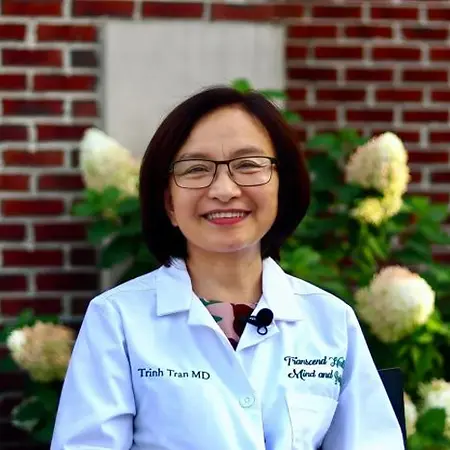
Influential Woman · Rheumatology | Cellular Medicine
Trinh Tran, MD
Rheumatologist and Founder, Transcend Health Mind & Body LLC
Westfield, IN 46062
Her Story
About Trinh
Trinh Tran, MD, is a board-certified rheumatologist based in Carmel, Indiana, with 22 years of experience diagnosing and managing complex autoimmune and musculoskeletal conditions, including rheumatoid arthritis and lupus. Born in Vietnam, she earned her medical degree in London, completed her internal medicine residency at the Medical College of Wisconsin, and trained in rheumatology at Duke University. After several years in conventional practice, she opened her own private practice in 2012, blending evidence-based medicine with individualized care. Her outlook shifted in 2017, when persistent fatigue, joint pain, and other symptoms led her to examine nutrition, supplements, and the effects of chronic stress on the body. These experiences drew her to functional medicine, and then to mindfulness meditation, which she studied under a Buddhist monk before assisting with instruction and learning to teach. She went on to found the Nirodha Mindfulness Center, offering patients meditation education through in-person opportunities, livestreams, and online videos. She also pursued cellular medicine training associated with Dr. William Seeds, which introduced her to emerging approaches such as peptide-related therapies. In 2026, Dr. Tran closed her traditional rheumatology practice to focus on cellular medicine, using anti-inflammatory nutrition, breathing practices that engage the vagus nerve, and root-cause strategies to help patients with autoimmune conditions. Guided by empathy, curiosity, and a belief that patients are more than their diagnoses, she hopes to help people understand their health and take an active role in their well-being.
Her Interview
Ten minutes with Trinh
01What do you attribute your success to?
I attribute my professional growth to perseverance, curiosity, continuous learning, compassion, and a willingness to challenge my own assumptions. My personal health struggles led me to look at areas such as nutrition and stress management, which received limited attention in my conventional medical education. Rather than relying only on familiar approaches, I studied other perspectives and considered how they relate to my patients’ experiences. Remaining open-minded has helped me grow as both a physician and a person, and my own experiences have deepened my empathy for patients living with chronic illness, fatigue, and difficult-to-manage symptoms.
02What’s the best career advice you’ve ever received?
The most meaningful guidance I have received came from my Buddhist master Thich Nguyen Tu who helped me to enrich my spiritual existence, as well as the Buddhist monk Thich Thien Tri who led my mindfulness training. I was uncertain about meditation at first, but I enrolled in an eight-week introductory course and found that it offered a new way to manage stress and build self-awareness. I went on to more advanced instruction and eventually assisted him in teaching. His mentorship inspired my vision of bringing mindfulness practices to patients. I have also been influenced by physicians and educators who study the connection between lifestyle, cellular health, and chronic illness, including the cellular medicine training associated with Dr. William Seeds, and longevity training with Dr. Isaac Jones at Health Expert Alliance.
03What advice would you give to young women entering your industry?
My advice is to stay committed to continuous learning, resilience, compassion, and openness to new perspectives. Professional expertise can keep evolving throughout a career, and I have reconsidered established approaches and pursued new education even after more than two decades in medicine. I encourage those entering healthcare to pay attention to their own well-being and to understand the challenges patients face beyond their diagnoses. A career grounded in both scientific knowledge and empathy, supported by curiosity and perseverance, is a strong foundation.
04What are the biggest challenges or opportunities in your field right now?
I see significant challenges in managing chronic autoimmune conditions, persistent fatigue, and inflammation, as well as in understanding how lifestyle factors affect patient health. I believe conventional care can be complemented by greater attention to nutrition, stress management, and daily habits. There is an opportunity to improve patient education and encourage people to engage more actively in understanding their health. I am also interested in emerging research in cellular medicine and newer therapeutic approaches, and in evaluating and incorporating them responsibly into care.
05What values are most important to you in your work and personal life?
I value compassion, curiosity, perseverance, patient-centered care, education, mindfulness, personal responsibility, and continuous growth. As both a physician and someone who has navigated chronic illness, I believe patients deserve to feel heard and understood. I place particular importance on the broader circumstances that shape a person’s health, including nutrition, stress, and daily habits. I also value staying open to new knowledge and questioning established assumptions when other perspectives may benefit patient care. My meditation practice reflects my belief in self-awareness, emotional balance, and healthier responses to stress.
Join Influential Women and start making an impact. Register now.