
Women in tech often get trapped in supportive roles that render them invisible. This article explores how shifting from offering options to making clear recommendations—both in careers and AI design—transforms how you're perceived and empowers you to lead.
Her Story
About Yamini
My days don't follow a template — and that's exactly why I love this work.
I might start the morning on a customer call, walking a CTO through why their AI-ready landing zone needs a different governance model than what they built for traditional workloads. By mid-morning, I'm deep in Terraform code, designing multi-account architectures that will outlast my engagement. After lunch, I'm coaching a junior consultant through her first customer presentation — helping him/her find the right words for the thing they already know.
Some days I'm troubleshooting a hybrid server at 8 PM because a CloudWatch agent won't authenticate. Other days I'm writing a LinkedIn article about why enterprise AI fails at the data layer, not the model layer. Most days, I'm doing both — and making dinner in between.
I'm a technical delivery leader at AWS Professional Services. I lead enterprise AI and cloud transformation for regulated-industry customers. But if you asked my team what I actually do, they'd probably say: "She makes complex things simple, makes invisible people visible, and asks the question no one else is willing to ask in the room."
Outside of work, I'm a mom to a very opinionated 1-year-old, an amateur gardener who talks to her tomato plants, and the daughter of parents visiting from India who still can't believe I chose a career where I stare at a screen all day. My mom makes better food than any restaurant in Virginia, and my dad takes a walk every morning at 6 AM regardless of weather. They remind me daily that all the architecture in the world means nothing if you don't also build a life worth coming home to.
Her Interview
Ten minutes with Yamini
01What do you attribute your success to?
Curiosity, stubbornness, and the people who gave me chances before I felt ready.
I'm curious enough to take on problems I haven't solved before. I'm stubborn enough to stay with them until they're solved. And I've had people at key moments who said "you should be in that room" when I was still waiting for permission.
Now I try to be that person for others. That's the part I'm proudest of — not what I've built, but who's building because I opened a door.
02What’s the best career advice you’ve ever received?
The best career advice I ever received was to stop waiting for the room to notice you, and build a different room. I learned that I don't have to perform confidence, but I have to be intentional about making my work visible - send the pre-read with my name on it, volunteer to present my own design, follow up with written summaries of decisions so the trail leads back to you. Don't wait to be ready, and being right isn't the job - being effective is. That advice made me influential, because now, because of me, someone else's path actually changed. I'm not talking about one or two people - I'm talking about hundreds of practitioners who benefit from what I did, not in an abstract, inspirational way, but in a concrete, measurable way.
03What advice would you give to young women entering your industry?
Stop rehearsing your readiness. Start before you're ready.
I waited two years before I volunteered to present to a customer. Two years of being "ready next quarter." You know what made me ready? Doing it badly once, surviving, and realizing the bar was lower than I'd imagined. The confidence came after the action, not before. It always does.
Your technical skills are not the problem. Your visibility might be.
Nobody told me this early enough: being excellent in private is a hobby, not a career strategy. Send the pre-read with your name on it. Volunteer to present your own design. Follow up with the summary email so the decision trail has your fingerprints on it. The work doesn't speak for itself — you have to introduce it to the room.
Find the person who opens doors. Then become that person.
Somewhere in your career, someone will say "you should be in that room" before you believe it yourself. Pay attention to that person. Study what they did. Then do it for the next woman behind you — because she's waiting for the same permission you were.
You don't have to be loud. You have to be undeniable.
I grew up in India where the expectation was: work hard, don't boast, let merit speak. That doesn't fully work in corporate rooms — but it doesn't mean you have to become someone you're not. Find your version of visible. For me, it's publishing what I learn, coaching others publicly, and making sure my name is attached to what I build. Quiet and strategic beats loud and scattered every time.
And finally — eat well, sleep enough, and call your mother.
I'm serious. This industry will take everything you give it and ask for more. Guard your energy. The woman who shows up rested and grounded will outlast the one running on caffeine and imposter syndrome every single time. Talking to my parents has solved more career crises than any mentor ever could.
04What are the biggest challenges or opportunities in your field right now?
AI is at a crossroads for women in tech. The risk: we staff AI projects the same way we've always staffed — "5 years experience required" — and lock out an entire generation of capable women before they start. The opportunity: AI tools democratize access to expertise, remove the "confidence performance" penalty, and create entirely new entry points for women from adjacent fields. The question isn't whether AI will change things for women. It's whether we'll be intentional enough to make sure it changes things for the better. I'm building that intentionality into everything I do — inclusive staffing, AI-powered mentorship, and public knowledge-sharing. Because the time to shape who builds AI is now, not after the patterns are set.
05What values are most important to you in your work and personal life?
At work, the most important value for me is democratizing knowledge. I publish my work, internally or externally, so that others can benefit from patterns that are proven, because access to knowledge shouldn't just depend on who you sit next to or which hallway conversation you overheard. I also believe in excellence through inclusion - the best work comes from teams where every voice is heard, not just the loudest. I've been in that boat. Inclusion isn't separate from quality, I believe it is the quality. Personally, family is a foundation for me. I also value leaving the doors open - once I figure out something, like a career path, a technical concept, or the way to be heard, I write it down, teach it, or build a system so that whoever comes behind me doesn't start from zero. They can take up from what I've built. And I always think that presence over perfection is a core personal value - whether I'm reading my daughter a bedtime story or coaching a teammate before a customer call, I choose to be there fully, even when I'm really tired.
Her Content Hub
Articles by Yamini
Stop Assisting. Start Deciding.
From the Assist Trap to Leadership: Why Women in Tech Need to Stop Offering Options and Start Making Decisions
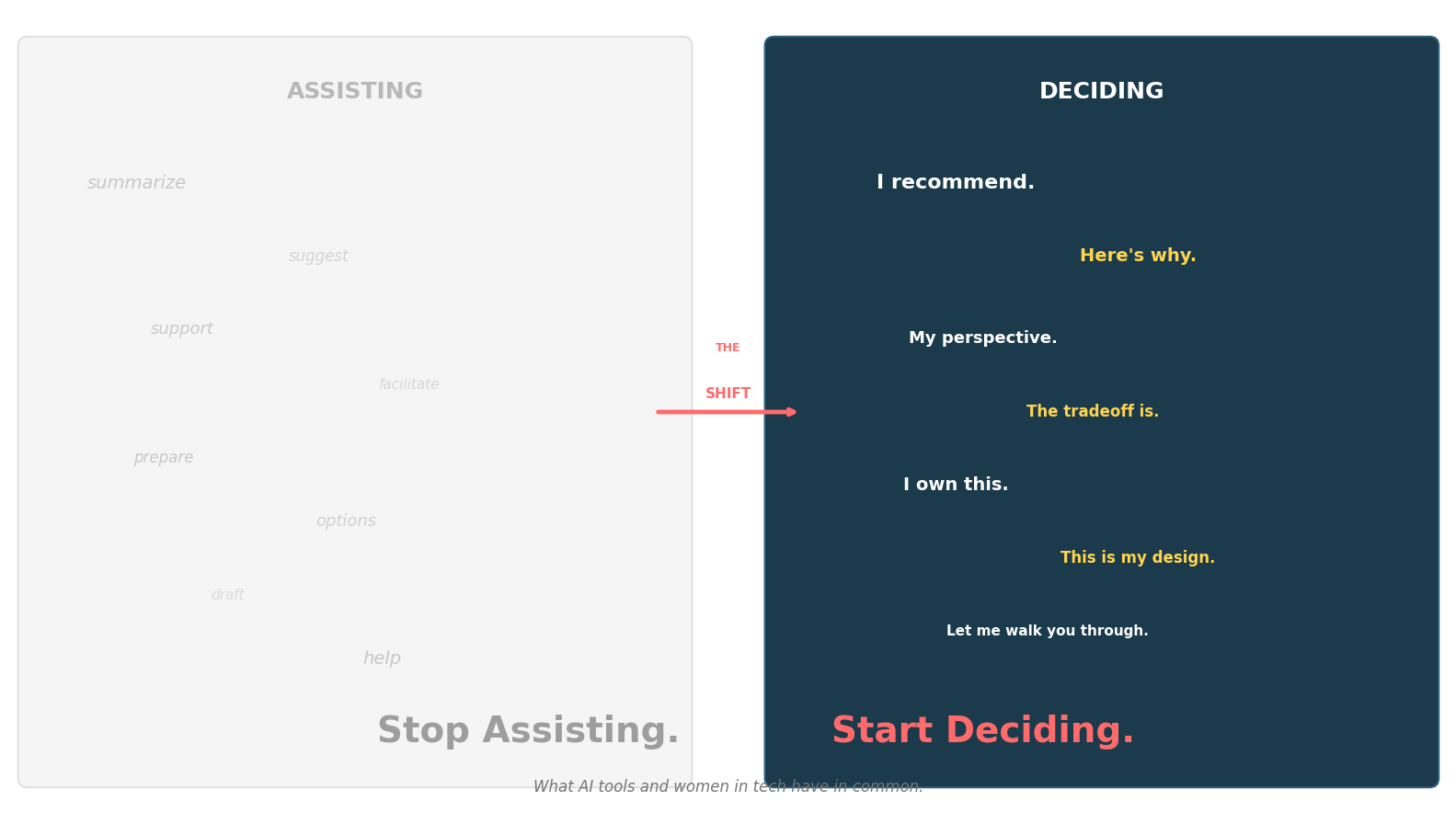
The most popular AI tools in the world are designed to do one thing: assist.
Summarize this. Draft that. Suggest options. Support the decision-maker. Stay neutral. Don’t have an opinion—just present the information and let the human choose.
Sound familiar?
If you’re a woman in a technical role, you’ve probably been cast in that exact mold: support the team, facilitate the meeting, prepare the pre-read for the person who will present it, take notes, offer options, and don’t be too opinionated—just be helpful.
I spent the first several years of my career as the most helpful person in the room. I prepared the best materials. I had the most thorough analysis. I offered three options with trade-offs for every decision. I was everyone’s favorite collaborator.
And I was invisible.
The Assist Trap
Here’s the pattern I’ve seen—in AI products and in women’s careers:
Stage 1: You’re indispensable. Everyone relies on you. The meetings don’t run without your prep. The architecture doesn’t get reviewed without your analysis. The AI tool gets embedded in every workflow because it’s so useful.
Stage 2: You’re invisible. Because you’re positioned as support, nobody attributes the outcome to you. The decision gets credited to the person who states it—not the person who researched, framed, and prepared it. The AI gets used daily, but nobody calls it “the decision-maker.” You get used daily, but nobody calls you “the leader.”
Stage 3: You’re stuck. You’ve built a reputation for being helpful. Helpful doesn’t get promoted. Helpful doesn’t get the technical lead role. Helpful gets asked to “do that thing you do” for the next project too.
AI tools are stuck in this same loop. They summarize brilliantly. They suggest comprehensively. But the ones that break through—the ones that become indispensable in a different way—are the ones that develop a point of view.
“Based on what I see in your data, you should do X. Here’s why.”
Not: “Here are five options for your consideration.”
The Women Who Break Through
Every woman I know who moved from “senior individual contributor” to “technical leader people listen to” made the same shift: they stopped offering options and started stating recommendations.
Not aggressively. Not arrogantly. Just clearly.
“I recommend Option B. Here’s the trade-off. Here’s why it’s worth it.”
That’s it. One sentence. But it changes everything about how the room perceives you. You go from being the person who prepares the decision to the person who makes it.
I remember the first time I said, “I recommend X,” in a customer architecture review instead of, “Here are three options for your consideration.” The room reacted differently. They didn’t ask “why?” the way they used to when I presented options. They asked, “What do we need to do to make that happen?”
The shift wasn’t in my technical skills. It was in my posture. I went from assistant to advisor, from support function to authority.
Build AI the Way You Want to Be Treated
Here’s what’s interesting: the women I work with who’ve made this shift are now building AI products. And they’re building them differently.
They’re not building tools that say, “Here are your options.” They’re building tools that say, “Here’s what I recommend based on everything I’ve analyzed—and here’s my reasoning.”
That’s not just better AI. That’s opinionated AI. AI with a point of view. AI that doesn’t wait to be asked—it tells you what it sees.
We’re uniquely positioned to build this kind of AI because we’ve lived both sides. We know what it feels like to be cast as the assistant. And we know what changes when you stop assisting and start deciding.
We can build AI that does what we wish someone had told us earlier: lead with a recommendation, state it clearly, back it up, and stop apologizing for having a perspective.
The Shift in One Line
The difference between a support function and a leader is one sentence: “I recommend.”
Say it in your next meeting. Build it into your next AI product. Teach it to the next woman on your team.
Stop assisting. Start deciding.
The room is waiting for a point of view. Give it yours.
Join Influential Women and start making an impact. Register now.