Stop Assisting. Start Deciding.
From the Assist Trap to Leadership: Why Women in Tech Need to Stop Offering Options and Start Making Decisions

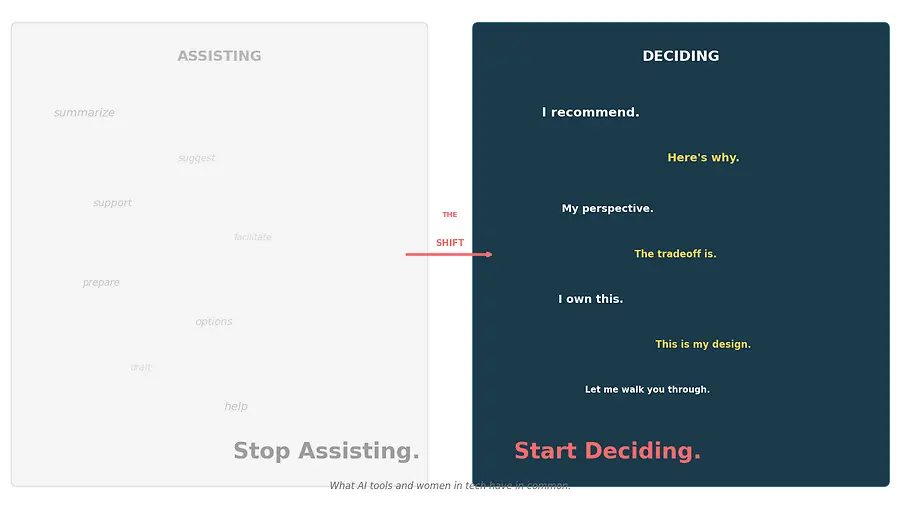
The most popular AI tools in the world are designed to do one thing: assist.
Summarize this. Draft that. Suggest options. Support the decision-maker. Stay neutral. Don’t have an opinion—just present the information and let the human choose.
Sound familiar?
If you’re a woman in a technical role, you’ve probably been cast in that exact mold: support the team, facilitate the meeting, prepare the pre-read for the person who will present it, take notes, offer options, and don’t be too opinionated—just be helpful.
I spent the first several years of my career as the most helpful person in the room. I prepared the best materials. I had the most thorough analysis. I offered three options with trade-offs for every decision. I was everyone’s favorite collaborator.
And I was invisible.
The Assist Trap
Here’s the pattern I’ve seen—in AI products and in women’s careers:
Stage 1: You’re indispensable. Everyone relies on you. The meetings don’t run without your prep. The architecture doesn’t get reviewed without your analysis. The AI tool gets embedded in every workflow because it’s so useful.
Stage 2: You’re invisible. Because you’re positioned as support, nobody attributes the outcome to you. The decision gets credited to the person who states it—not the person who researched, framed, and prepared it. The AI gets used daily, but nobody calls it “the decision-maker.” You get used daily, but nobody calls you “the leader.”
Stage 3: You’re stuck. You’ve built a reputation for being helpful. Helpful doesn’t get promoted. Helpful doesn’t get the technical lead role. Helpful gets asked to “do that thing you do” for the next project too.
AI tools are stuck in this same loop. They summarize brilliantly. They suggest comprehensively. But the ones that break through—the ones that become indispensable in a different way—are the ones that develop a point of view.
“Based on what I see in your data, you should do X. Here’s why.”
Not: “Here are five options for your consideration.”
The Women Who Break Through
Every woman I know who moved from “senior individual contributor” to “technical leader people listen to” made the same shift: they stopped offering options and started stating recommendations.
Not aggressively. Not arrogantly. Just clearly.
“I recommend Option B. Here’s the trade-off. Here’s why it’s worth it.”
That’s it. One sentence. But it changes everything about how the room perceives you. You go from being the person who prepares the decision to the person who makes it.
I remember the first time I said, “I recommend X,” in a customer architecture review instead of, “Here are three options for your consideration.” The room reacted differently. They didn’t ask “why?” the way they used to when I presented options. They asked, “What do we need to do to make that happen?”
The shift wasn’t in my technical skills. It was in my posture. I went from assistant to advisor, from support function to authority.
Build AI the Way You Want to Be Treated
Here’s what’s interesting: the women I work with who’ve made this shift are now building AI products. And they’re building them differently.
They’re not building tools that say, “Here are your options.” They’re building tools that say, “Here’s what I recommend based on everything I’ve analyzed—and here’s my reasoning.”
That’s not just better AI. That’s opinionated AI. AI with a point of view. AI that doesn’t wait to be asked—it tells you what it sees.
We’re uniquely positioned to build this kind of AI because we’ve lived both sides. We know what it feels like to be cast as the assistant. And we know what changes when you stop assisting and start deciding.
We can build AI that does what we wish someone had told us earlier: lead with a recommendation, state it clearly, back it up, and stop apologizing for having a perspective.
The Shift in One Line
The difference between a support function and a leader is one sentence: “I recommend.”
Say it in your next meeting. Build it into your next AI product. Teach it to the next woman on your team.
Stop assisting. Start deciding.
The room is waiting for a point of view. Give it yours.


