
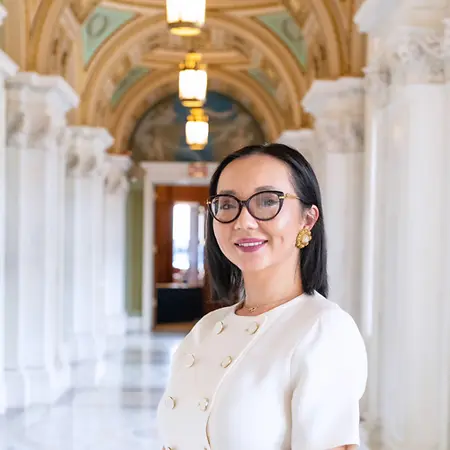
Influential Woman · Geopolitical Risk, Investment Strategy, Energy & Critical Minerals
Elvira Aidarkhanova
Founder and Principal, Steppe Bridge Advisory LLC
Washington, DC 20007
Workplace culture is not created only by leadership, it is shaped every day by how each of us treats the people around us, because even small actions matter.
Elvira Aidarkhanova · In Her Own Words
Her Story
About Elvira
Elvira Aidarkhanova is a Washington, D.C.-based geopolitical analyst, researcher, and entrepreneur with more than a decade of experience in international relations, policy research, and strategic analysis. Originally from Kazakhstan, she has built an international career spanning Central Asia, the United States, and broader Eurasian affairs, bringing a cross-cultural perspective to the complex political and economic challenges shaping today's world.
Her professional expertise focuses on the geopolitical and economic dynamics of Eurasia and the Middle East and North Africa (MENA), particularly the growing connections between these regions and their strategic importance to Western governments, investors, and international businesses. Her areas of specialization include geopolitical risk, investment environments, energy security, critical minerals, international trade, sanctions, regional connectivity, and the evolving relationships among major global powers.
Elvira is the Founder and Principal of Steppe Bridge Advisory LLC, a Washington, D.C.-based boutique geopolitical risk and strategic advisory firm. Through the company, she seeks to bridge the gap between academic research, regional expertise, and practical business decision-making. The firm's mission is to help organizations understand complex political environments, evaluate emerging market opportunities, anticipate geopolitical risks, and develop informed strategies for operating across Eurasia and MENA.
Before establishing Steppe Bridge Advisory, Elvira developed her expertise through academic research, policy analysis, and work with Washington-based research institutions. As a Research Fellow at the Center for the National Interest, she has examined geopolitical developments in Central Asia, relations between the Gulf states and Central Asian countries, international trade corridors, and the broader implications of shifting global economic and political alignments.
Her research and commentary have appeared in publications including The National Interest and The Diplomat, contributing to discussions on regional security, economic integration, foreign policy, and international investment. She believes that rigorous research should not remain confined to academic institutions but should inform real-world decisions and contribute to a deeper understanding of international affairs.
Education has played a defining role in her personal and professional development. She holds bachelor's and master's degrees from Al-Farabi Kazakh National University and has pursued additional international academic opportunities. She is currently an MBA candidate at Boston University's Questrom School of Business, where she is expanding her expertise in business strategy, management, and organizational leadership.
She is also the founder and host of Beyond the Bridge, a podcast developed through Steppe Bridge Advisory that brings together scholars, policy experts, and international affairs professionals to discuss geopolitics, global challenges, and emerging regional developments.
Outside her professional activities, Elvira is a dedicated marathon runner who has completed the Marine Corps Marathon, the New York City Marathon, and the Chicago Marathon. Long-distance running reflects many of the principles that guide her professional life: discipline, resilience, patience, and the determination to continue moving forward despite uncertainty.
Throughout her journey, Elvira has remained committed to lifelong learning, intellectual curiosity, integrity, and service. Her professional philosophy is grounded in the belief that meaningful leadership requires not only knowledge and ambition but also empathy, responsibility, and the courage to pursue new opportunities.
As she continues developing her advisory firm, research initiatives, and philanthropic projects, her broader ambition is to build lasting connections between people, ideas, institutions, and regions while contributing to a more informed, collaborative, and inclusive world.
Her Interview
Ten minutes with Elvira
01What do you attribute your success to?
I attribute my success to education, perseverance, intellectual curiosity, and a willingness to move forward even when the path ahead is uncertain. Throughout my life, I have believed that meaningful achievements rarely happen overnight. They usually result from years of preparation, consistent effort, personal sacrifices, and the determination to keep learning despite setbacks.
Growing up in Kazakhstan and later building a professional career in the United States taught me the importance of adaptability and resilience. Moving between different countries, cultures, and professional environments required me to constantly challenge myself, develop new skills, and become comfortable with uncertainty. These experiences helped me understand that our circumstances do not necessarily define our future; our decisions, discipline, and willingness to grow play an equally important role.
Education has been one of the strongest foundations of my journey. My academic background in history and international relations encouraged me to question assumptions, examine complex issues from multiple perspectives, and appreciate the importance of critical thinking. Over time, I realized that intellectual development is a lifelong process, not something that ends with a university degree.
Another important factor has been my willingness to create opportunities rather than wait for them. Whether pursuing research, contributing to policy discussions, launching my own advisory firm, or developing humanitarian initiatives, I have learned that progress often requires taking calculated risks and stepping outside familiar environments.
I also believe that resilience is closely connected to one's ability to begin again. Not every professional decision leads to immediate success, and not every opportunity develops as expected. However, even difficult experiences can provide valuable lessons and open unexpected doors.
Equally important are the people who have contributed to my journey: teachers, mentors, colleagues, friends, and individuals who have shared their knowledge and perspectives. Their encouragement has reinforced my belief that success is rarely an entirely individual achievement.
Ultimately, I do not view success solely in terms of professional titles, financial accomplishments, or public recognition. For me, success means continuing to grow intellectually, maintaining my independence and integrity, creating something meaningful, and using the opportunities I have been given to make a positive difference in the lives of others.
02What’s the best career advice you’ve ever received?
One of the most valuable pieces of advice I have received is that almost every problem has a solution, even when that solution is not immediately visible. This perspective has profoundly influenced how I approach professional challenges, uncertainty, and decision-making.
Throughout my career, I have encountered situations where circumstances changed unexpectedly, opportunities did not materialize, or the direction I had initially envisioned became difficult to pursue. In those moments, I learned that focusing exclusively on what has gone wrong rarely leads to progress. A more productive approach is to ask what can still be done, what alternatives exist, and what lessons can be taken from the experience.
This advice has been especially relevant in international affairs and entrepreneurship, where uncertainty is often unavoidable. Political developments, economic conditions, institutional priorities, and market environments can change rapidly. Professionals who succeed in such fields must be able to reassess circumstances, adapt their strategies, and make thoughtful decisions without having complete information.
I have also learned that resilience does not mean ignoring difficulties or pretending that every challenge is easy to overcome. Rather, it means maintaining perspective, accepting what cannot be controlled, and concentrating on the actions that remain within our reach.
Another lesson closely connected to this advice is the importance of not allowing fear of failure to prevent action. Many people postpone important decisions because they are waiting for perfect circumstances, complete certainty, or universal approval. Yet some of the most meaningful opportunities emerge precisely when we are willing to move forward despite uncertainty.
Today, whether I am conducting research, developing a new business initiative, or working with international experts, I try to approach challenges with a solution-oriented mindset. I remind myself that a setback does not necessarily represent the end of a journey. Sometimes it simply requires a different strategy, a new perspective, or the courage to begin again.
For me, the most important professional lesson is that persistence, combined with flexibility and sound judgment, can transform obstacles into opportunities for growth.
03What advice would you give to young women entering your industry?
My advice to young women entering international relations, geopolitical analysis, policy research, or strategic consulting is to believe in the value of their knowledge, invest seriously in their education, and never underestimate the importance of their own perspectives.
These fields can be highly competitive and, in certain professional environments, remain traditionally male-dominated. Young women may sometimes find themselves participating in discussions with senior executives, government officials, established scholars, or experienced policymakers. It is natural to feel intimidated in such situations, particularly at the beginning of a career. However, I would encourage them not to confuse limited experience with a lack of potential.
You do not need to know everything before you deserve a seat at the table. What matters is your willingness to prepare thoroughly, ask thoughtful questions, develop expertise, and contribute meaningfully to the conversation.
I strongly encourage young women to develop both intellectual confidence and professional competence. Confidence without preparation can be fragile, while knowledge combined with integrity and clear communication creates lasting credibility. Read widely, follow international developments, study history, understand economic trends, and learn how political decisions affect businesses, institutions, and ordinary people.
Another important piece of advice is to embrace opportunities that may initially seem beyond your comfort zone. Apply for competitive positions, pursue international fellowships, attend conferences, introduce yourself to people whose work you admire, and do not hesitate to express your professional ambitions.
I would also encourage women to cultivate independence in their thinking. In international affairs, it is particularly important to examine issues critically rather than simply repeat dominant narratives. A strong analyst must be able to consider different perspectives, recognize complexity, and form conclusions based on evidence.
Building professional relationships is equally essential. Seek mentors, support other women, and develop networks based on mutual respect and genuine intellectual exchange. Professional success should not be viewed as a competition in which another woman's achievement diminishes your own opportunities.
Finally, I would remind young women that careers are rarely linear. Your interests may evolve, your circumstances may change, and you may discover new ambitions along the way. Do not be afraid to redefine your goals or begin a new chapter.
Above all, remain curious, principled, courageous, and willing to learn. Your background, experiences, and unique perspective can become some of your greatest professional strengths.
04What are the biggest challenges or opportunities in your field right now?
One of the most significant developments in my field is the growing intersection between geopolitics, international business, investment strategy, and economic security. Political developments that were once considered primarily matters of foreign policy are increasingly influencing corporate decisions, supply chains, energy markets, technological development, and international investment.
The global economic environment is becoming more complex as governments and businesses reassess their strategic dependencies, diversify partnerships, and respond to geopolitical competition. Issues such as energy security, critical minerals, sanctions, trade restrictions, emerging technologies, and infrastructure connectivity are now central to both national security discussions and long-term business planning.
For geopolitical analysts and strategic advisers, this creates an important challenge: translating rapidly changing political and economic developments into practical insights that decision-makers can use.
One area that I find particularly important is the growing strategic significance of Central Asia. Countries such as Kazakhstan, Uzbekistan, and their regional neighbors occupy a geographically important position between major economic and political centers. Their natural resources, transportation networks, investment opportunities, and relationships with global powers make the region increasingly relevant to international businesses and policymakers.
Critical minerals represent another major area of opportunity. As countries seek to strengthen supply-chain resilience and expand technologies associated with the energy transition, access to strategically important resources has become a central economic and geopolitical consideration. Central Asia possesses considerable mineral potential, but realizing these opportunities requires an understanding of regulatory environments, infrastructure constraints, political risks, and local market conditions.
At the same time, the growing connections between Central Asia and the Gulf states are opening new possibilities for investment, infrastructure development, energy cooperation, and regional economic diversification. These developments demonstrate how relationships between regions that were previously examined separately are becoming increasingly interconnected.
Another challenge is the speed at which information circulates. Decision-makers have access to an extraordinary volume of news, data, and analysis, yet greater access to information does not always produce better understanding. In an environment shaped by competing narratives, misinformation, and political uncertainty, independent research and sound analytical judgment are especially valuable.
I believe the future of geopolitical advisory work lies in combining deep regional knowledge with economic analysis, business strategy, and practical engagement with local experts. Organizations increasingly need advisers who can explain not only what is happening politically, but also why it matters for investment, operations, partnerships, and long-term strategic planning.
Through Steppe Bridge Advisory, I hope to contribute to this evolving field by connecting regional expertise with the needs of international organizations and translating complex geopolitical developments into informed, actionable perspectives.
Ultimately, I see the greatest opportunity in helping bridge the gap between knowledge and decision-making. In a world characterized by uncertainty and rapid transformation, thoughtful analysis can help institutions recognize risks while identifying possibilities for cooperation, innovation, and sustainable growth.
05What values are most important to you in your work and personal life?
The values that guide both my professional and personal life are integrity, honesty, kindness, generosity, responsibility, and respect for human dignity. I believe these principles form the foundation of meaningful relationships, responsible leadership, and lasting achievement.
Integrity holds particular significance for me because trust is at the heart of every successful relationship, whether personal or professional. In research, consulting, and international affairs, credibility depends not only on knowledge and expertise but also on intellectual honesty, transparency, and the courage to remain truthful, even when doing so is difficult or inconvenient.
I have always believed that professional success should never come at the expense of one's principles. A reputation takes years to build, yet it can be compromised in a moment. For this reason, I strive to approach my work with a strong sense of ethical responsibility, recognizing that the decisions we make and the advice we offer can have consequences far beyond ourselves.
Kindness is another value I hold especially close to my heart. In competitive professional environments, kindness is sometimes mistaken for weakness. I see it as a reflection of inner strength, emotional maturity, and confidence. Treating others with compassion, patience, and respect does not diminish one's authority; rather, I believe it strengthens the foundation of genuine leadership.
I also believe that how we treat those who have nothing to offer us in return reveals far more about our character than how we interact with people of influence or authority. Every individual deserves to be treated with dignity, regardless of their background, circumstances, or position in society. Titles and achievements may distinguish our professional roles, but they should never determine the respect we extend to one another.
Generosity and service are equally important to me. I believe that true success becomes more meaningful when it enables us to uplift others, share knowledge, and create opportunities beyond ourselves. Whether through mentorship, education, professional collaboration, or simple acts of kindness, each of us has the ability to make a positive difference in another person's life. Sometimes, even the smallest gesture of encouragement can have a lasting impact.
Education and lifelong learning are also central to my personal philosophy. Intellectual curiosity encourages humility by reminding us that there is always more to discover, understand, and appreciate. It allows us to challenge our assumptions, embrace different perspectives, and recognize the richness of human experiences beyond our own.
I also deeply value perseverance and humility. Life inevitably brings uncertainty, disappointment, and challenges that test our strength and convictions. I believe that what ultimately defines us is not the absence of difficulties but the grace, courage, and determination with which we respond to them. Every experience, including the most difficult ones, offers an opportunity to grow in wisdom, empathy, and understanding.
To me, leadership is not simply about authority, recognition, or professional accomplishments. It is about inspiring trust, remaining faithful to one's principles, taking responsibility for one's actions, and recognizing the humanity in others. The most meaningful leaders are not necessarily those who hold the highest positions, but those whose presence, decisions, and actions leave a positive and lasting impression.
In a world that often feels increasingly divided and uncertain, I believe that our accomplishments matter, but the way we treat one another matters just as much. Ultimately, I hope to be remembered not only for what I have accomplished, but also for the kindness I have shown, the opportunities I have created, and the positive difference I have made in the lives of others.
Join Influential Women and start making an impact. Register now.