How Directors Navigate Product vs Engineering Tension
Turning Functional Friction into Enterprise Strength

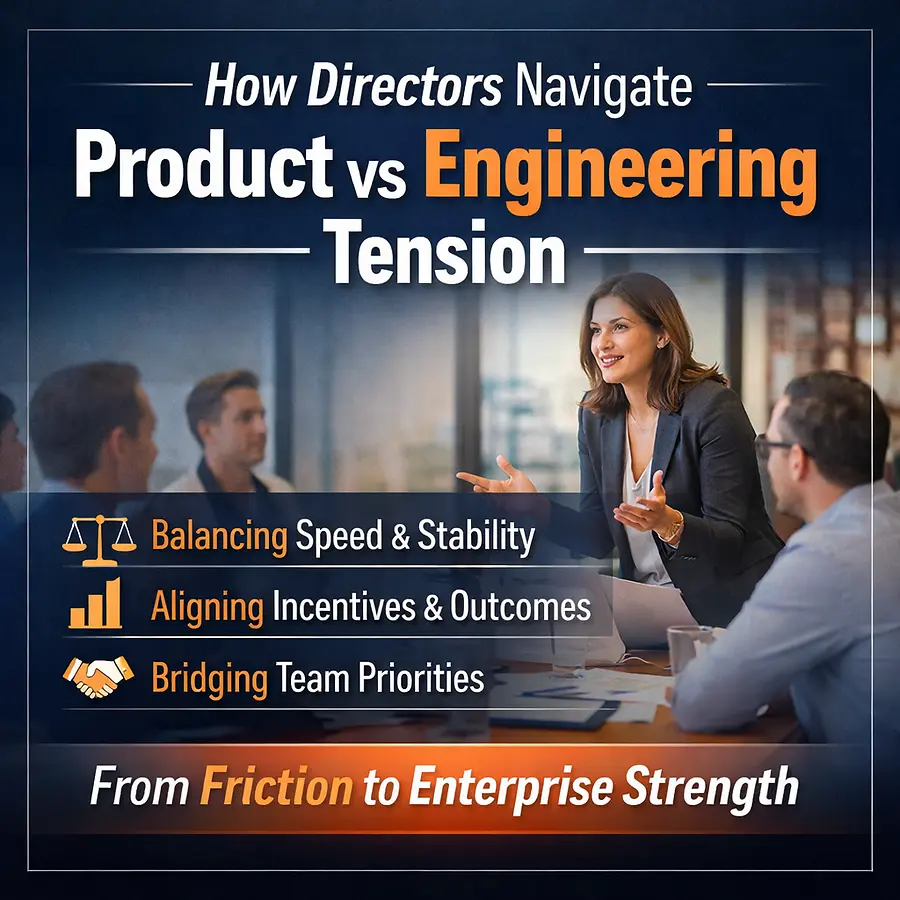
In growing organizations, tension between Product and Engineering is inevitable.
Product pushes for speed, differentiation, and customer impact.
Engineering pushes for stability, scalability, and technical integrity.
At the Director level, the role is not to eliminate this tension.
It is to channel it.
Because when managed correctly, this friction becomes a strategic advantage.
Why the Tension Exists
Different Incentives, Different Pressures
Product organizations are often measured by:
- Revenue growth
- Feature adoption
- Competitive positioning
- Time-to-market
Engineering organizations are measured by:
- System reliability
- Security and compliance
- Technical debt management
- Delivery predictability
Neither is wrong. Both are essential.
The tension arises when these incentives are not structurally aligned. Directors must recognize that most conflict at this level is systemic—not personal.
Time Horizon Misalignment
Product frequently operates in quarterly cycles, driven by customer commitments and market windows.
Engineering operates in architectural timelines that span years.
Shipping quickly can accelerate revenue—but it can also compound technical debt.
Building perfectly can protect systems—but it can also slow competitive momentum.
Directors bridge this divide by structuring phased delivery models:
- Release in increments.
- Pair new feature launches with stabilization cycles.
- Budget time for refactoring as part of roadmap planning—not as an afterthought.
The question is not “speed or stability.”
It is “how do we responsibly balance both?”
Language and Framing Gaps
Product speaks in customer value:
“This feature drives $5M ARR.”
Engineering speaks in risk exposure:
“This dependency increases system fragility.”
Both are accurate assessments through different lenses.
Directors translate between these lenses—connecting revenue opportunity to architectural impact, and technical constraint to financial risk.
When translation improves, trust increases.
The Director’s Strategic Role
Directors do not referee arguments.
They design operating models that reduce recurring friction.
1. Anchor Decisions in Enterprise Outcomes
Instead of asking, “Who is right?” Directors ask:
- What enterprise objective are we optimizing?
- What is the cost of delay?
- What is the cost of instability?
- What risk profile are we willing to accept?
By elevating the conversation to business outcomes, Directors move discussions from emotion to economics.
2. Make Tradeoffs Explicit
Unspoken tradeoffs create resentment.
Strong Directors quantify impact:
- Capacity models
- Risk scoring
- Incident probability analysis
- Revenue implications
- Opportunity cost assessments
Rather than saying, “We can’t do both,” they present scenarios:
“If we accelerate Feature X, we increase delivery risk by Y%. Are we comfortable with that tradeoff?”
Clarity reduces politics. Data reduces defensiveness.
3. Build Shared Accountability
Misalignment persists when ownership is siloed:
- Product owns roadmap.
- Engineering owns delivery.
- No one jointly owns outcomes.
Directors correct this by implementing:
- Shared OKRs
- Joint roadmap reviews
- Cross-functional planning cadences
- Transparent capacity dashboards
- Clear escalation pathways
Alignment must be structural, not emotional.
4. Protect Engineering Without Enabling Rigidity
Engineering teams often absorb pressure quietly—until burnout or system instability surfaces.
Directors ensure:
- Dedicated refactoring cycles
- Measured technical health KPIs
- Investment in platform modernization
- Realistic velocity expectations
At the same time, maturity requires distinguishing between legitimate architectural risk and over-engineering. Sustainable systems require discipline—not perfection.
5. Protect Product Without Enabling Chaos
Product leaders face intense commercial pressure. Directors support them by ensuring:
- Feasibility validation before commitments
- Clear definitions of done
- Guardrails around scope expansion
- Transparent delivery forecasting
Speed without structure creates volatility.
Structure without agility creates stagnation.
Effective Directors protect both.
Advantages of Healthy Tension
When navigated well, Product–Engineering tension produces:
- Better prioritization discipline
- Increased risk visibility
- Stronger cross-functional trust
- Higher delivery predictability
- More resilient architecture
- Improved executive confidence
Healthy friction sharpens organizations.
When Directors Fail to Manage It
When tension becomes politicized or ignored:
- Engineering disengages
- Product overpromises
- Roadmaps destabilize
- Technical debt compounds
- Blame culture emerges
- Executive trust erodes
At Director level, unmanaged friction becomes enterprise risk.
The Executive Mindset Shift
The transition from senior manager to Director is defined by this evolution:
You stop solving for individual deliverables.
You start solving for systemic patterns.
The question is no longer:
“How do we get this release out?”
It becomes:
“What operating model prevents this recurring conflict?”
Directors institutionalize clarity.
They normalize healthy tension.
They design governance that aligns incentives with outcomes.
They understand that collaboration is not about agreement.
It is about disciplined alignment in service of the enterprise.