How Engineering Changes Directly Influence Material Planning in Manufacturing
From ECR/ECO to BOM, MRP, and the shop floor—why tight alignment prevents shortages, scrap, and schedule slips.

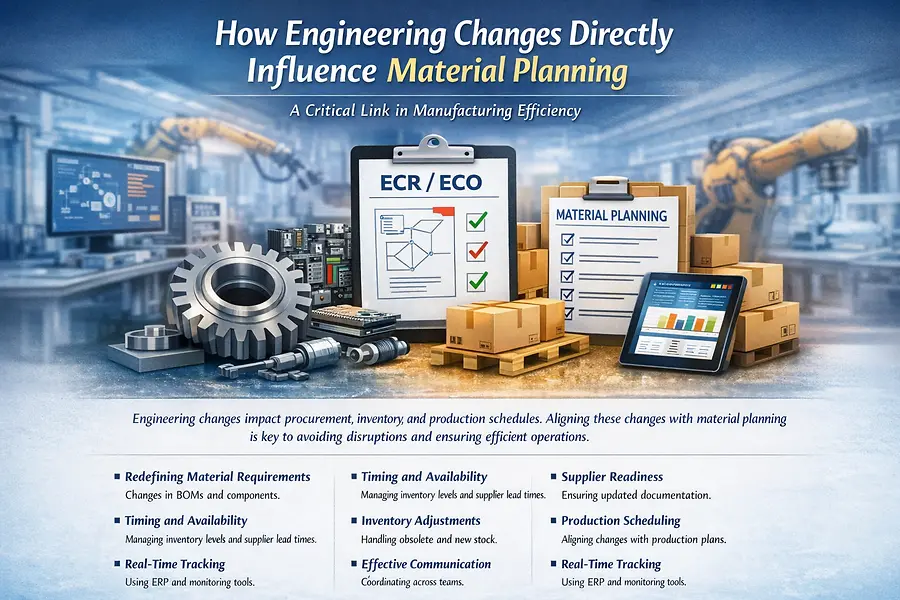
1) The Immediate Link: ECR/ECO → BOM → MRP
Every Engineering Change Request (ECR) or Engineering Change Order (ECO) ultimately updates the Bill of Materials (BOM). Once the BOM version changes, MRP recalculates requirements, lead times, and planned orders. If material planning isn’t synchronized to that cutover, planners may buy obsolete parts or miss new components entirely.
Key actions
- Version‑control the BOM and routings; tie each change to a unique effectivity (date, serial, or lot).
- Trigger MRP regeneration and pegging analysis immediately after approval.
- Communicate “last‑time‑buy” and “first‑article” needs to procurement and suppliers.
2) Choosing the Right Cut‑In Strategy
The timing of a change determines exposure and risk. Typical effectivity options:
- Date‑based (e.g., effective March 1): simple to administer, higher risk of mixed inventory.
- Serial/lot‑based: better traceability, suits regulated industries.
- Breakpoint/consumption‑based: implement when legacy inventory is consumed—minimizes scrap but may delay benefits.
Planner checklist
- Quantify on‑hand, on‑order, WIP, and pipeline inventory for both old and new parts.
- Align production schedule so the changeover coincides with a natural lull or model-year shift.
- Secure capacity for rework or retrofit if needed.
3) Managing Obsolescence and Financial Exposure
Engineering changes can strand legacy stock. A proactive plan avoids write‑offs:
- Run‑out plans: pull‑ahead production to consume remaining parts if feasible.
- Supplier returns/credits: negotiate RTV or repurposing; check MOQs and NCNR clauses.
- Disposition rules: re‑grade as service spares, secondary markets, or controlled scrap with cost tracking.
Metrics to watch
- Obsolescence exposure ($) at approval vs. actual realized ($) at closure.
- % of changeovers executed with zero line‑stops.
- Inventory turns for superseded vs. new parts.
4) Supplier Readiness Is a Gate, Not a Footnote
Suppliers cannot ship conforming material until they receive:
- Final drawings/specs, PPAP/FAI criteria, and updated control plans.
- New packaging/label standards and part numbers.
- Confirmed lead times, safety stock targets, and logistics instructions.
Best practices
- Issue change packages via supplier portals with acknowledgment tracking.
- Use readiness checklists (tooling, capacity, quality approvals, APQP milestones).
- Time‑phase purchase orders so incoming receipts match the effectivity window.
5) Data Discipline: The Backbone of Smooth Changeovers
Discrepancies between engineering, planning, and purchasing data create shortages or overbuys.
Control points
- Single source of truth for part attributes (unit of measure, yield, lead time, MOQ, ABC class).
- Automatic where‑used analysis to identify all products and service SKUs impacted.
- Change‑linked MRP exceptions and dashboards (late changes, open POs to superseded parts, unqualified alternates).
6) Cross‑Functional Cadence That Works
Successful organizations operate a predictable rhythm from proposal to closure:
- Impact assessment (engineering, planning, procurement, finance, quality).
- Business case (cost, timing, customer/ regulatory needs).
- Approval & effectivity (define breakpoint, serialization, labeling).
- Supplier enablement (samples, PPAP/FAI, capacity sign‑off).
- Cutover execution (inventory disposition, PO changes, line trials).
- Post‑implementation review (metrics, lessons learned, residual clean‑up).
7) Digital Enablers That Reduce Risk
- ERP/MES integration for instant BOM revision roll‑down and work‑center instructions.
- Change‑workflow tools for status visibility and accountability.
- Advanced planning & simulation to model demand, lead times, and constraint impacts before go‑live.
- Traceability (lot/serial genealogy) to segregate pre‑ and post‑change outputs and simplify audits.
Conclusion
Engineering changes and material planning are two halves of the same discipline. Treating change effectivity as a supply chain event—not just a design decision—prevents shortages, curbs obsolescence, and protects customer commitments. With disciplined data, supplier readiness, and clear breakpoints, organizations turn change into a competitive edge.