
A Full Calendar Is Not a Full Life
Learn to close the gap between your packed schedule and a meaningful life by questioning urgency and reclaiming what actually matters.

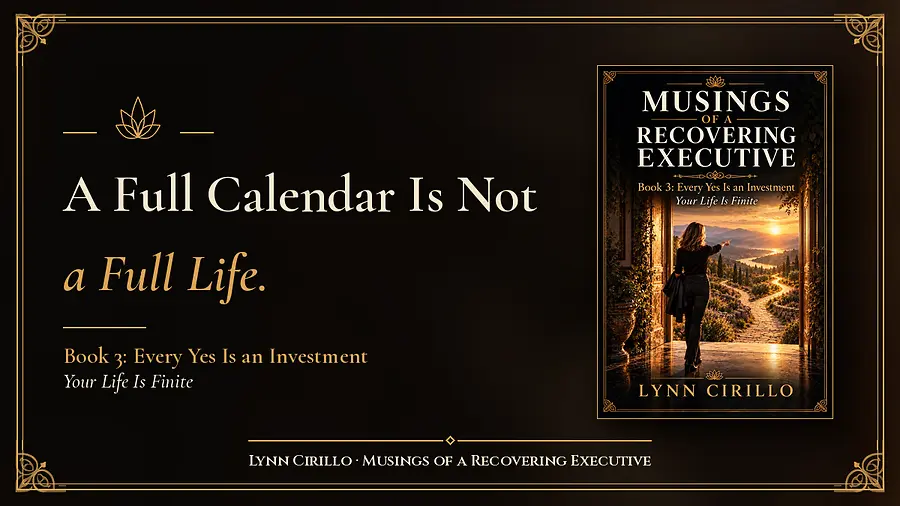
A Full Calendar Is Not a Full Life
Urgency quietly decides where our lives go. Here's how to notice it, measure what actually matters, and take your days back.
By Lynn Cirillo
For years, I thought I was getting better at managing my time. Better calendars, better systems, better routines. Some of it genuinely helped, and I still appreciate a good system.
What changed wasn't my calendar. It was the question I started asking.
I had become very good at managing my time. I was not nearly as intentional about how I was spending my life. Those sound like the same thing. They aren't. In my book Every Yes Is an Investment, I put it this way: "The calendar measures your time. Only you can measure your life."
This article is about the gap between those two things, why so many workplaces widen it, and what any of us can do to close it. It's for everyone, not just people who run teams. If you have a calendar, this is about you.
First, Some Validation
If you've ever finished a packed day, every box checked, and still felt like you weren't really there for any of it, that feeling deserves validation. You're not ungrateful, and you're not bad at your job. You're noticing something real.
Most of us were taught to read a full calendar as proof that we matter. Busy meant needed, and needed meant valuable. In my book's Musing, I describe what I'm still recovering from: "The belief that every hour needs to produce something visible before it counts."
That belief didn't come from nowhere. It was rewarded, often for years. So if you're tired of it, that isn't a character flaw. It may be the first honest signal you've had in a while.
You Can't Save Time
We talk about "saving time" constantly. But as I wrote, "I've never been able to save an hour." None of us can. We can only decide how to spend it. Once an hour is lived, it becomes part of our story for good.
That changes what a yes actually is. A commitment doesn't simply occupy a slot on a schedule. It occupies a piece of a life you will never get to live again. The question stops being "Do I have an hour for this?" and becomes, in the book's words, "I'm deciding whether it deserves a piece of my life."
I don't find that heavy. I find it freeing. Once you start looking at your life instead of just your schedule, some things stay exactly the same, and others quietly disappear. Not because they were bad, but because they no longer fit the life you're trying to build.
Urgency Was Never Elected
When I stepped away from my executive career, one of the biggest surprises wasn't the free time. It was "noticing how much of my life had been organized around urgency."
Urgency is persuasive. There's always something that needs an answer, a fix, or a decision right now. And "urgency has a way of making everything else seem less important." Nobody votes for it. It just takes the chair at the head of the table and starts running the meeting.
Most of us know the difference between urgent and important. The trouble is that urgency doesn't introduce itself as urgency. It shows up looking like responsibility, like being a good teammate, like caring. That's why it wins so often and why the things that matter most, such as thinking time, rest, real conversation, and the people we love, keep getting rescheduled.
What This Looks Like Inside Organizations
Individuals don't invent urgency culture on their own. Workplaces build it, usually without meaning to.
They measure what's visible. Calendars, response times, meeting attendance, and finished task lists are easy to count. Judgment, presence, a well-timed conversation, and the problem that never happened because someone had space to think are not. So we reward the countable, and people learn to look busy.
They treat speed as care. When the fastest reply earns the most trust, everyone starts answering everything immediately. The real deadline was often next week. The habit spends people's attention today.
They let "everything is a priority" stand. When every request is labeled urgent, the label stops meaning anything, and the people most willing to absorb it carry the most.
They confuse presence with attendance. Someone can sit in every meeting and be mentally somewhere else in all of them. Organizations rarely ask whether people had enough margin left to actually think, listen, or be patient. That margin is where good work comes from.
None of this requires bad intentions. It only requires a system that counts hours and assumes the life inside them will take care of itself.
The Spent-Well Test
Here's the framework I now use, built from the questions at the end of Chapter 7. It's four quick checks you can run on a single commitment, a week, or a whole team's habits. Each check swaps a time question for a life question.
1. The Afterward Check. Not "Is this urgent?" but "Will this still feel important afterward?" The book asks, "What do you currently make time for because it feels urgent but rarely feels important afterward?" If the honest answer is "this," it's a candidate to shrink, delay, or drop.
2. The Enriched-or-Occupied Check. Not "Did I get it done?" but "Did it enrich my life, or just occupy it?" Look back over the past month. Some commitments gave you energy, learning, or connection. Others just filled space. Both can be necessary, but only one deserves to keep growing.
3. The Presence Check. Not "Was I there?" but "Was I actually present?" One of my favorite questions in the book is simple: "Who receives your presence, not just your time?" If the answer is "almost no one," the schedule is too full, no matter how well it's organized.
4. The Visible-or-Valuable Check. Not "What did this produce?" but "Does this matter even if nothing measurable comes from it?" Some of the most valuable hours produce nothing you could put in a report. They don't advance anything. They simply become part of a life worth having lived.
If a commitment fails all four checks, it isn't a responsibility. It's a habit with good branding.
Practices You Can Start This Week
Change your end-of-day question. Instead of "What did I accomplish?" try the question I now ask myself: "How did I spend my life today?" The answers won't always match. That gap is useful information.
Read your calendar like a stranger would. The book asks, "If someone looked only at your calendar, what story would they tell about your life?" Look at last week with that question in mind. Then ask whether that story feels complete.
Ask "by when, really?" Before treating a request as urgent, ask for the actual deadline. Many "right now" requests turn out to be "by Friday." That difference is hours of your life.
Protect one unproductive block. Put something on your calendar that has no output: a walk, music, or a conversation with nowhere to be. If it feels irresponsible, notice that. That feeling is the old belief talking.
Run a monthly enriched-or-occupied review. Once a month, list your recurring commitments and mark each one. Keep the enriching ones. Question the occupying ones. You don't have to cut everything; you just have to stop renewing things on autopilot.
If You Lead, Coordinate, or Influence Anyone
You don't need a title to shape someone else's urgency. Anyone who sends a request does.
Label urgency honestly. Say when something is genuinely time-sensitive, and say so when it isn't. "No rush, next week is fine" may be one of the kindest sentences in the workplace.
Stop rewarding the fastest reply. Notice who thinks well, not just who answers first.
Ask about presence, not just progress. In one-on-ones or check-ins, ask, "What's crowding out the work that matters most to you?" Then actually help clear some of it.
Model it out loud. When you protect thinking time, come home a little earlier, or close the laptop, say so. People rarely give themselves permission that their leaders and peers don't visibly use.
The Ordinary Days Count
The choices that shape a life are rarely dramatic. They're ordinary decisions made over and over: taking one more meeting, missing one more dinner, picking up the phone, putting it down, and listening.
Other people will have opinions about how you spend your days. As I wrote in Chapter 8, "Other people can offer perspective. They don't have to live the outcome. I do." So do you.
Here's the hope I want to leave you with. You don't need a sabbatical, a career change, or a perfect system to start spending your life on purpose. You need a different question and the willingness to listen to the answer. "A full life and a full calendar are not the same thing." Sometimes they overlap. When they don't, you're allowed to choose the life.
I spent years learning how to run organizations. As the book puts it, "I learned how to manage companies. Life taught me how to steward myself." It's never too late to learn the second one.
So, a final question to sit with, straight from the book: "If your calendar disappeared tomorrow, what would still tell the story of your life?"
Every Yes Is an Investment is the third book in my Musings of a Recovering Executive series. It's about boundaries, capacity, and choosing where your yes goes, with Investment Questions at the end of every chapter. You can learn more at https://MusingsOfaRecoveringExecutive.com/books/every-yes-is-an-investment/.
About the Author
Lynn Cirillo is an author, leadership mentor, and founder of Grounded Leadership LLC, based in Cheyenne, Wyoming. She lives with ADHD, OCD, and dyslexia and writes the six-book Musings of a Recovering Executive series about leadership, identity, boundaries, reinvention, neurodiversity, and reclaiming confidence after difficult workplaces. Learn more at https://MusingsOfaRecoveringExecutive.com/.

Lynn Cirillo is an author, leadership mentor, and Founder and Principal of Grounded Leadership, LLC in Cheyenne, Wyoming. She brings nearly 40 years of professional experience across commercial real estate, corporate operations, research, and technology. Her six-book nonfiction series, Musings of a Recovering Executive, explores the journey from burnout and reinvention to boundaries, identity, neurodiversity, and…





