A Hotter Planet, A Sicker World
How rising temperatures are expanding disease risks and why clean, reliable power is essential to public health.

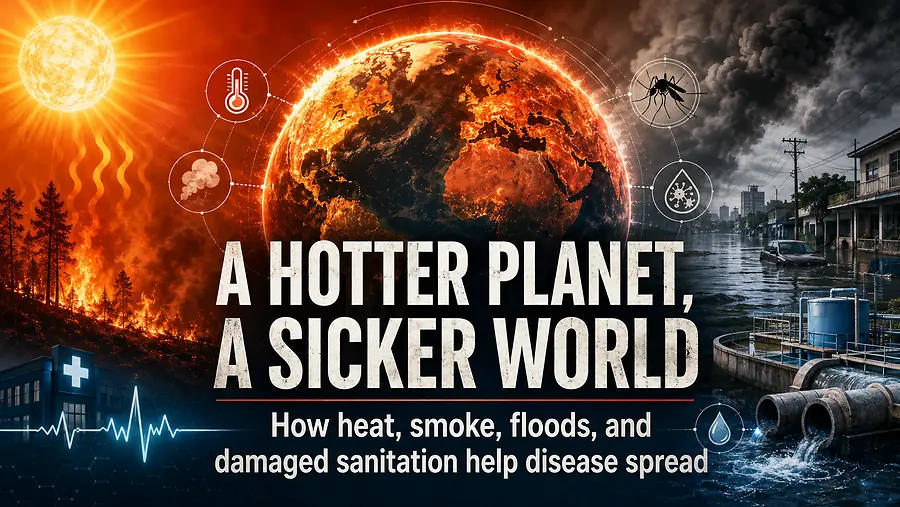
Climate Change Is Changing the Conditions in Which Disease Spreads
Climate change is not only changing the weather.
It is changing the conditions in which disease spreads.
That may be one of the most personal and frightening parts of an overheating planet. Heat waves, wildfire smoke, floods, droughts, damaged water systems, food contamination, and expanding mosquito habitats are not separate problems. They are connected health risks.
A hotter planet can become a sicker world.
We are used to thinking of climate change as something measured in degrees, sea levels, ice loss, storm damage, or acres burned by wildfires. Those are all important. But climate change is also measured in asthma attacks, heatstroke, contaminated drinking water, diarrhea, mosquito-borne disease, respiratory illness, hospital overload, and communities struggling to recover after disasters.
That is why public health must be part of the climate conversation.
The World Health Organization says climate change is already affecting health through more frequent extreme weather events, disrupted food systems, increases in food-, water-, and vector-borne diseases, zoonotic diseases, and mental health impacts. WHO estimates that between 2030 and 2050, climate change is expected to cause approximately 250,000 additional deaths per year from malnutrition, malaria, diarrhea, and heat stress alone. (World Health Organization)
Those are not abstract numbers.
They are real people.
They are warning signs.
Heat Is a Health Threat
Heat is the most direct climate-health danger.
Extreme heat stresses the body's ability to cool itself. When the body cannot release heat quickly enough, the heart, kidneys, lungs, brain, and other organs come under strain. Heat can worsen cardiovascular disease, asthma, diabetes, kidney disease, mental health conditions, and pregnancy-related risks. Heatstroke can become a medical emergency very quickly.
WHO's updated heat-and-health fact sheet calls heat an important environmental and occupational health hazard and notes that heat stress is a leading cause of weather-related deaths. It also warns that heat can worsen underlying illnesses and may increase the risk of accidents and the transmission of some infectious diseases. (World Health Organization)
Heat also changes behavior and puts additional pressure on infrastructure.
People crowd into cooling centers. Hospitals see more emergency visits. Outdoor workers face greater danger. Schools, nursing homes, prisons, and low-income housing become risk points when cooling is inadequate. Power outages during heat waves can become deadly.
And heat does not act alone.
High temperatures dry vegetation and increase wildfire danger. They can warm water and affect pathogen growth. They can increase demand for air conditioning, placing additional stress on the electric grid. They can worsen air pollution and turn a manageable illness into a serious one.
In public health, heat is not just weather.
It is a force multiplier.
Wildfire Smoke Travels
Wildfire smoke is another growing health threat.
Fires may burn in one region, but smoke can travel hundreds or even thousands of miles. People far from the flames may breathe polluted air for days. Children, older adults, pregnant women, outdoor workers, and people with asthma, heart disease, or lung disease are especially vulnerable.
Wildfire smoke contains fine particles and toxic pollutants that can penetrate deep into the lungs. WHO describes wildfire smoke as a mixture of hazardous pollutants, including fine particulate matter, nitrogen dioxide, ozone, aromatic hydrocarbons, and even lead. WHO also notes that wildfires can disrupt transportation, communications, water supplies, power, and gas services. (World Health Organization)
That means wildfire is not just a fire problem.
- It is a respiratory problem.
- A heart problem.
- A school problem.
- A work problem.
- A hospital problem.
- A power problem.
- A water problem.
Smoke can trigger asthma attacks, worsen chronic obstructive pulmonary disease, increase cardiovascular stress, and send vulnerable people to emergency rooms. It can keep children indoors, close schools, interrupt travel, and reduce opportunities for outdoor work. It can also combine with heat to create especially dangerous conditions.
A hotter planet produces more of these overlapping risks.
Floods Spread More Than Water
Flooding is often described in terms of property damage.
But floodwater can also carry disease.
Heavy rainfall and flooding can overwhelm storm drains, sewers, septic systems, wastewater treatment plants, and drinking-water infrastructure. Floodwater can mix with sewage, animal waste, chemicals, fuel, and debris. Wells can become contaminated. People cleaning up after floods can be exposed to pathogens, mold, injuries, and hazardous materials.
A 2026 review in Nature Reviews Microbiology explains that climate-influenced temperature, heavy rainfall, flooding, drought, and extreme weather can affect the biology and transmission of waterborne pathogens, especially those spread through the fecal-oral route. The review also emphasizes the importance of water, sanitation, hygiene, vaccination where available, and enhanced surveillance to reduce climate-related disease risks. (Nature)
This matters because climate change is intensifying the water cycle.
In some places, drought dries soils and reduces water supplies. In others, heavy rainfall overwhelms infrastructure. Sometimes both occur in the same region at different times: drought followed by intense rain, or flooding followed by contaminated standing water.
Both extremes can raise health risks.
- Too little water can make hygiene more difficult.
- Too much water can spread contamination.
- Damaged sanitation systems can turn a weather disaster into a disease outbreak.
Food Safety Is Part of Climate Health
Foodborne illness is another piece of the picture.
Warmer temperatures can affect how pathogens survive, grow, and spread. Heavy rains and floods can contaminate fields. Drought can increase reliance on irrigation water of varying quality. Long supply chains can carry contaminated food across many states or countries before an outbreak is recognized.
The recent Cyclospora outbreak is a reminder of how quickly foodborne illness can become a public health concern.
Cyclospora is a parasite that causes cyclosporiasis, an intestinal illness often associated with contaminated fresh produce. Cyclosporiasis can cause watery diarrhea, fatigue, loss of appetite, abdominal cramping, nausea, and other gastrointestinal symptoms.
Recent U.S. reports describe a large cyclosporiasis outbreak linked to contaminated lettuce, with cases across multiple states and hundreds of hospitalizations reported in some accounts. Reuters reported that Michigan health officials eased lettuce warnings after new cyclosporiasis reports declined, while still advising consumers to avoid recalled lettuce. The state had reported more than 12,000 cases, 279 hospitalizations, and two deaths involving people with underlying health conditions. (Reuters)
No single outbreak should be casually attributed to climate change. Foodborne disease is affected by farming practices, water quality, sanitation, inspection, transportation, processing, refrigeration, and reporting systems.
But climate change can stress all of those systems.
More heat, flooding, drought, and extreme weather can increase the chances that contamination occurs, spreads, or becomes more difficult to control. Food safety must now be part of climate resilience.
Mosquitoes and Ticks Follow Conditions
Vector-borne diseases are another major concern.
A vector is a living carrier, such as a mosquito, tick, or flea, that can transmit pathogens from one host to another. Mosquitoes can spread diseases such as dengue, malaria, Zika, chikungunya, yellow fever, West Nile virus, and others. Ticks can spread Lyme disease and other infections.
Chikungunya, for example, is a mosquito-borne viral disease that can cause sudden fever and severe joint pain. It is usually not fatal, but it can be debilitating, and it is one of the diseases public health agencies monitor as mosquito habitats and transmission seasons shift.
Climate affects vectors because temperature, rainfall, humidity, standing water, vegetation, and seasonal patterns influence where mosquitoes and ticks can survive and reproduce.
WHO says climate change substantially affects pathogens, vectors, and reservoir hosts, with implications for the transmission of many vector-borne diseases. WHO also notes that major outbreaks of dengue, malaria, chikungunya, yellow fever, and Zika have overwhelmed health systems in many countries. (World Health Organization)
The CDC also notes that a changing climate influences the geographic distribution and seasonality of vector-borne diseases. (CDC)
This does not mean every mosquito season will be worse everywhere.
Disease transmission is complicated. It depends on local climate, mosquito control, housing, screens, air conditioning, public health surveillance, travel, sanitation, healthcare access, and human behavior. Very high temperatures can even reduce mosquito survival in some circumstances.
But the overall warning is clear: as climate zones shift, disease risk can shift too.
Warmer winters may allow some vectors to survive in places where they once could not. Longer warm seasons can lengthen transmission windows. Heavy rains can create breeding sites. Drought can lead people to store water, which can also create mosquito habitat if containers are left uncovered.
Climate change does not act alone.
It changes the playing field.
El Niño Adds Another Layer
This year's El Niño makes the health story even more urgent.
El Niño is a natural climate pattern, but it is now operating in a warmer world. PAHO and WHO's 2026–2027 public health situation analysis for El Niño in the Americas warns that El Niño-related climate anomalies may increase risks of vector-borne, water-borne, and food-borne diseases; heat-related illness; wildfire-associated respiratory impacts; food insecurity; displacement; and disruptions to health services. (PAHO)
That is exactly the kind of overlapping risk we need to understand.
El Niño can shift rainfall patterns. Some regions may become drier, increasing drought and wildfire risk. Others may become wetter, increasing flooding and standing water. Heat can intensify. Food systems can be disrupted. Health services can be stretched.
Again, the danger is not one single effect.
It is the combination.
- Heat plus smoke.
- Floods plus sewage.
- Drought plus poor hygiene.
- Standing water plus mosquitoes.
- Food disruption plus poverty.
- Power outages plus extreme heat.
- Disaster displacement plus limited healthcare.
That is how climate stress becomes public health stress.
Health Infrastructure Needs Power
The connection to energy is direct.
A hotter, sicker world needs reliable electricity.
Hospitals need power for operating rooms, intensive care, oxygen, refrigeration, sterilization, dialysis, electronic records, and emergency care. Clinics need power for vaccines, medicines, lighting, communications, and diagnostics. Water systems need power for pumping, treatment, and wastewater management. Cooling centers need power during heat waves. Food systems need refrigeration. Public health agencies need surveillance, communication, and data systems.
When electricity fails during a heat wave, flood, wildfire, or disease outbreak, health risks rise quickly.
That is why clean, reliable power is not a luxury.
It is public health infrastructure.
And it must be clean because fossil fuels are part of what is driving the climate instability that makes these health threats worse.
Burning coal, oil, and gas releases greenhouse gases that heat the planet. Fossil-fuel combustion also produces air pollution that harms lungs and hearts even apart from climate change. A health-centered climate policy must reduce fossil-fuel dependence while keeping electricity reliable.
That is where nuclear power belongs in the conversation.
Why Nuclear Matters to Climate Health
Nuclear power does not prevent mosquitoes from biting. It does not disinfect floodwater. It does not replace public health agencies, sanitation systems, vaccines, doctors, nurses, or disease surveillance.
But nuclear power can help provide the clean, reliable electricity those systems depend on.
That matters.
A grid built only around fuels that worsen climate change cannot protect public health in the long run. A clean grid that cannot operate reliably during heat waves and disasters will also fail the public. We need both: low-carbon electricity and dependable electricity.
Nuclear power provides large amounts of low-carbon electricity around the clock. It can operate through calm nights, cloudy days, heat waves, and long periods of high demand. Paired with renewables, storage, transmission, efficiency, geothermal, hydropower where available, and smarter demand management, nuclear can help build a power system strong enough for a more dangerous climate.
This is not only an energy argument.
It is a health argument.
- Clean, firm power supports hospitals.
- It supports clean water.
- It supports cooling.
- It supports emergency response.
- It supports food safety.
- It supports disease surveillance.
- It supports resilience.
In a hotter world, electricity saves lives.
Prevention Is Better Than Emergency Response
Public health has always taught a simple lesson: prevention is better than treatment.
It is better to keep drinking water clean than to treat thousands of people for waterborne disease. It is better to reduce mosquito breeding sites than to respond to a dengue outbreak. It is better to maintain sanitation systems than to repair them after flood contamination. It is better to protect people from extreme heat than to fill emergency rooms with heatstroke patients.
Climate policy should follow the same logic.
It is better to prevent additional warming than to adapt endlessly to worsening disasters.
But prevention and preparation must happen together now because climate impacts are already here.
- That means cutting emissions.
- Strengthening public health.
- Improving water and sanitation systems.
- Preparing for heat.
- Monitoring disease risks.
- Controlling mosquitoes and ticks.
- Protecting food systems.
- Building resilient electric grids.
- Expanding clean, reliable power.
A hotter planet does not give us the luxury of choosing only one solution.
A Sicker World Is Not Inevitable
The future is not fixed.
A hotter planet increases health risks, but it does not mean we are helpless. Public health systems can adapt. Cities can cool neighborhoods. Communities can improve drainage, sanitation, and water treatment. Mosquito control can reduce risk. Surveillance can detect outbreaks earlier. Hospitals can strengthen backup systems. Food-safety systems can improve. Early warnings can save lives.
But none of this happens by accident.
It requires planning, investment, and political will.
It also requires telling the truth: climate change is already a health issue.
Not someday.
Now.
When the air fills with smoke, climate change is a lung issue.
When heat sends people to emergency rooms, climate change is a heart and kidney issue.
When floods contaminate water, climate change is a sanitation issue.
When mosquitoes expand into new areas, climate change is an infectious-disease issue.
When foodborne outbreaks spread through supply chains, climate change is a food-safety issue.
When power fails during extreme weather, climate change is an infrastructure issue.
And when all of these happen together, climate change becomes a test of whether our society is prepared to protect life.
The Warning We Should Hear
Disease does not spread only because of germs.
It spreads because conditions allow it.
Climate change is changing those conditions.
Heat weakens our bodies and strains hospitals. Smoke damages our lungs. Floods contaminate water. Drought reduces hygiene and concentrates risk. Warmer seasons can expand mosquito and tick activity. Food systems become more vulnerable. Health services face more disruptions.
That is the warning.
A hotter planet can become a sicker world—unless we act.
- We need strong public health systems.
- We need clean water and sanitation.
- We need disease surveillance.
- We need heat protection.
- We need wildfire preparedness.
- We need resilient food systems.
- We need reliable electricity.
- And we need clean energy that does not make the problem worse.
That is why climate action is health action.
And it is why nuclear power, as a low-carbon and reliable source of electricity, belongs in the solution.
The goal is not simply to survive the next outbreak, heat wave, flood, or smoke event.
The goal is to build a world less likely to produce them—and better prepared when they come.