A Signal Is Not an Opportunity: Signal Selling
A four-stage framework for turning buying signals into verified sales opportunities.

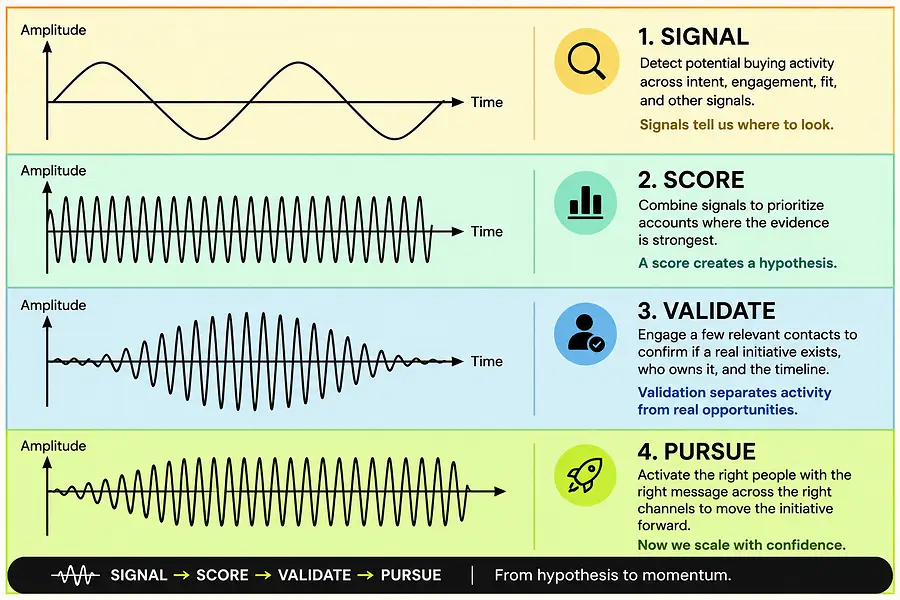
Signal Selling: From Intent to Verified Opportunity
There are so many signals available now. We can see intent, engagement, fit, website activity, competitor information, and different indicators that suggest something may be happening inside an account. But I think where things can go wrong is when we see one of those signals and immediately assume that we have an opportunity.
A signal can tell you where to look, but it does not necessarily tell you when to sell.
That distinction is really important because an account showing strong signals may actually have an active initiative. They may have something coming up in the future. Or the activity we're seeing may not correspond to a buying initiative at all.
This is where I think signal selling needs to become much more intentional.
The way I think about it is through four stages: Signal, Score, Validate, and Pursue.
Signal
The first step is obviously the signal itself.
Something has happened that gives you a reason to pay attention to an account. Maybe they are researching a relevant topic. Maybe there is engagement happening. Maybe they strongly fit your ICP, and there are other indicators appearing at the same time.
Whatever the signal may be, I think its purpose at this stage is simply to tell us where we should look. It is evidence that something may be happening.
That is very different from knowing that something actually is.
I think this is especially important now because sales and marketing teams have access to more data than ever. Having more signals does not necessarily mean we have more certainty. If anything, it means we need a better way of determining which signals deserve our attention.
Score
That is where scoring comes in.
Instead of treating every signal independently, you need some way of bringing the information together and determining which accounts actually deserve attention first. I talked about this in my previous article because I believe prioritization should consider more than whether an account is simply showing activity. You want to understand whether the company fits, whether there appears to be a real initiative, whether the timing makes sense, and how advanced the buying motion appears to be.
The score should help prioritize that evidence.
But I also don't think a high score automatically means that Sales should immediately activate an entire buying committee.
The score is still a hypothesis.
Based on everything we know about this account, something may be happening there. Now we need to find out whether it actually is.
Validate
This is probably the part of signal selling that I find the most interesting because I think validation is what separates activity from actual intelligence.
Before putting significant sales resources behind an account, I want to understand a few things:
Is there actually an initiative?
Who owns it?
And what is the timeline?
The first question matters the most because everything else depends on whether there is actually something happening in the first place.
I think the objective during this stage should be truth-finding rather than persuasion.
You are not necessarily trying to convince someone to buy something yet. You are trying to understand what is actually happening inside the account. And I think there is a really important efficiency component to this as well. You should use the minimum amount of activity necessary to learn the maximum amount about the account.
You don't need to immediately contact every person who could possibly sit on a buying committee simply because an account showed intent. Start narrow. Learn what you can. If you still don't have enough information, expand from there.
Sometimes one conversation may tell you exactly what you need to know. Other times, it may take several conversations before you understand what is actually happening.
And sometimes the answer is that there is no initiative at all. I don't think that should be considered a failure.
You have taken an uncertain signal and turned it into verified information. More importantly, you have prevented Sales from spending time and resources pursuing an opportunity that wasn't actually there.
Pursue
Once an initiative has actually been confirmed, the entire motion changes.
Before validation, the question is: Is something actually happening here?
After validation, the question becomes: How do we enter this buying process?
That is when I believe it makes sense to expand the motion. Now you can start thinking about the broader buying committee, personalized messaging, email, phone, social, relevant content, sequencing, and multi-threading because you are no longer engaging people simply because their titles suggest that they might be involved.
You have context.
You know there is an initiative.
Ideally, you also know something about who owns it, what the company is trying to accomplish, and when they are trying to accomplish it.
Your outreach can now be based on something real.
That is the biggest difference between signal selling and simply having access to buying signals.
The goal isn't to turn every high-intent or high-scoring account into an opportunity. The goal is to use signals to determine where to look, prioritize where you should spend your time, validate what is actually happening, and then put the appropriate resources behind the accounts where demand has been confirmed.
That creates a much cleaner progression:
Signal → Score → Validate → Pursue
A signal gives you a reason to investigate. The score helps determine where to investigate first. Validation establishes what is actually happening. And once you have confirmed that there is a real buying initiative, then you have earned the right to scale the pursuit.
I think that last piece is especially important.
We shouldn't scale outreach simply because an account looks in-market.
We should scale outreach because we have done enough work to understand whether it actually is.