A Story of the Half-Diamond Design by: Meritza Shumake
The Half-Diamond: A Geography of Survival Stitched into Mississippi Choctaw Memory

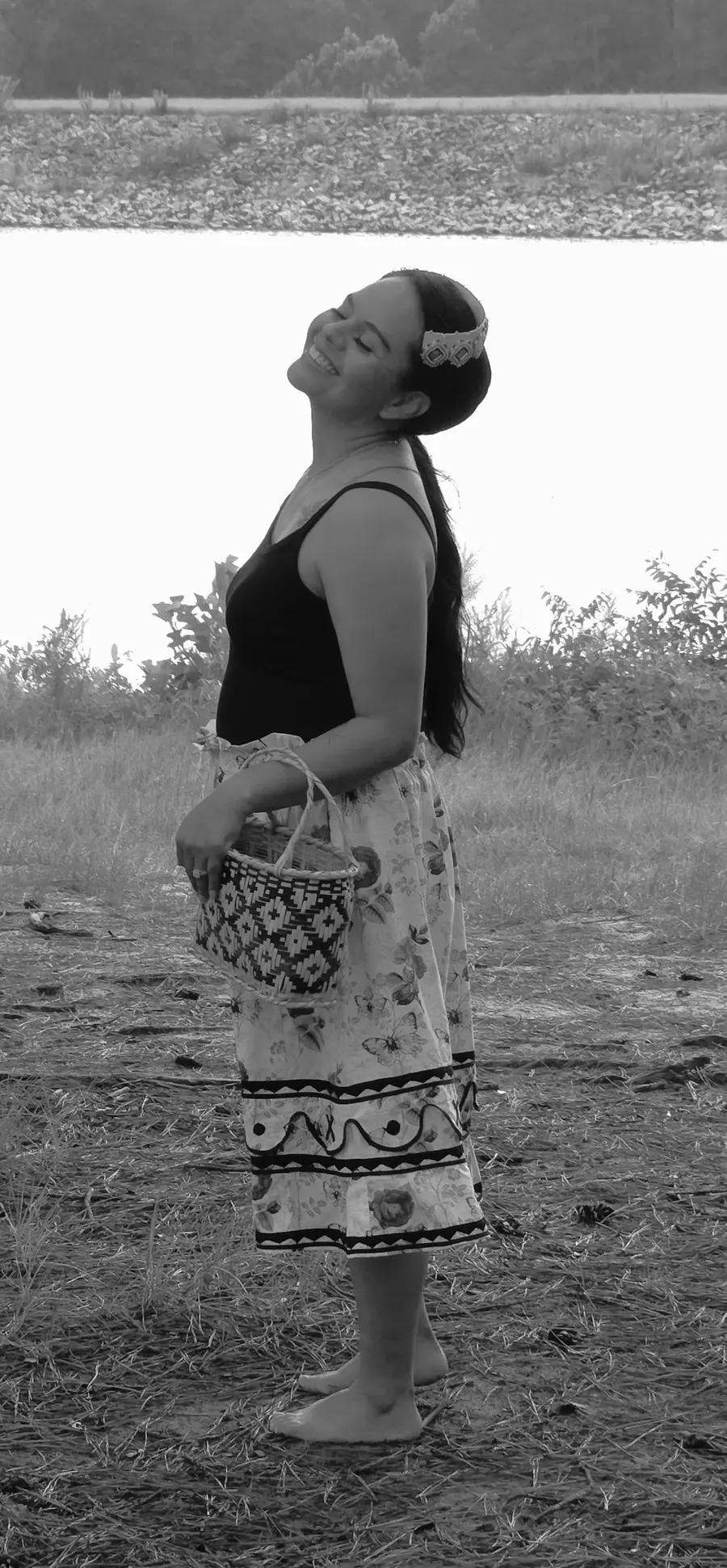
In the quiet weave of Mississippi Choctaw memory, where the scent of pine and river clay lingers in the afternoon heat, there exists a story stitched not in words alone, but in threads of white, black, and red—patterns that speak before the mouth opens. Among these, the half-diamond motif holds a place apart, not as mere ornament, but as a living cartography of the soul. It is a design that does not shout, but murmurs, like wind through canebrakes, like the slow turn of seasons over ancient hills.
To understand the half-diamond, one must first know that its full counterpart, the diamond entire, is the sign of the Eastern diamondback rattlesnake, that old guardian of the earth, whose rattle is the percussion of warning and whose coiled patience is the shape of survival itself. But the half-diamond is something gentler, and yet no less profound. It is the snake’s form broken by the horizon, cleft by the very land it moves upon. For the Choctaw of Mississippi, that break is not a loss but a reverence. It is the hills themselves, those long, breathing swells of earth that rise and fall like the chest of a sleeping giant, given a geometric voice. The half-diamond does not mimic the serpent; it mimics the serpent’s home, the undulating spine of the homeland, where every ridge tells of old journeys and every hollow holds the echo of Pokni’s songs.
Beneath this broken diamond, there runs a horizontal bar—straight, unyielding, humble. That bar is the river, or perhaps the path, for in Choctaw thought, water and trail are kinsmen. The river is the path that moves, and the path is the river made solid. This bar is the grounding line, the anchor that reminds the wearer that even the most sacred symbols must touch the mud of the real world. It speaks of the Pearl River and Bok Cito, of the muddy footprints left by those who walked the Trail of Tears and those who stayed, who hid in the swamps and folded their ceremonies into the folds of their skirts and the hems of their shirts. That bar is both a bridge and a boundary—it carries the weight of a literal crossing, yet it also marks the threshold between the day’s labor and the night’s vision.
But more than geography, the half-diamond with its river bar is a philosophy stitched into cloth. It says that life is never whole in the way a diamond is whole; it is always halved, always leaning into its missing mirror. That missing half is not absence; it is possibility. It is the valley that the hill looks down upon, the low tide that makes the high tide meaningful. The Choctaw seamstress, as she pulls the needle through the cotton, is not merely decorating; she is recounting the story of her people’s endurance. Each point of the half-diamond is a peak of joy or sorrow—a birth, a death, a harvest, a flood. And the bar below is the steady current that carries them all, the unbroken thread of community that says: You are not alone in your rising, nor in your falling.
In ceremony, when the regalia is worn, whether at the stickball game, where the young men leap like herons, or at the Green Corn Dance, where the fire is fed with seven kinds of wood, the half-diamond catches the light and throws it back as broken fire. It is a reminder that the hills of Mississippi are not just dirt and stone; they are the bones of ancestors, the spine of the tribe. And the river bar is the blood that still flows, even when the river itself has been dammed or diverted. The wearer becomes a living map, a walking story, a testament to the truth that the Choctaw did not simply survive the removal; they carried their landscape inside them, folded into their patterns, hidden in plain sight.
And so, when a child asks why that shape is only half, the elder will not answer with haste. She will point to the western sky, where the sun is halved by the tree line, and say, “That is our shape, because we are always between two worlds, but the path below is always ours.” The half-diamond is thus not a fragment, but a fulcrum, a balance between what was taken and what remains, between the snake’s danger and the hill’s shelter, between the river’s wandering and the path’s purpose. It is the geometry of hope, stitched in patience, worn with pride, and understood only by those who know that a story, like a pattern, is never truly finished; it is only passed on.