A Castle Crumbles...
United's East Coast fortress hub struggles with infrastructure, staffing, and air traffic control challenges that threaten operational reliability.

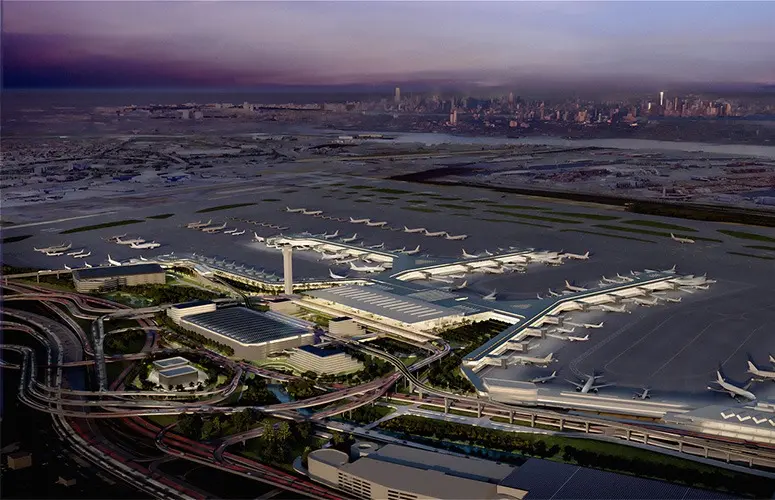
Newark is, to state it flatly, unreliable. Newark Liberty International Airport (IATA code: EWR, see picture above) is United's widely recognized fortress hub on the East Coast. United controls 67% of Newark Liberty's entire aerial output and input and accounts for 72% of Newark's net airline profits. Indeed, if one pays close attention, two out of every three departures at EWR carry the signature blue globe on the United tailfin. Yet Newark has been rendered unreliable.
This is mainly due to a combination of air traffic control depletion and staffing issues, Federal Aviation Administration regulatory controls, inadequate equipment, and crowded airspace, all of which have led to the fortress's crumble. Newark is still very much active and has improved, but compared to, say, San Francisco (SFO), the airport's infrastructure is at least twenty years behind the current technological curve.
The airport's inadequate copper wiring for air traffic control (ATC) was a large part of the reason so many already short-staffed air traffic controllers walked off the job, even as aircraft were in the sky, landing, or waiting to take off. The FAA had lengthy discussions with United during Q2 of fiscal year 2025, and United then quickly canceled thousands of flights, costing the airline over $230 million, according to its Q2 2025 earnings report.
To date, Newark—and, to a greater extent, ATC nationwide—is still understaffed. One cannot fix the now-diagnosed "chronic" ATC staffing shortage simply by throwing money at the problem. It takes three years to train any given ATC class, and this does not account for typical job-related challenges that controllers may face once they graduate, such as basic human exhaustion, illness, substance abuse, burnout, insufficient pay, lack of adequate rest, limited family time, or a lack of days off.
United CEO Scott Kirby has said that if even one major issue at Newark were resolved, it would alleviate 70–75% of United's (and, by extension, other airlines') operational problems.
The FAA issued flight caps at Newark until October 2026, a duration of 18 months at the time of issuance. Essentially, the FAA decreed that only a limited number of daily flights may land at Newark (the exact number varies daily or weekly). This measure is intended to lessen the strain on Newark's aging network infrastructure.
United has focused on Newark primarily because the New York Area TRACON (Terminal Radar Approach Control) is shared with New York–John F. Kennedy Airport (JFK) and the much smaller New York–LaGuardia Airport (LGA). Both airports are dominated by competitor airlines. Delta essentially monopolizes JFK, turning it into its fortress hub, much as United has done at Newark (though United has been more successful from a business perspective). American Airlines has access to one terminal at JFK, though its presence remains significant. Delta is also dominant at LaGuardia, with 270 daily departures. United views Delta's presence as strong competition, though less so with American.
United has a trick up its metaphorical sleeve, however. The BlueSky Alliance with JetBlue gives United access to at least five of JetBlue's gates at JFK's Terminal 5 (T5), as well as three daily departures and arrivals from United hubs, notably San Francisco (SFO), Denver (DEN), and Chicago O'Hare (ORD).
Time, as always, will determine the outcome of Newark's—and, to a slightly lesser extent, United's—challenges.
As always, book your dream trip (away from Newark) with Brooke In The Air Travel at brookeintheairtravel.net!