Advancing Inclusive Art Education in Early Childhood Through Accessible Learning Environments and Adaptive Practices
Creating Equitable Art Experiences for All Children Through Universal Design and Intentional Instructional Planning

Art experiences constitute a foundational component
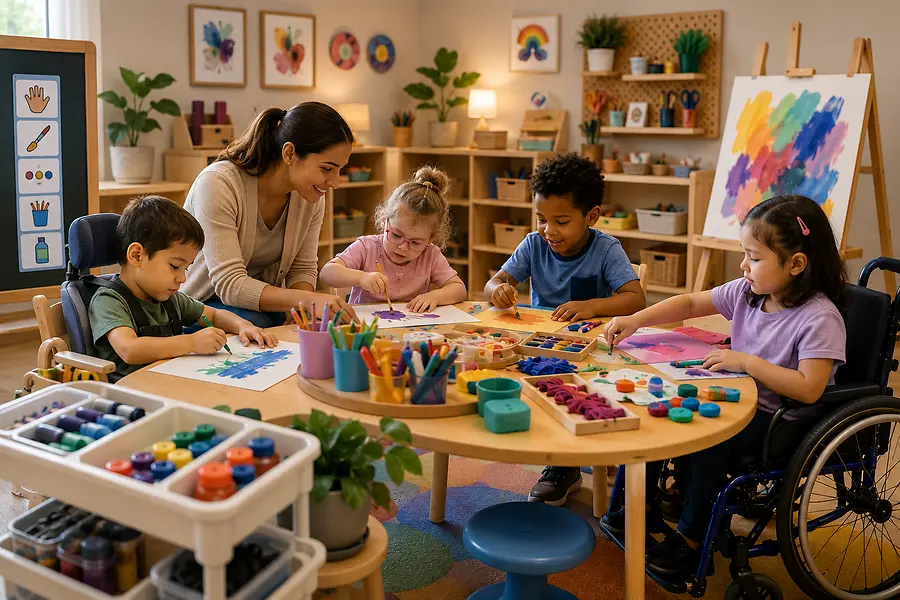
Art experiences constitute a foundational component of high-quality early childhood education because they foster creativity, communication, cognitive development, and social-emotional competence while providing children with authentic opportunities for self-expression. For children with disabilities and other diverse learning needs, meaningful participation in artistic experiences often requires intentional instructional planning and environmental adaptations that promote equitable access.
An inclusive classroom art environment recognizes learner variability as an expected characteristic of development rather than an exception requiring remediation. Consequently, educators should design learning experiences that eliminate barriers to participation through accessible classroom environments, adaptive materials, and responsive instructional practices.
Rather than expecting children to conform to existing learning environments, effective educators proactively construct settings that accommodate diverse developmental, sensory, physical, cognitive, and communicative needs. Grounded in the principles of Universal Design for Learning (UDL) and Developmentally Appropriate Practice (DAP), inclusive art environments empower all children to engage in creative exploration with autonomy, confidence, and a sense of belonging.
Accessibility begins with the intentional organization
Accessibility begins with the intentional organization and design of the physical learning environment. Classroom workstations should incorporate adjustable-height tables, flexible seating arrangements, and ergonomic workspaces that accommodate children with diverse physical abilities. Art centers should also provide unobstructed pathways and ample maneuvering space to ensure independent access for children who use wheelchairs, walkers, or other mobility devices.
Frequently used materials should be stored on low, clearly labeled shelves that encourage self-selection and foster independence. Visual supports-including photographs, pictorial symbols, color-coded storage systems, and sequential visual directions-reduce cognitive demands while enhancing comprehension for children with autism spectrum disorder, language delays, intellectual disabilities, and executive functioning differences.
Accessibility is further enhanced through sensory-responsive planning, which minimizes excessive visual distractions, balances artificial and natural lighting, and reduces disruptive noise levels. Furthermore, providing designated quiet spaces allows children with sensory sensitivities to regulate their attention and emotions while remaining actively engaged in artistic projects.
The deliberate selection of instructional materials
The deliberate selection of instructional materials is equally essential for cultivating inclusive art experiences. Adaptive tools-including ergonomic paintbrushes, easy-grip scissors, weighted markers, adaptive pencil grips, large-diameter crayons, and stabilized easels-enable children with fine motor challenges or physical disabilities to participate alongside their peers with greater independence and success.
Equally important is providing multiple artistic media, such as finger paints, textured papers, modeling compounds, collage materials, fabric, natural objects, recycled materials, and digital art applications, allowing children to select materials that align with their sensory preferences, communication styles, and physical capabilities. This diversity of media reflects the principles of differentiated instruction by recognizing that creativity is expressed through multiple modalities.
Furthermore, educators should intentionally select non-toxic, hypoallergenic, and culturally responsive materials that authentically represent children's identities, family structures, languages, and lived experiences. Such intentionality promotes psychological safety, cultural affirmation, and a stronger sense of belonging within the classroom community.
Inclusive pedagogy extends beyond accessible environments
Inclusive pedagogy extends beyond accessible environments and adaptive materials by emphasizing individualized support, authentic participation, and process-oriented learning. Effective educators prioritize children's creative processes rather than evaluating artistic products against predetermined standards, recognizing that artistic expression reflects individual developmental trajectories, interests, and perspectives.
Open-ended questioning strategies-including prompts such as, "Tell me about your artwork," "How did you decide to use these materials?" and "What inspired your artistic choices?"-encourage language development, metacognitive thinking, and self-reflection without imposing adult interpretations or limiting creative autonomy.
Educators can further facilitate participation by modeling artistic techniques, scaffolding complex tasks into manageable steps, incorporating visual schedules, fostering collaborative peer partnerships, and providing flexible timeframes that accommodate individual processing and learning needs. These evidence-based instructional strategies promote independence while honoring children's unique developmental pathways.
Moreover, collaboration among families, special educators, occupational therapists, speech-language pathologists, and other related service providers enhances instructional coherence by ensuring that classroom adaptations align with each child's Individualized Education Program (IEP) or Individualized Family Service Plan (IFSP), thereby strengthening continuity across educational and therapeutic contexts.
Universal Design for Learning offers a comprehensive framework
Universal Design for Learning offers a comprehensive, research-informed framework for designing equitable and inclusive art experiences by providing multiple means of engagement, representation, and expression. UDL focuses on proactively designing flexible learning environments that anticipate diverse learner variability rather than merely retrofitting accommodations after barriers have already emerged.
Within early childhood art education, this framework may include offering meaningful choices in artistic materials, presenting instructions through verbal, visual, tactile, and modeled demonstrations, integrating assistive technologies, and permitting children to demonstrate understanding through diverse forms of creative expression.
Such proactive instructional planning extends beyond supporting children with identified disabilities; it also benefits multilingual learners, children exhibiting developmental variability, and typically developing peers by increasing engagement, reducing unnecessary barriers, and promoting equitable participation. Consequently, UDL enhances both instructional effectiveness and educational equity across the classroom community.
Ultimately, an inclusive art environment
Ultimately, an inclusive art environment reflects a broader commitment to educational equity, accessibility, and respect for human diversity. When educators intentionally design accessible learning spaces, thoughtfully curate adaptive and culturally responsive materials, and implement evidence-based instructional practices, children with diverse abilities are empowered to participate fully in artistic experiences that promote cognitive, linguistic, physical, social-emotional, and creative development.
Inclusive art education affirms that creativity is not constrained by disability or developmental differences but is cultivated through equitable opportunities for meaningful participation. By integrating Universal Design for Learning, Developmentally Appropriate Practice, differentiated instruction, and interdisciplinary collaboration, early childhood educators establish learning environments in which every child is recognized as capable, valued, and empowered to communicate their unique perspectives through artistic expression.


