AI-Enabled Learning & Development Requires Better Questions, Not Just Better Tools
Leadership Matters More Than Technology: Why Asking Better Questions is the Key to AI-Powered Learning Design

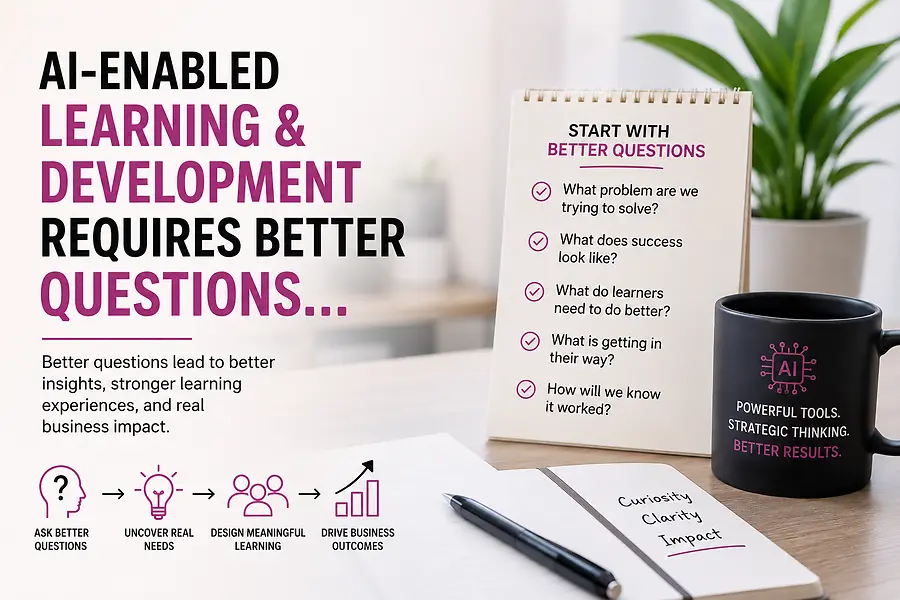
AI is very good at giving answers.
But learning leaders create value by asking better questions.
That is the part we cannot afford to skip.
When a stakeholder asks for training, AI can help us build it faster. But the first leadership move should not be opening a tool and typing, "Create a course on..."
The first move should be curiosity.
What problem are we trying to solve?
Who is impacted?
What are people doing today?
What do they need to do differently?
What is preventing that behavior?
Is the gap related to knowledge, skill, motivation, process, system design, communication, or leadership reinforcement?
What does success look like after the learning experience?
These questions matter because AI will follow the direction we give it.
If we ask for content, it will give us content. If we ask for strategy, analysis, scenarios, practice, and measurement alignment, we get something far more useful. That is the leadership opportunity.
AI can help learning teams move from blank-page panic to structured thinking. It can create draft personas, organize stakeholder notes, identify likely misconceptions, suggest assessment strategies, and generate scenario-based practice.
But the leader must frame the work.
The leader must ensure the tool is solving the right problem.
Otherwise, we risk becoming very efficient at producing learning that does not change anything. And that is not a technology problem. That is a leadership problem wearing a shiny software hat.
AI as a thinking partner, not a vending machine
The best LxD leaders will use AI as a thinking partner, not a vending machine.
They will ask AI to challenge assumptions.
They will ask it to identify risks.
They will ask it to compare design options.
They will ask it to simplify without dumbing things down.
They will ask it to turn information into application.
They will ask it to help design practice, not just presentation.
That is where the magic happens.
Not because AI is magical, but because strong leadership gives it a meaningful role.
The future of learning design will reward leaders who can combine human insight, business acumen, instructional strategy, and AI fluency.
Better tools are helpful. Better questions are transformational.
And if we are going to invite AI into the work, let's not make it the intern who makes slide decks. Let's make it the strategy partner that still knows who's boss.


