AI Is Not a Feature. It’s an Operating Model
How Strategic Leaders Transform AI from Innovation Theater into Structural Competitive Advantage

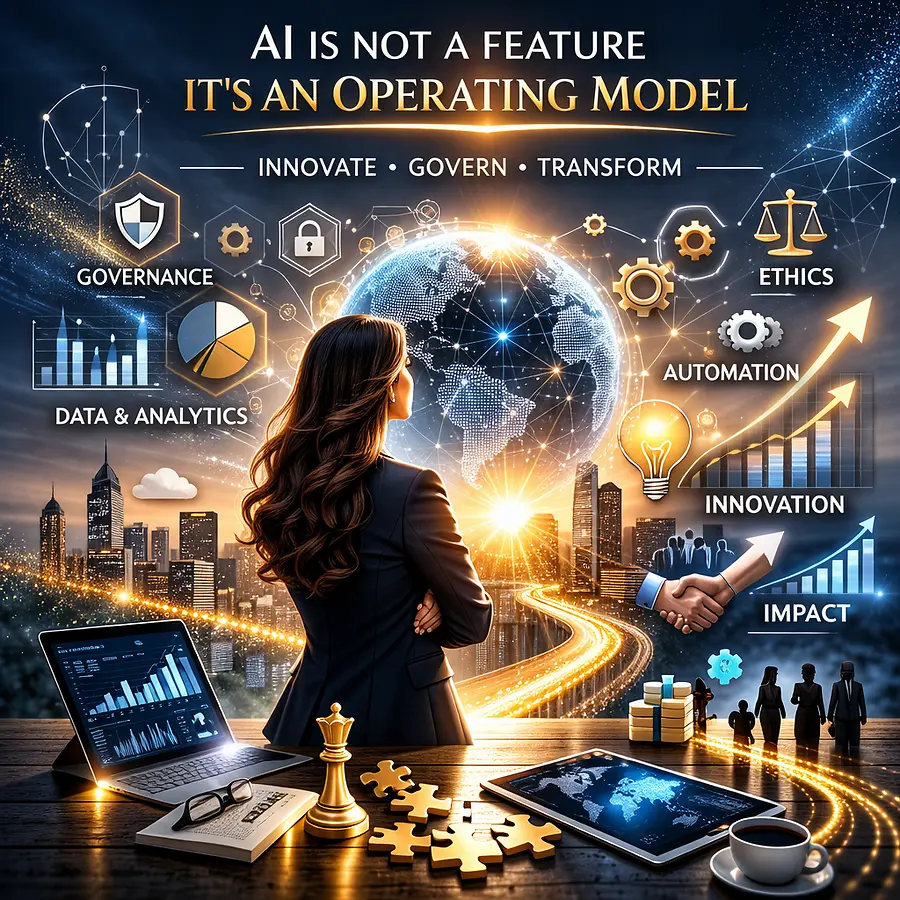
Artificial intelligence is no longer experimental.
It is structural.
Across fintech, healthcare modernization, enterprise SaaS, and public sector transformation, AI has moved from innovation labs into the core architecture of how institutions function. What once differentiated market leaders is now becoming an operational expectation.
Boards are no longer debating whether to adopt AI.
They are debating how to govern it, scale it, and extract measurable value—without destabilizing the enterprise.
Yet despite record investment, many AI initiatives stall or quietly collapse.
The failure is rarely technical.
It is strategic.
I. The Executive Misconception: Treating AI as a Tool
Many organizations approach AI as they would a software implementation:
- Select a vendor
- Pilot a use case
- Deploy across teams
But AI is not a feature enhancement.
It is decision infrastructure.
It alters:
- How data is interpreted
- How authority is distributed
- How quickly decisions are made
- How risk is assessed
- How compliance is enforced
- How accountability is measured
AI restructures the operating model itself.
It compresses the time between insight and action.
It reduces information asymmetry.
It challenges legacy hierarchies built on information control.
When leaders underestimate this structural shift, implementation becomes fragmented. When they recognize it, transformation becomes intentional.
Advantages of Viewing AI as Infrastructure
When AI is treated as enterprise architecture:
• Use cases align with measurable business outcomes
• Investment decisions occur at the portfolio level
• Governance is designed before scale
• Workforce evolution is anticipated
• Cross-functional ownership becomes clear
The result is durable modernization—not isolated experimentation.
Disadvantages When AI Is Treated as a Feature
When AI is deployed as “just another tool”:
• Ownership becomes ambiguous
• IT is overburdened
• ROI is unclear
• Compliance becomes reactive
• Culture resists quietly
The organization experiences innovation fatigue instead of evolution.
II. Strategic Advantages of AI Adoption
When aligned with disciplined leadership, AI delivers layered enterprise value.
1. Productivity Acceleration
AI copilots and automation engines reduce cognitive friction across teams:
- Drafting documentation
- Summarizing meetings
- Analyzing datasets
- Automating reporting
- Streamlining customer support workflows
Advantage
Time compression expands strategic capacity. Talent shifts from repetitive tasks toward innovation, optimization, and customer experience.
Risk
If leaders increase expectations without redesigning workloads, AI becomes a silent multiplier of burnout rather than relief.
Productivity gains must be paired with operating model recalibration.
2. Decision Intelligence
Traditional reporting tells leaders what happened.
AI-driven analytics forecast what is likely to happen.
Predictive modeling enhances:
- Fraud detection
- Revenue forecasting
- Churn mitigation
- Operational risk identification
- Capacity planning
Advantage
Leadership transitions from reactive management to anticipatory governance. Decision-making becomes probabilistic rather than speculative.
Risk
Overreliance without human validation can create blind trust in flawed outputs. Human-in-the-loop governance is essential.
AI informs judgment—it does not replace it.
3. Structural Cost Optimization
Automation reduces error rates, shortens processing cycles, and decreases manual review layers.
Advantage
Lower cost per transaction. Scalable operational efficiency.
Risk
Short-term cost cutting without workforce reinvestment erodes morale and institutional knowledge. Sustainable optimization includes reskilling and role elevation.
Cost efficiency without cultural investment creates instability.
4. Competitive and Market Positioning
AI-forward organizations signal strategic maturity.
They attract:
- Institutional investors
- High-caliber engineering talent
- Enterprise clients seeking innovation
- Strategic partnerships
Advantage
Market perception strengthens brand authority and long-term viability.
Risk
Performative AI adoption—announcements without execution—damages credibility when outcomes fail to materialize.
Transformation must precede promotion.
III. The Strategic Disadvantages and Enterprise Risks
Executive maturity is revealed in risk discipline, not enthusiasm.
1. Governance Exposure
AI systems operate on sensitive data.
Risks include:
- Data leakage
- Compliance violations
- Model hallucinations
- Insufficient audit trails
- Cross-border regulatory conflicts
Strong governance requires:
• Data lineage documentation
• Model validation cycles
• Bias testing protocols
• Role-based access controls
• Escalation frameworks
• Clear accountability ownership
AI governance is not a legal afterthought.
It is an architectural necessity.
2. Cultural Disruption
AI destabilizes psychological safety.
Employees fear:
- Role obsolescence
- Increased performance expectations
- Loss of relevance
Middle management may resist:
- Transparency
- Flattened decision hierarchies
- Data-driven accountability
Transformation without structured change management results in compliance without engagement.
High-performing organizations pair AI adoption with transparent communication, training investment, and visible executive sponsorship.
Culture cannot be modernized by technology alone.
3. Ethical and Bias Amplification
AI systems inherit the data on which they are trained.
Unchecked, they can:
- Reinforce inequitable hiring patterns
- Skew lending decisions
- Misclassify healthcare recommendations
- Amplify systemic bias at scale
Bias at machine speed is more damaging than bias at human speed.
Ethical oversight must be proactive—not reactive crisis management.
4. Over-Acceleration
AI enthusiasm often triggers simultaneous deployment across departments.
Consequences include:
- Fragmented workflows
- Duplicate investments
- Data inconsistency
- Tool fatigue
- Integration complexity
Disciplined leaders scale sequentially:
Pilot → Measure → Refine → Expand.
Strategic patience outperforms reactive expansion.
IV. Why AI Initiatives Fail: A Leadership Analysis
Across industries, failure patterns are consistent.
AI programs collapse when:
- Business outcomes are undefined
- KPIs are vague
- Ownership is fragmented
- Executive sponsorship is weak
- Change management is underfunded
- Governance is implemented too late
- Training is insufficient
Most AI failures are not engineering failures.
They are leadership failures.
Successful AI transformation is approximately:
70% operating model alignment
30% technology capability
Directors who understand this ratio outperform those chasing novelty.
V. What Strategic Directors Do Differently
High-performing leaders treat AI as enterprise architecture.
They:
✔ Start with clearly defined business problems
✔ Align initiatives with measurable financial outcomes
✔ Establish cross-functional AI governance councils
✔ Integrate legal and compliance early
✔ Invest in workforce upskilling
✔ Sequence pilots before scale
✔ Communicate consistently to reduce fear
They resist speed without structure.
They understand that AI reveals inefficiencies—and they are willing to confront them.
VI. The Leadership Imperative
Artificial intelligence will not replace leadership.
It will redefine the standard for it.
AI compresses the time between decision and consequence.
It surfaces inefficiencies that were once buried in reporting cycles.
It quantifies performance in real time.
It reveals risk before escalation.
In this environment, ambiguity is unsustainable.
Governance cannot be improvised.
Culture cannot be ignored.
Strategy cannot be cosmetic.
AI accelerates everything—including accountability.
The question before executive leaders is no longer:
“How do we adopt AI?”
It is:
“Are our operating models strong enough to withstand the transparency AI creates?”
Because intelligent systems do not merely optimize workflows.
They reveal institutional truth.
They illuminate whether decision rights are clear.
Whether governance is structured.
Whether data is trusted.
Whether culture is resilient.
Organizations will not fail because artificial intelligence is too powerful.
They will fail because artificial intelligence exposes structural weaknesses leadership delayed addressing.
The future will not belong to those who deploy AI the fastest.
It will belong to those who integrate it with discipline, govern it with foresight, and scale it with integrity.
This is not a technology cycle.
It is a leadership inflection point.
AI is not a feature.
It is an operating model.
And operating models are shaped not by algorithms—
but by accountable leaders willing to modernize boldly, govern responsibly, and build institutions strong enough to thrive under intelligent transparency.