AI Literacy Is the New Leadership Currency
Why Women Leaders Who Master AI Will Outpace Everyone Else in 2025

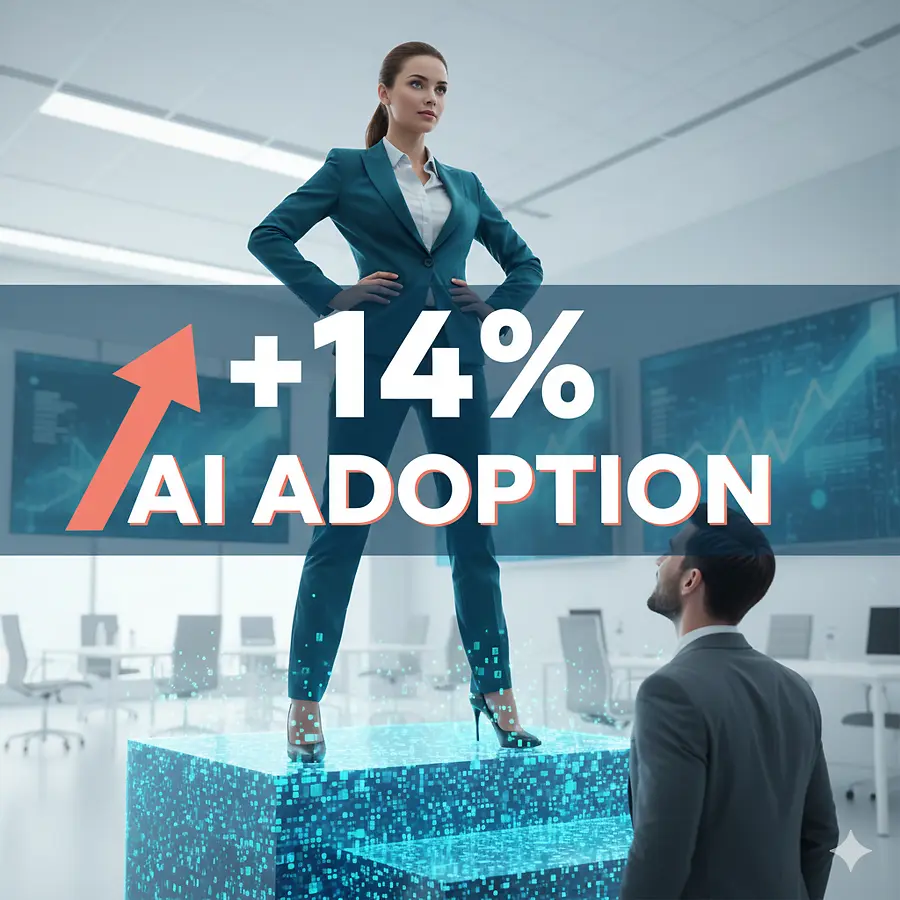
AI is not the future; it’s the present. And women leaders who delay becoming AI-literate aren’t simply “a little behind.” They are putting their influence, innovation capacity, and competitive edge at risk.
But here’s what most articles fail to say:
When women adopt AI, they outperform.
When women lead AI initiatives, results improve.
When women shape AI systems, ethics strengthen, bias drops, and organizations thrive.
This isn’t hype—it’s happening now.
Why AI Literacy Matters More for Women Leaders Than Anyone Else
AI literacy is no longer about “knowing a few tools.” It’s a strategic leadership competency that signals:
- You make faster, higher-quality decisions
- You can lead modern, AI-enabled teams
- You can spot opportunities others overlook
- You understand how emerging technologies shape risk, culture, and innovation
For women, AI literacy carries an even deeper responsibility.
Women are uniquely positioned to challenge embedded bias in AI systems—biases that continue to produce real-world harm when left unchecked. When women understand how AI works, where it fails, and how it affects people, they become the ethical compass, strategic voice, and stabilizing force in the room.
AI literacy means understanding:
- How data, algorithms, predictions, and generative models work
- What AI should never do without human oversight
- Where AI can create value for teams and organizations
- How to communicate AI’s benefits and limitations
- How to identify and challenge ethical, privacy, or compliance concerns
This isn’t “extra credit.”
This is the new leadership baseline.
What the Research Shows: Women Who Lean Into AI Rise Faster
The data is clear:
- A 2024 study found that senior women in technical roles outpaced men in weekly generative-AI use by 14 percentage points. The women who made it to the top didn’t fear AI—they ran toward it.
- Yet women overall use AI about 25% less than men, creating a dangerous capability gap that affects promotions, influence, and pay.
- Organizations with women in AI governance roles report stronger outcomes in bias reduction, stakeholder trust, and compliance.
- Teams led by women adopt AI models up to one-third faster, thanks to stronger communication, collaboration, and change-management leadership.
The message is undeniable:
Women who embrace AI accelerate.
Women who avoid it get left behind.
Women who understand AI—deeply—shape the future.
How AI-Literate Women Lead Differently (and More Effectively)
Across industries, AI-literate women leaders tend to:
1. Make sharper strategic decisions
They combine AI-driven insights with intuition, context, and human understanding. They don’t blindly trust algorithms—they refine them.
2. Elevate productivity without burning out
AI eliminates the administrative burden: scheduling, analysis, documentation, planning. They redirect their time toward high-value leadership work.
3. Strengthen culture and trust
AI helps them identify burnout early, understand team sentiment, and craft clearer communication—always refined through a human lens.
4. Expand customer insight and market reach
Women-led teams leverage AI to personalize services, analyze trends, and find gaps before competitors do.
5. Innovate faster with fewer resources
Women entrepreneurs use AI to prototype, validate, and launch ideas without needing a large technical team.
These strengths—empathy, collaboration, ethical awareness—naturally enhance AI outcomes, making systems fairer, more effective, and more human-centered.
The Business Case: Organizations Win When Women Lead AI
Research consistently shows that teams led by AI-literate women:
- Roll out AI faster and with less resistance
- Reduce algorithmic bias
- Strengthen regulatory compliance
- Build trustworthy, human-centered solutions
- Boost innovation, customer satisfaction, and market credibility
Ethics and excellence don’t compete.
Women leaders are proving you can deliver both—and outperform along the way.
The Barriers Are Real, But They Are Conquerable
Women face undeniable structural obstacles:
- Unequal access to AI training and technical stretch roles
- Limited sponsorship for AI-critical projects
- Stereotypes that wrongly categorize AI as “too technical”
- Underrepresentation in STEM and AI governance
But here’s the good news:
These barriers crumble when women have access, community, and opportunity.
Top research recommends:
- Equal access to AI training and pilot projects
- Communities and networks of women in AI leadership
- Women represented on ethics boards and governance councils
- Tracking AI skill development by gender
- Early AI and digital education for girls and young women
A Practical Blueprint for Women Leaders Who Want to Become AI-Ready
If you want to build AI literacy fast—and sustainably—use this four-part roadmap:
1. Learn + Experiment Weekly
- Take micro-courses in AI, data literacy, and ethics
- Block 60 minutes a week to experiment with AI tools
- Use AI for writing, analysis, brainstorming, or strategy prep
Think of it as leadership strength training. Repetition builds mastery.
2. Build Your Personal AI Strategy
Ask yourself:
- What tasks drain my time but don’t require my expertise?
- Where must I stay fully human? (Coaching, conflict, culture, performance)
- What guardrails do I need in place?
Decide what to automate, what to augment, and what remains fully human-led.
3. Lead AI Adoption on Your Team
- Start with one small pilot
- Encourage experimentation, not perfection
- Debrief regularly: what worked, what didn’t?
- Scale only when value is clear
This builds trust, curiosity, and momentum.
4. Strengthen the Skills AI Cannot Replace
AI frees you to focus on the leadership that truly matters:
- Communication & storytelling
- Emotional intelligence
- Strategic thinking
- Ethical decision-making
- Collaboration & conflict resolution
- Coaching & mentorship
AI is powerful—but it cannot replicate your insight, presence, or humanity.
The Call to Women Leaders Everywhere
Let’s be direct:
AI is not a technical skill.
It is a leadership skill.
And the women who choose to invest in AI literacy now won’t just “keep up.”
They will lead.
They will outperform.
They will shape the future we all inherit.
If women are not at the table designing and governing AI systems, the world suffers.
If women are at the table, the entire ecosystem becomes more innovative, more ethical, and more human.
AI won’t replace women leaders.
But women leaders who use AI will replace those who don’t.
The future is wide open.
Your move.


