America 250th: A Mirror for All Women
Centering Women's Leadership in America's Semiquincentennial Celebration

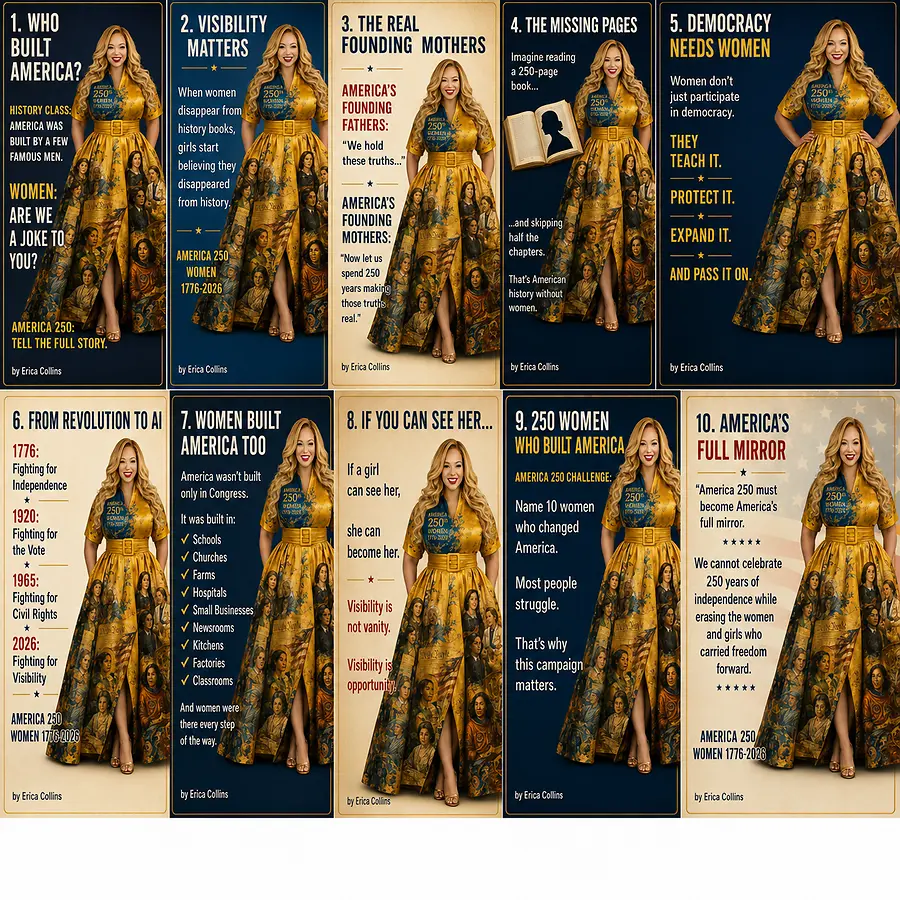
America 250: A Mirror for All Women
As America prepares to mark its 250th birthday, we must resist the temptation to center the celebration solely on the men who wrote the nation’s founding documents. History shows that women have always been architects of democracy, not accessories to it.
From Indigenous matriarchs and Black freedom fighters to immigrant entrepreneurs and mothers holding families together during times of war, women helped build America’s foundations, industries, schools, and social movements. We deserve to be more than a footnote in the nation’s semiquincentennial narrative.
Erica Collins, a dynamic media personality and entrepreneur known for amplifying women’s voices and pioneering digital storytelling, argues that America at 250 should be a mirror that reflects all of us. It should elevate the stories of Black women, Indigenous women, Latina women, Asian women, immigrant women, working-class women, disabled women, educators, mothers, and girls.
For too long, our contributions have been erased by narratives that glorify presidents, soldiers, and monuments while relegating women to the margins. When policymakers promote “family values” as a justification for restricting women’s rights and choices, they reduce women to domestic roles and ignore our power as voters, scientists, artists, entrepreneurs, and defenders of democracy.
Turning Erasure Into Visibility
To honor women’s leadership over the last 250 years and set the stage for the next era, America 250 should become a Women and Girls Visibility Campaign.
Here are five ways we can transform this anniversary into a catalyst for inclusion and progress:
1. Tell the Full American Story
Celebrate the women who carried freedom forward—Abigail Adams, Sojourner Truth, Harriet Tubman, Ida B. Wells, Eleanor Roosevelt, Shirley Chisholm, Dolores Huerta, Patsy Mink, Coretta Scott King, Wilma Mankiller, Fannie Lou Hamer, and Ruth Bader Ginsburg—as well as local heroines from every city and town.
As a mentor and educator, I have seen firsthand how naming these women and sharing their stories gives young leaders the courage to step into their own power.
2. Center Women From Every Background
America was not built only in Congress. It was built in churches, kitchens, farms, factories, unions, newsrooms, classrooms, and small businesses.
We must spotlight the Black, Indigenous, Latina, Asian, immigrant, and working-class women whose labor and leadership have sustained this nation for generations.
3. Launch a "250 Women Who Built America" Multimedia Series
Produce daily short-form videos, podcasts, AI-generated timelines, educational lesson plans, and community events that bring these stories to life.
As someone who bridges leadership development with AI literacy, I understand how technology can democratize access to history and empower women to claim their narratives.
4. Connect America 250 to the United Nations Sustainable Development Goal 5
Use the anniversary to ask difficult but necessary questions:
Are women safer, freer, better paid, better represented, and more visible than they were in 1776?
The United Nations Sustainable Development Goal 5 (SDG 5) calls for gender equality, an end to violence and discrimination, and the empowerment of all women and girls. Aligning our national celebration with global human rights goals can anchor patriotism in justice, equity, and progress.
5. Combat Restrictive Agendas Through Civic Education
Some contemporary policy proposals seek to roll back reproductive rights, gender equity protections, and diversity initiatives, while SDG 5 advocates for equality and empowerment.
The most effective response to regressive policies is education, civic engagement, and informed participation.
Women’s rights are human rights. Women’s leadership is democratic infrastructure.
When we teach our children—and remind our elected officials—of that truth, we help protect history from erasure and ensure that the future remains inclusive.
The Message for America 250
We stand at a crossroads.
Will America 250 be a polished pageant celebrating a handful of founding men, or will it become a transformative celebration of inclusion?
I believe it must be the latter.
As a conscious thought leader committed to empowering women and girls, I see this milestone as an opportunity to widen the lens of history and expand the scope of possibility.
America 250 must be America’s full mirror.
We cannot celebrate 250 years of independence while overlooking the women and girls who carried freedom forward. From the American Revolution to the Civil Rights Movement, from classrooms to boardrooms, from farms to AI laboratories, women helped build America too.
By elevating their stories through education, media, and digital innovation, we can ensure that the next 250 years are defined not by erasure, but by visibility, equity, and collective power.


