A thoughtful examination of how sports organizations can establish fair eligibility rules that protect competitive integrity, athlete safety, and human dignity while adapting to technological and biological advances.
In Conversation
Bold. Brilliant. Unstoppable.
Read the transcript
Erica Collins: Speaker: Erica CollinsWhat does being an Influential Woman mean to you?Being an influential woman isn't about titles or followers. It's about impact. It means using my voice so other women know they're not invisible. It means advocating for small businesses before support local was trending. It means showing up in media spaces that weren't built for women who look like me and staying anyway. As a pioneer plus size model, I didn't wait for permission. I created visibility as an actress and a media influencer. I tell stories that challenge narratives. As a podcaster and educator, I give women the tools I wish I had sooner. Influence is a legacy in motion. It's lifting as you climb. It's turning loved experience into opportunity, not just for yourself, but for others. To me, an influential woman builds bridges, not just brands. She creates access, not just applause, and she leaves doors open wider than she found them. That's influence and that is what this means to me. Every day, every year, every moment.What's one piece advice would you give to younger women chasing their dreams?Learn to love all of yourself, the flaws and the fabulous parts. Every chapter of who you are has value, even the ones you don't fully yet understand, Chad. Your imperfections aren't obstacles. They're information. They teach you resilience, creativity, and compassion, and your strengths, they deserve to be celebrated out loud. Life will change you. Industries will change. Dreams will evolve. The key is. Learning how to adapt with grace, gratitude, and an open mind, because growth doesn't happen when you resist change. It happens when you work with it. Stay curious, think forward, be willing to rewrite the plan without abandoning the vision, and never shrink to fit someone else's expectations of you, who you should be. The world doesn't need a smaller version of you. It needs the whole you. Trust yourself, honor your journey, and move boldly toward a life you're meant to build.
Full transcript available
Her Story
About Erica
Erica Collins is a dynamic media personality, entrepreneur, and small business advocate with nearly two decades of experience in television, radio, public speaking, and professional modeling. As the Executive Producer and Host of America's Enterprise, Erica leads a TV cable and streaming show, as well as Blog Talk Radio’s enterprise-focused programming, reaching an estimated 14 million viewers and listeners. Her work highlights entrepreneurs, the business of sports, and the entertainment industry, providing insights and inspiration to audiences across the globe. In addition to her media career, Erica is an accomplished author, educator, and conscious thought leader, known for empowering women and entrepreneurs through her speaking engagements and mentorship.
Beyond media, Erica has built a pioneering career as a professional plus model and former pageant queen, breaking barriers in fashion for more than 20 years. She has modeled for major brands including Macy’s, Bloomingdale’s, Liz Claiborne, and Just My Size, and has served as a spokesperson for organizations such as Fashion to Figure and the Women Helping Others Foundation. Her work in modeling and media is complemented by her advocacy for diversity, inclusion, and entrepreneurship, providing a platform for underrepresented voices in business and the arts.
Erica is also deeply committed to public service and small business advocacy. She serves on the National Small Business Association Leadership Council, where she tackles critical issues impacting small business owners nationwide, including access to capital, tax policy, and regulatory concerns. A sought-after professional speaker, she has shared her expertise at national conferences, universities, and community events, inspiring audiences with her unique perspective on leadership, empowerment, and sustainable business growth.
Her Interview
Ten minutes with Erica
01What do you attribute your success to?
I attribute my success to adaptability, vision, and a willingness to evolve ahead of trends. By staying curious and embracing innovation, I’ve been able to reinvent myself across industries, refusing to let any single title or category define me. My ability to pivot—from media to fashion, from publishing to AI-focused projects—has allowed me to stay relevant and make a meaningful impact.
02What’s the best career advice you’ve ever received?
The best career advice I ever received was not to limit myself to a single lane or identity. Embracing this mindset has allowed me to say yes to opportunities that felt unconventional at the time, many of which became defining moments in my career.
03What advice would you give to young women entering your industry?
I would tell young women entering my industry to stay adaptable and embrace reinvention, especially in fast-changing fields. Don’t wait for permission, don’t shrink yourself to fit outdated expectations, and trust that your diverse interests can coexist and become strengths that set you apart.
04What are the biggest challenges or opportunities in your field right now?
One of the biggest challenges I see in my field is the rapid pace of change across media, fashion, and technology, which can feel overwhelming for those who resist innovation. At the same time, I see tremendous opportunity—especially with AI and digital publishing—for women to create, own, and scale intellectual property without relying on traditional gatekeepers.
05What values are most important to you in your work and personal life?
Integrity, creativity, empowerment, and lifelong learning are at the heart of my work. I’m deeply committed to using my platform to uplift women and girls, expanding representation and access to opportunity wherever I can. In my personal life, I prioritize growth, cultural awareness, and meaningful connections, making sure that everything I do aligns with purpose rather than ego.
Her Content Hub
Articles by Erica
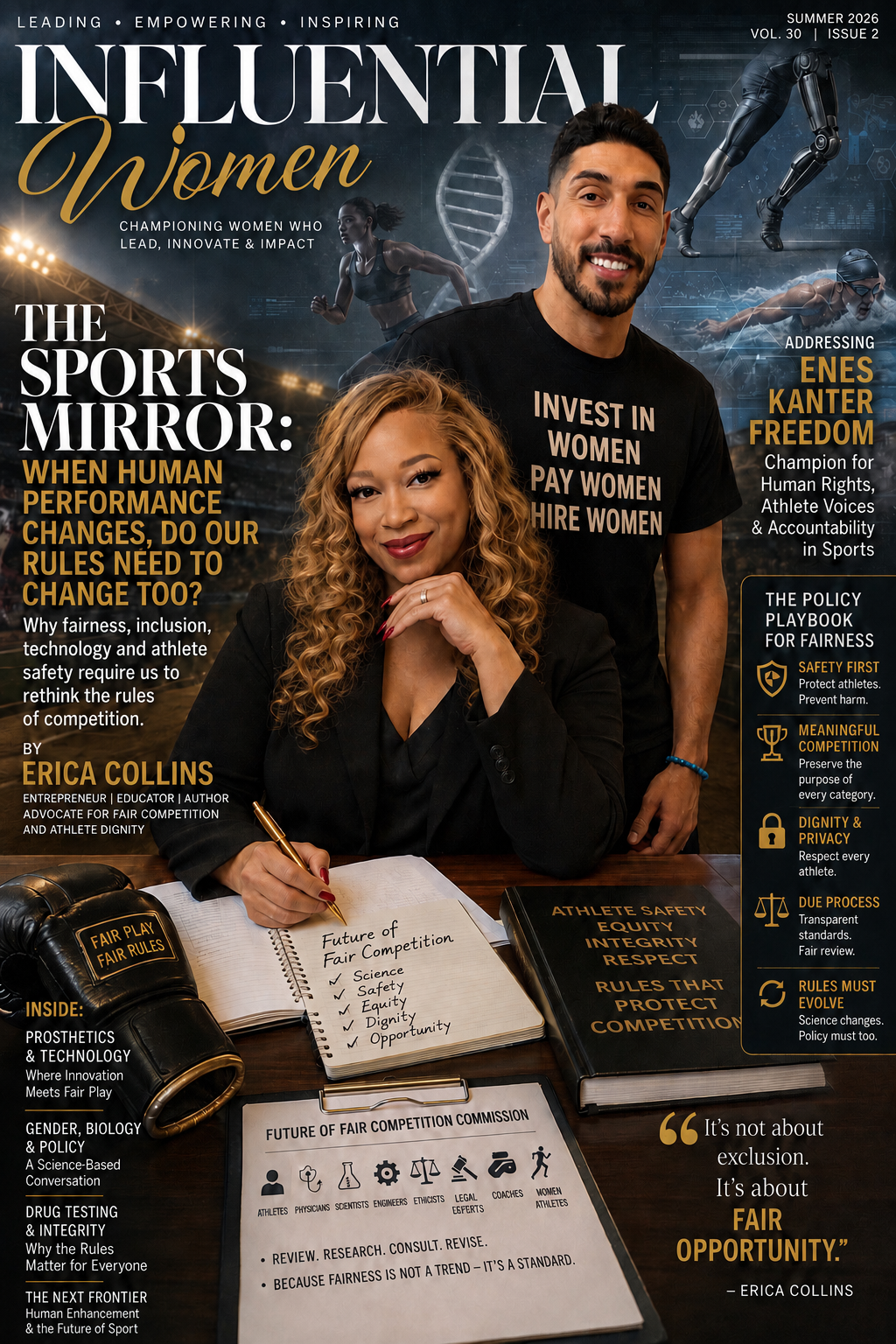
The Sports Mirror: When Human Performance Changes, Do Our Rules Need to Change Too?
Rethinking Sports Policy in an Era of Technological Change and Human Enhancement
The Future of Fair Competition
By Erica Collins
There are moments when sports become more than entertainment. They become a mirror.
Recent debates involving athletes, gender, performance-enhancing substances, and eligibility have forced us to look at something larger than any one athlete or controversy:
What does fair competition mean when the human body—and the technology around it—is changing faster than the rules governing sports?
This is a policy question.
It should not automatically become a political question, a personal attack, or a reason to label someone a “loser,” “dumb,” or “attention-seeking” simply because they are asking whether the rules are still adequate.
Athletes deserve dignity. But athletes also deserve rules that protect the integrity and safety of competition.
And spectators deserve confidence that the person who wins did so under meaningful and reasonably comparable competitive conditions.
That is the conversation I believe we should be having.
I Learned Early That Physical Differences Matter in Sports
My own perspective comes from personal experience.
As a child, my size and physical strength affected how I was placed in school physical education. I developed very much as a girl. Still, from elementary school through high school, I found myself participating in sports with boys—including playing quarterback in elementary school and wrestling boys during my first year of high school.
I remember being placed into competitive situations based largely on what my physical abilities could handle.
At one point in junior high/middle school, I scored 21 points in approximately 10 minutes on the basketball court because the girls were intimidated by my size and strength. As a result, I was placed in gym class with all boys for the rest of the year.
Eventually, however, the boys grew, and the physical differences became more noticeable. My experience shifted toward more female physical-education classes.
That experience has stayed with me because it taught me something very simple:
Physical differences are not an insult. They are a reality that sports have historically created rules around.
That is precisely why we have weight classes in boxing and wrestling. It is why we separate many competitions by sex. It is why athletes are tested for prohibited substances. And it is why sports organizations establish equipment and eligibility rules.
The purpose of those rules should not be humiliation.
The purpose should be meaningful competition.
We Already Regulate the Human Body
Consider performance-enhancing drugs.
Nobody seriously argues that an athlete should be permitted to take whatever substance they want simply because they identify as an athlete.
The global sporting system has created an elaborate framework around this problem.
The World Anti-Doping Agency (WADA) maintains a Prohibited List identifying substances and methods that athletes cannot use in competition or, depending on the substance, at other times.
Why?
Because we recognize that changing an athlete’s physiology can change the competitive equation.
We therefore test. We establish thresholds. We create therapeutic-use exceptions. We investigate violations. And, when appropriate, an athlete can become ineligible to compete.
Nobody should interpret that framework as saying the athlete has less human dignity.
It is saying something different:
The rules of the competition matter.
So What Happens When Technology Changes the Human Body?
Now take the conversation one step further.
This is where what some people once called science fiction begins entering serious policy discussions.
We already have athletes competing with sophisticated prosthetic technology. Sports governing bodies already ask whether a technological device provides a competitive advantage.
World Athletics, for example, has a Mechanical Aids Review Panel that evaluates whether mechanical aids provide an overall competitive advantage. In one case involving Blake Leeper, World Athletics determined that the proposed carbon-fiber running prostheses would provide an overall competitive advantage and therefore prohibited their use in World Athletics-sanctioned competition.
World Para Athletics likewise has specific rules governing assistive devices and has acknowledged that prosthetic devices can raise questions about performance advantage.
This is important.
We are already living in the beginning stages of a world in which the boundary between the human body and technology is becoming increasingly complicated.
Today, we might be discussing prosthetics.
Tomorrow, we could be discussing increasingly sophisticated implants, powered exoskeletons, neural interfaces, artificial organs, enhanced sensory systems, or other technologies that could materially affect athletic performance.
I am not suggesting that every futuristic technology exists today or that every technological enhancement would necessarily create an advantage.
I am asking a policy question:
If technology can materially enhance speed, strength, endurance, reaction time, or recovery, when does assistance become an athletic advantage—and who decides?
We should establish the framework before the controversy arrives.
Sex, Chromosomes, and Differences of Sex Development Require Careful Policy—Not Name-Calling
Another complicated conversation involves transgender athletes and athletes with differences of sex development, commonly called DSD.
It is important to use accurate language. “Intersex” or “differences of sex development” are appropriate contemporary terms for people born with variations in sex characteristics. The term “hermaphrodite” is generally considered outdated and should not be used casually to describe people.
Sports organizations have not treated this issue as simple.
World Athletics has repeatedly revised its eligibility policies as scientific information, legal circumstances, and sports policy have evolved.
Its 2023 rules, for example, required certain DSD athletes competing in the female category to maintain testosterone below 2.5 nmol/L for at least 24 months for international competition.
Then, in 2025, World Athletics conducted another major consultation concerning eligibility for its female category, explicitly stating that scientific developments, sport, and law required the organization to reconsider its regulations.
That is exactly what responsible policy should look like:
Review. Research. Consult. Revise.
Not ridicule.
Not censorship.
Not pretending the question doesn’t exist.
Different Sports May Require Different Solutions
One of the most important lessons from these policies is that there may not be one universal answer.
Running is different from boxing.
Boxing is different from swimming.
Swimming is different from shooting.
A physical advantage that matters enormously in a combat sport may have a different impact in another sport.
World Boxing provides a particularly important example. Beginning in August 2025, World Boxing implemented a sex-eligibility policy establishing male and female categories based on sex at birth and requiring genetic screening for athletes participating in its competitions. The organization specifically cited safety, competitive fairness, and sporting integrity.
The policy also contains an appeals process.
That last part matters.
Good policy should not simply say “yes” or “no.” It should provide:
- Clear eligibility standards;
- Confidential procedures;
- Qualified medical and scientific review;
- An appeals process;
- Protection against harassment and discrimination;
- Consistent enforcement; and
- Periodic review as science changes.
In fact, World Boxing demonstrated why an appeals process is necessary when, in 2026, it announced that a boxer who had initially triggered a screening issue was ultimately determined eligible for the female category after medical documentation was reviewed through its appeal process.
That is a much more constructive model than turning individual athletes into political symbols.
Even College Sports Have Already Changed Their Rules
The NCAA provides another example.
In February 2025, the NCAA changed its transgender participation policy. Under the current policy, athletes assigned male at birth may not compete on NCAA women’s teams, although they may practice with a women’s team and receive other applicable benefits. The policy also addresses athletes assigned female at birth who have begun testosterone therapy.
Whatever one’s political position, the important policy lesson is this:
Sports organizations are capable of establishing specific eligibility rules without declaring that the athletes affected are less worthy as human beings.
That distinction is essential.
Protecting a competitive category is not automatically the same thing as condemning an individual.
The Question I Want Us to Ask About DEI
I believe this is where the broader DEI conversation needs greater maturity.
If inclusion means that every person must have identical access to every competitive category regardless of biological or technological differences, we eventually run into contradictions.
Sports has never operated that way.
We have weight classes.
Age classifications.
Sex categories.
Disability classifications.
Skill divisions.
Equipment rules.
Drug-testing rules.
Amateur and professional classifications.
Why?
Because fairness sometimes requires recognizing differences rather than pretending differences do not exist.
At the same time, fairness should never become an excuse for humiliation.
We can simultaneously say:
“You deserve respect.”
and
“The competition needs rules.”
Those statements are not contradictory.
They are the foundation of good governance.
We Should Not Wait for a Crisis
The greatest policy mistake would be waiting until an athlete is seriously injured, an entire category becomes commercially unsustainable, or competitors begin refusing to participate before we decide that the rules need review.
Boxing makes this especially important because physical differences can have direct safety consequences.
We should not have to wait for a catastrophic injury to ask whether eligibility rules adequately address competitive and medical risk.
Likewise, we should not wait until a technological enhancement creates an undeniable competitive advantage before determining whether the technology belongs in a particular category.
The question should be asked before the crisis.
My Proposal: Create a “Future of Fair Competition” Framework
Rather than treating every controversy as a culture war, I would propose that major sports organizations establish a permanent Future of Fair Competition Commission.
The commission could bring together:
- Athletes—including current and retired competitors;
- Sports physicians—to evaluate health and safety;
- Scientists and physiologists—to evaluate measurable performance effects;
- Genetic and endocrinology specialists—when biological eligibility questions arise;
- Engineers and technology experts—to evaluate prosthetics, implants, and emerging performance technologies;
- Ethicists and civil-rights experts—to protect individual dignity and prevent discriminatory practices;
- Legal scholars—to evaluate evolving laws and regulations; and
- Coaches and sports administrators—who understand the practical consequences of rules.
And perhaps most importantly:
Women athletes themselves.
Their voices should not be an afterthought when policies directly affect women’s competitive opportunities.
Five Principles Could Guide the Framework
1. Safety First
Particularly in combat sports, rules must consider whether a competitive difference creates an unacceptable risk of injury.
2. Meaningful Competition
Eligibility rules should preserve the purpose of the competitive category rather than allowing technological, physiological, or other advantages to fundamentally redefine it.
3. Dignity and Privacy
No athlete should be publicly humiliated, harassed, or turned into a political target because of a medical or eligibility determination.
4. Due Process
Athletes should have access to confidential review, independent experts, and an appeal mechanism.
5. Rules Must Evolve
A policy written in 2026 should not necessarily govern sports in 2036. Scientific and technological developments require periodic review.
We Don’t Have to Choose Between Compassion and Common Sense
This is where I believe the conversation has become unnecessarily polarized.
We are told that if we question a sports policy, we must hate someone.
We are told that if we support inclusion, we must ignore biological differences.
Neither is true.
There is a middle ground.
It is called policy.
Enes Kanter Freedom’s willingness to challenge sporting policies is one example of why public discussion can be valuable—even when people strongly disagree with the messenger.
The answer should not be to silence the conversation.
The answer should be to bring the conversation into a room with scientists, athletes, policymakers, medical professionals, lawyers, and technology experts and say:
Show us the evidence.
Show us the risks.
Show us the competitive impact.
Show us the alternatives.
Then create rules.
As someone who experienced sports classifications firsthand as a young girl, I understand why physical differences can matter.
As an educator, entrepreneur, and media professional, I also understand that policy must evolve with society and technology.
And as we enter an era in which artificial intelligence is transforming nearly every industry, the question of human enhancement will not disappear.
It will grow.
The future may force us to distinguish between the natural human body, medically necessary intervention, performance enhancement, and technological augmentation in ways sports has never had to consider before.
We should not be frightened by that conversation.
We should lead it.
Because ultimately, this is not about deciding who belongs.
It is about deciding how everyone can participate with dignity while preserving the integrity, safety, and meaning of the competition itself.
The goal should not be exclusion.
The goal should be fair opportunity.
And if our policies cannot answer the challenges of tomorrow, then perhaps the most responsible thing we can do today is begin rewriting them.
About Erica Collins
Erica Collins is an author, media producer and host, strategist, and founder of initiatives focused on women in leadership, entrepreneurship, empowerment, and AI-driven engagement.
She has interviewed several professional athletes and has worked for the George Michael Sports Machine at WRC-NBC and for Time Warner/HBO Sports.
She also pursued independent study at The George Washington University in Washington, D.C., developing graduate-level curriculum on “Jackie Robinson: Race, Sports and the American Dream.” The curriculum grew into a student society and community symposium.
Erica Collins has been involved in various sports conferences and programs focused on athletes’ lives after competition and their transitions into organizations and businesses.
The future of sports will require more than athletes who can compete. It will require leaders willing to ask difficult questions, examine the evidence, and build rules that are fair, safe, and worthy of the people who play the game.
Discover how women can embrace summer as a transformative season of self-care, adventure, and empowerment while celebrating a new children's book inspiring the next generation to dream fearlessly.
Empowering Women to Make This Summer Their Season of Joy, Growth, and Adventure
Reconnect with Yourself This Summer: A Journey of Self-Discovery, Empowerment, and Dreams
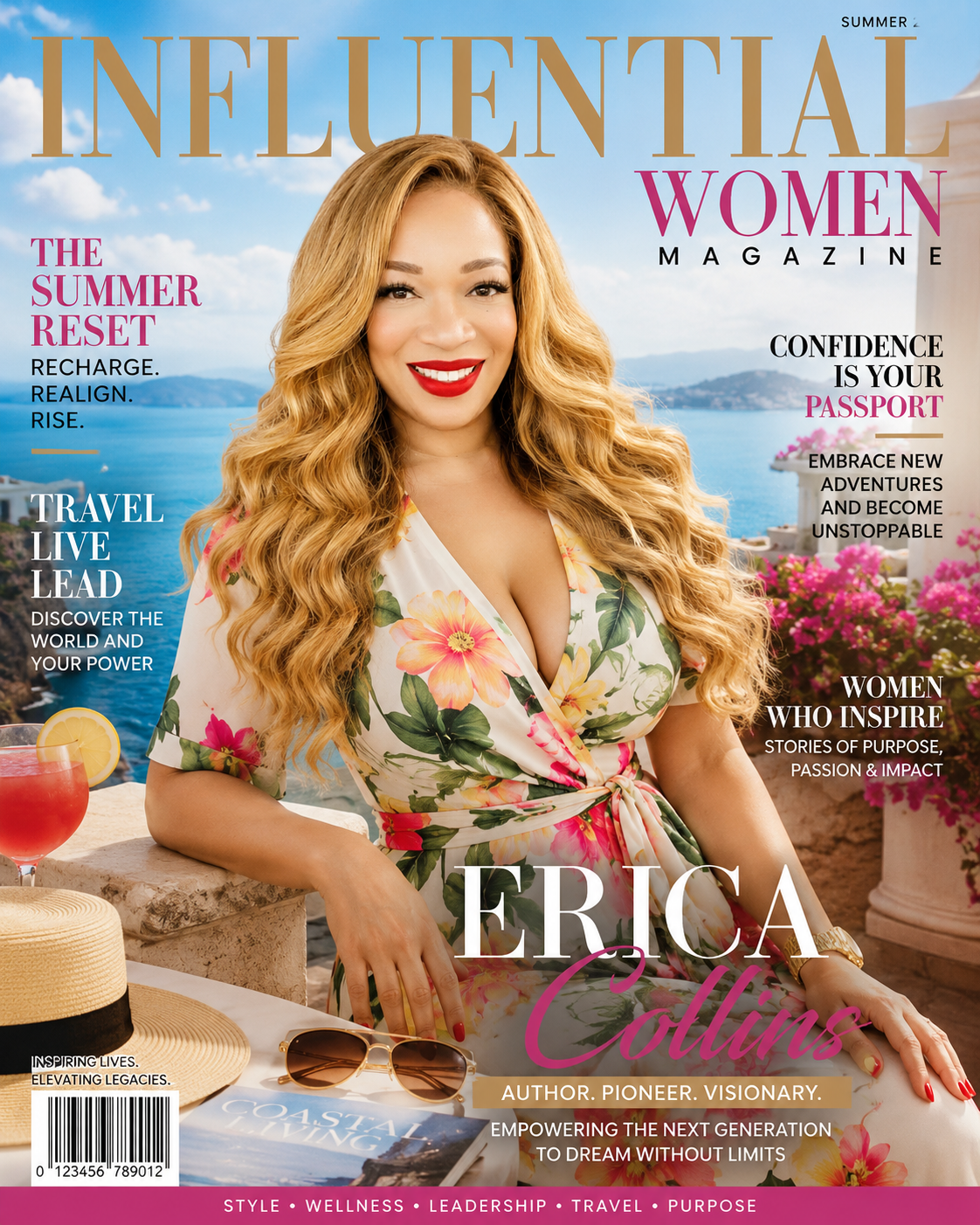
Summer is more than a season—it's an invitation for women to reconnect with themselves, embrace new experiences, and create memories that last a lifetime. Whether you're planning an international getaway, a relaxing beach retreat, a family road trip, or simply discovering hidden gems close to home, taking time to recharge is an investment in your well-being.
Empowered women understand that self-care isn't a luxury; it's a necessity that fuels confidence, creativity, and purpose.
Every vacation offers an opportunity to step outside your daily routine and rediscover the woman behind the responsibilities. Summer adventures remind us to celebrate our accomplishments, prioritize our peace, and welcome moments of laughter, reflection, and inspiration. From exploring diverse cultures to supporting women-owned businesses while traveling, every journey becomes a chance to grow personally while empowering communities around the world.
As you pack your suitcase this season, don't forget to pack your dreams as well. Bring the book you've been meaning to read, start the journal you've been putting off, capture unforgettable moments, and allow yourself to dream even bigger. Strong women know that every destination can become a classroom, every conversation can become a lesson, and every experience can strengthen the confidence needed to pursue the next chapter of life.
This summer, give yourself permission to rest, recharge, and return home with renewed vision and purpose.
A Pioneer Plus Model of the World Stage
As we celebrate women embracing new adventures this summer, I'm thrilled to announce the launch of my official children's video book, Erica Collins: A Pioneer Plus Model of the World Stage.
This inspiring story encourages children to believe in themselves, embrace their uniqueness, and understand that no dream is too big.
If this message inspires even one child to dream bigger, encourages one parent to nurture a child's gifts, or empowers one future leader never to give up, then together we've already made a difference.
Watch the official video here:
https://www.youtube.com/watch?v=0VfA8z-cBGY
Please watch, like, leave a comment sharing where you're watching from, and share it with parents, teachers, libraries, schools, churches, and every child who needs encouragement.
Together, we can remind the next generation that greatness has no limits, dreams have no boundaries, and the world is waiting for their unique light to shine.
#EricaCollins #ChildrensBooks #RepresentationMatters #InclusiveAuthors #DreamBig #FutureLeaders #KidsBooks #Inspiration #WomenWhoLead #ReadingIsPower #EducationMatters #AuthorLife #BelieveInYourself #WorldStage #SummerEmpowerment #InfluentialWomenMagazine
America's 250th birthday must celebrate women's critical contributions to democracy and nation-building, transforming the anniversary into a visibility campaign that honors Black, Indigenous, immigrant, and working-class women whose leadership shaped America's past and future.
America 250th: A Mirror for All Women
Centering Women's Leadership in America's Semiquincentennial Celebration
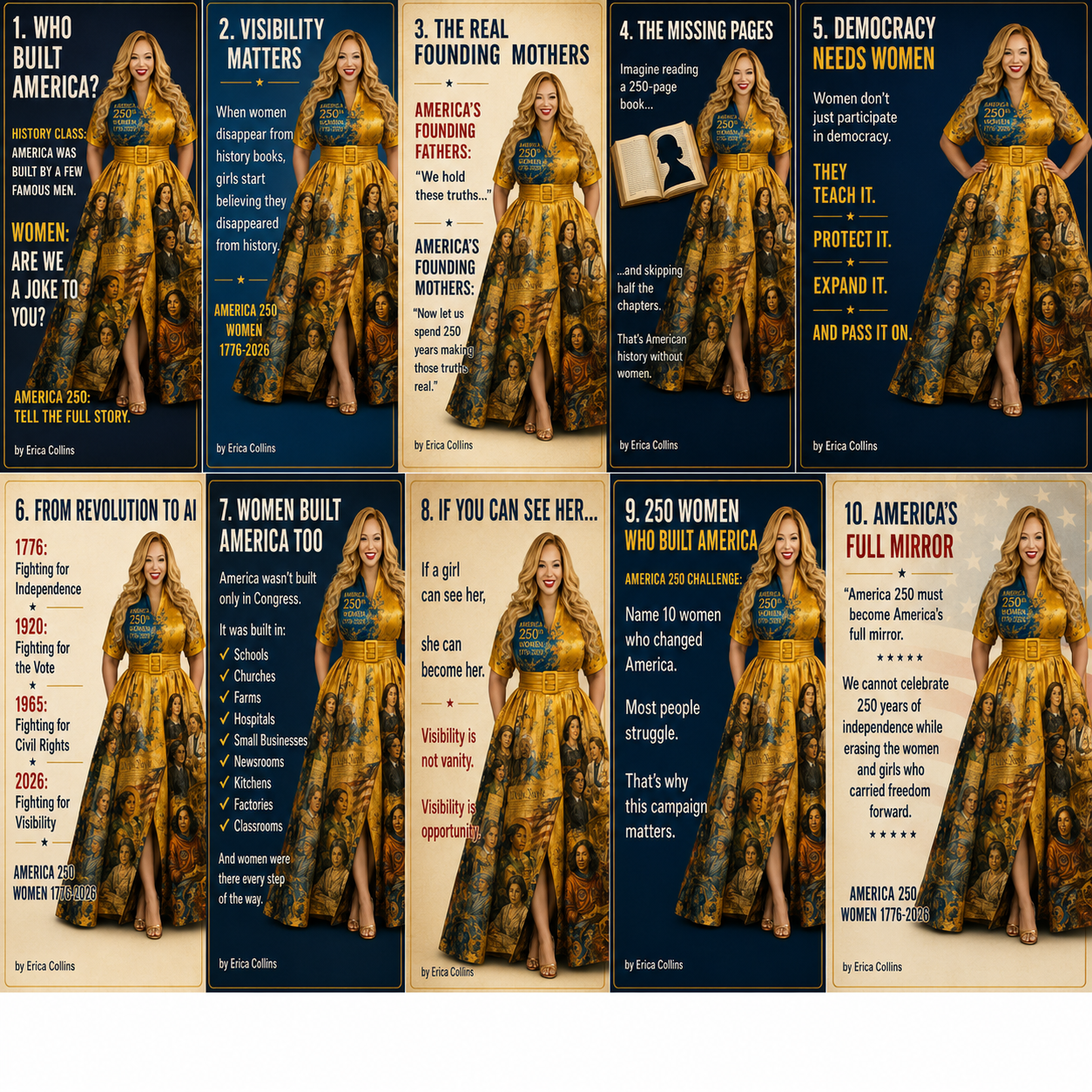
America 250: A Mirror for All Women
As America prepares to mark its 250th birthday, we must resist the temptation to center the celebration solely on the men who wrote the nation’s founding documents. History shows that women have always been architects of democracy, not accessories to it.
From Indigenous matriarchs and Black freedom fighters to immigrant entrepreneurs and mothers holding families together during times of war, women helped build America’s foundations, industries, schools, and social movements. We deserve to be more than a footnote in the nation’s semiquincentennial narrative.
Erica Collins, a dynamic media personality and entrepreneur known for amplifying women’s voices and pioneering digital storytelling, argues that America at 250 should be a mirror that reflects all of us. It should elevate the stories of Black women, Indigenous women, Latina women, Asian women, immigrant women, working-class women, disabled women, educators, mothers, and girls.
For too long, our contributions have been erased by narratives that glorify presidents, soldiers, and monuments while relegating women to the margins. When policymakers promote “family values” as a justification for restricting women’s rights and choices, they reduce women to domestic roles and ignore our power as voters, scientists, artists, entrepreneurs, and defenders of democracy.
Turning Erasure Into Visibility
To honor women’s leadership over the last 250 years and set the stage for the next era, America 250 should become a Women and Girls Visibility Campaign.
Here are five ways we can transform this anniversary into a catalyst for inclusion and progress:
1. Tell the Full American Story
Celebrate the women who carried freedom forward—Abigail Adams, Sojourner Truth, Harriet Tubman, Ida B. Wells, Eleanor Roosevelt, Shirley Chisholm, Dolores Huerta, Patsy Mink, Coretta Scott King, Wilma Mankiller, Fannie Lou Hamer, and Ruth Bader Ginsburg—as well as local heroines from every city and town.
As a mentor and educator, I have seen firsthand how naming these women and sharing their stories gives young leaders the courage to step into their own power.
2. Center Women From Every Background
America was not built only in Congress. It was built in churches, kitchens, farms, factories, unions, newsrooms, classrooms, and small businesses.
We must spotlight the Black, Indigenous, Latina, Asian, immigrant, and working-class women whose labor and leadership have sustained this nation for generations.
3. Launch a "250 Women Who Built America" Multimedia Series
Produce daily short-form videos, podcasts, AI-generated timelines, educational lesson plans, and community events that bring these stories to life.
As someone who bridges leadership development with AI literacy, I understand how technology can democratize access to history and empower women to claim their narratives.
4. Connect America 250 to the United Nations Sustainable Development Goal 5
Use the anniversary to ask difficult but necessary questions:
Are women safer, freer, better paid, better represented, and more visible than they were in 1776?
The United Nations Sustainable Development Goal 5 (SDG 5) calls for gender equality, an end to violence and discrimination, and the empowerment of all women and girls. Aligning our national celebration with global human rights goals can anchor patriotism in justice, equity, and progress.
5. Combat Restrictive Agendas Through Civic Education
Some contemporary policy proposals seek to roll back reproductive rights, gender equity protections, and diversity initiatives, while SDG 5 advocates for equality and empowerment.
The most effective response to regressive policies is education, civic engagement, and informed participation.
Women’s rights are human rights. Women’s leadership is democratic infrastructure.
When we teach our children—and remind our elected officials—of that truth, we help protect history from erasure and ensure that the future remains inclusive.
The Message for America 250
We stand at a crossroads.
Will America 250 be a polished pageant celebrating a handful of founding men, or will it become a transformative celebration of inclusion?
I believe it must be the latter.
As a conscious thought leader committed to empowering women and girls, I see this milestone as an opportunity to widen the lens of history and expand the scope of possibility.
America 250 must be America’s full mirror.
We cannot celebrate 250 years of independence while overlooking the women and girls who carried freedom forward. From the American Revolution to the Civil Rights Movement, from classrooms to boardrooms, from farms to AI laboratories, women helped build America too.
By elevating their stories through education, media, and digital innovation, we can ensure that the next 250 years are defined not by erasure, but by visibility, equity, and collective power.
Join Influential Women and start making an impact. Register now.