American Sociocultural History (part III)
A Comprehensive Look at the Civil War's Major Battles, Lincoln's Legacy, and the Reconstruction Era That Followed.

Welcome back, everyone!
As promised, here in Part III, we're covering a few highlights of the Civil War, starting in 1861 and ending in 1865. We're also covering Reconstruction. What we do not cover here, we'll cover in Part IV, which will also emphasize the Lost Cause myth. Part IV will likely be the last in this series and will include a bibliography. Then we shall return to the art of travel, aviation, and the world's wonders.
We will continue in timeline form for ease of literary digestion.
Major Events in the Civil War: Highlights
1861 – South Carolina becomes the first state to secede. Others soon follow after Lincoln is officially inaugurated as president of the United States. Fort Sumter, a Union garrison and defense fort on an island at the mouth of Charleston Harbor in Charleston, South Carolina, is fired upon by Confederate troops under General P. T. Beauregard. The result is zero casualties on either side, but the fort quickly falls into Confederate hands as the Union garrison surrenders. This becomes known as the opening volley of the war.
1861, cont. – First Battle of Bull Run (known as First Manassas by Southerners) is fought as the very first actual battle of the Civil War. Fought in Prince William County, Virginia, near what is now the town of Manassas, both sides had about 18,000 poorly led and poorly trained troops. The battle was a technical Confederate victory but pyrrhic at best. What was more important, arguably, is that it showed the public and politicians that this war would not be quick or bloodless.
1862 – Battle of Antietam. This battle is widely regarded as the single bloodiest battle in the entire war. Taking place near Antietam Creek and Sharpsburg, Maryland, 54,000 troops were deployed by the Union's Army of the Potomac, commanded by George McClellan, while about 31,000 soldiers would take the field under General Robert E. Lee's Army of Northern Virginia. While tactically inconclusive for either side, Lee's invasion of the North was turned back, and the strategic advantage pivoted to the Union. Nevertheless, Lincoln soon relieved McClellan of command, frustrated by the general's timidity, and debated whom to place in charge.
1863 – The Emancipation Proclamation. Issued by President Lincoln on New Year's Day 1863, only a few months after Antietam, it declared all slaves in conquered Southern territory to be free and allowed them to enlist in the Union Army.
1863 – Battle of Gettysburg. This brutal, three-day battle is unanimously regarded as the metaphorical “High Water Mark” of the Confederacy in the war. The battle ended Lee's second invasion attempt of the North. From this point until the war ended, the South would never again invade the North. Gettysburg is also regarded as the single biggest battle in the Civil War.
1863, cont. – Gettysburg Address. Abraham Lincoln gave his famous Gettysburg Address in the autumn of 1863, just a few months after the battle. It was a short speech, only about half a page in length. Lincoln wrote it on the train from Washington, D.C., to Gettysburg, Pennsylvania. He ended the speech with:
"...But, in a larger sense, we can not dedicate—we can not consecrate—we can not hallow—this ground. The brave men, living and dead, who struggled here, have consecrated it, far above our poor power to add or detract. The world will little note, nor long remember what we say here, but it can never forget what they did here. It is for us the living, rather, to be dedicated here to the unfinished work which they who fought here have thus far so nobly advanced. It is rather for us to be here dedicated to the great task remaining before us—that from these honored dead we take increased devotion to that cause for which they gave the last full measure of devotion—that we here highly resolve that these dead shall not have died in vain—that this nation, under God, shall have a new birth of freedom—and that government of the people, by the people, for the people, shall not perish from the earth."
1863, cont. – While the war would rage for another two years, later that same month as Gettysburg, Ulysses S. Grant would gain control of the Mississippi River, causing the Confederate stronghold of Vicksburg to fall due to a siege and effectively cutting the South in two in a process of Divide et Impera, or divide and conquer. This campaign would lead to subsequent victories and to President Lincoln appointing Grant commanding general of all Union forces in 1864. (In 1868, Grant would ride the tide of his “war hero” fame to become the 18th president of the United States in the 1869 presidential election.)
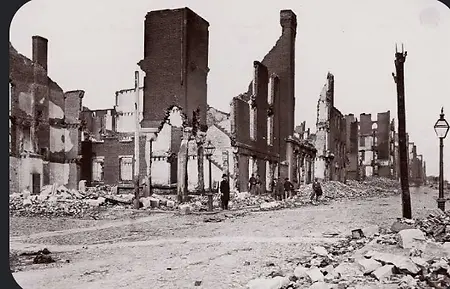
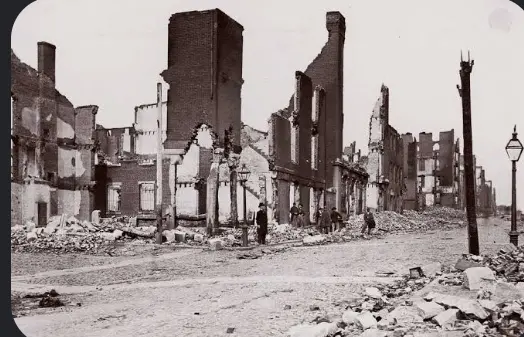
1864/65 – As commanding general, Grant appoints his friend, long-time colleague, and trusted field commander, William Tecumseh Sherman, as one of his advisors and most trusted subordinates. Sherman had an idea: “to make Georgia howl,” as he put it (he restated this in his memoirs). This is better known as Sherman's March to the Sea. With both Lincoln's and Grant's permission, Sherman started out by turning most of Atlanta into smoldering ruins on their way out of town. Sherman's march carried his troops from the captured city of Atlanta to Savannah, and from Savannah to the Carolinas, covering a distance of more than 300 miles in two massive army groups (Sherman's Army of the Tennessee, the Army of Georgia, and a cavalry brigade to support the army groups as they marched), with at least 60,000–62,000 troops in total. This was a scorched-earth campaign reminiscent of modern battles. Sherman targeted infrastructure, both civilian and military. He knew the only way to end the war was to bring the conflict to an irrevocable and speedy, yet favorable, conclusion as soon as possible. On December 21, the city of Savannah, Georgia, surrendered, and Sherman sent President Lincoln a telegraph informing him of his “Christmas gift, the city of Savannah.” (Yes, that is a direct quote taken from Sherman's letter to President Lincoln, informing the president of the taking of Savannah and calling the city a Christmas gift. Suffice it to say, Lincoln was elated and apologized profusely for his hesitation in granting Sherman leave to execute the campaign. This letter is currently on display in the National Archives in Washington, D.C.) When Confederate cavalry general Joseph E. Johnston surrendered to Sherman in April 1865, he had privately said of Sherman's army, “No finer army has existed since the time of Julius Caesar.”
End Results of the March to the Sea
The March to the Sea was devastating to Georgia and the Confederacy, and it was intended to be so. Sherman himself estimated that the campaign had inflicted $100 million (equivalent to $1,079 million in 2026 dollars) in destruction, about one-fifth of which “inured to our advantage,” while the “remainder is simple waste and destruction,” according to after-action reports from Sherman. The Army wrecked 300 miles of railroad, numerous bridges, and miles of telegraph lines. It seized 5,000 horses, 4,000 mules, and 13,000 head of cattle. It confiscated 9.5 million pounds of corn and 10.5 million pounds of fodder and destroyed uncounted cotton gins and mills, damaging Southern infrastructure.
1864/65, cont. – Capture of Columbia, South Carolina. The burning of the city, known as the “heart of secession,” is debated by historians to this day, particularly regarding which side caused the large number of fires. The myth of General Sherman lighting the fires and burning the city is, to be frank, Lost Cause propaganda. The destruction was immense, but not needlessly so, as Southerners would have people think. You must understand that much of what Sherman is known for is misconstrued, taken out of context, or often blown up with hyperbole. Sherman understood that the only way to end the war decisively was through overwhelming firepower and destruction. This is what many modern-day military scholars and historians recognize as the concept of total war. It wasn't honorable, chivalric, or “glorious,” as the Napoleonic style of warfare was thought to be at the time. Sherman admitted this in his memoirs, but it was effective. He targeted Southern infrastructure more often than not. The same heads of cattle his armies captured and fields of grain his troops burned had been feeding General Robert E. Lee's Army of Northern Virginia for the past three years. Sherman came to regard all Southerners, civilian and military alike, as rebels and traitors to the Union. He did not actively hunt down civilians; he was not a murderer, but he knew how to end the war.
1865 – Lee's Surrender. Robert E. Lee, commanding general of the Army of Northern Virginia, officially surrenders to Ulysses S. Grant at Appomattox Court House in Virginia. Lee is unable to resupply his troops or maintain their morale, with Grant in front of him and Sherman destroying everything he was protecting behind him. With Lee's surrender, the war effectively ends. The Confederacy was simply outgeneraled in the end. It took a bit of time to find the right leaders, but the Union decisively won the war on the field of battle.
1865, cont. – Two months later, on June 19, “Juneteenth” was declared when news of the end of the war reached enslaved people in Galveston, Texas.
The Civil War ends with nearly a million Americans dead and about five years of bloodshed. Robert E. Lee's estate and lands in Arlington, Virginia, were permanently annexed as part of his parole and largely became what is today Arlington National Cemetery. His land was already involved in a dispute over property taxes, but the end of the war sealed his fate. After he surrendered, Lee went into academic life, becoming president of Washington College, now the prestigious Washington and Lee University in Lexington, Virginia. There, he supported reconciliation between North and South during Reconstruction.
Southern sympathizers must stop thinking that Southern generals were “men of the people.” They weren't.
They were extremely privileged white Southern landowning “gentlemen.” Many were either part of the planter aristocracy or career military officers, often from Southern dynasties. Any way you classify them, the Southern leaders were atrociously rich, aristocratic, and upper-class. Lee was no exception. Lee was also, contrary to favorable statements by Southern sympathizers, intensely racist. In an 1856 letter to his wife, he maintained that slavery was a great evil, but primarily because of its adverse impact on white people:
"In this enlightened age, there are few I believe, but what will acknowledge, that slavery as an institution, is a moral & political evil in any Country. It is useless to expatiate on its disadvantages. I think it however a greater evil to the white man than to the black race, & while my feelings are strongly enlisted in behalf of the latter, my sympathies are more strong for the former. The blacks are immeasurably better off here than in Africa, morally, socially & physically. The painful discipline they are undergoing, is necessary for their instruction as a race, & I hope will prepare & lead them to better things. How long their subjugation may be necessary is known & ordered by a wise Merciful Providence."
The Reconstruction Era lasted from the end of the war in 1865 to, unofficially, 1877. It was just what its name suggests: a reconstruction of what was destroyed in the Civil War. However, it was not as it appeared. The primary stated goal was to reintegrate the Southern states into the Union. The process involved defining the social, legal, and political status of nearly four million emancipated African Americans.
In reality, what had been a war conducted on the field of battle merely transitioned to the legislative chambers, as Southerners were more determined than ever to win through the passage of laws, along with social and judicial constraints, what they could not successfully win on the battlefield. President Andrew Johnson, Lincoln's successor after his assassination, was especially lenient toward the rebellious South. Once General U. S. Grant was elected president in 1868, however, Southern power was curtailed somewhat, necessitating compromises on both sides. Grant was not nearly as conciliatory as Johnson, which is likely why Johnson served only one term, but that is purely speculation. Yet this period gave rise to two elements with which we are still contending today: (1) Jim Crow and (2) the growth of the Lost Cause narrative.
In Part IV, we will delve more deeply into these issues, which directly lead to social contention today.
Thank you for reading and hopefully understanding a bit more actual history. And especially, we thank you for continuing to support Brooke In The Air Travel here at Influential Women!

Brooke is the founder and chief operator of Brooke In The Air Travel LLC, a company she formed shortly after graduate school in 2022. She holds a Bachelor’s degree in history and sociology, plus a Master’s degree in history, and has since dedicated her life to travel and unraveling the complex mysteries of flights, connections, hotel bookings, etiquette, and in general “how to travel” with the least hassle…