Anatomy & Physiology Basics
How Well Do You Know Your Body

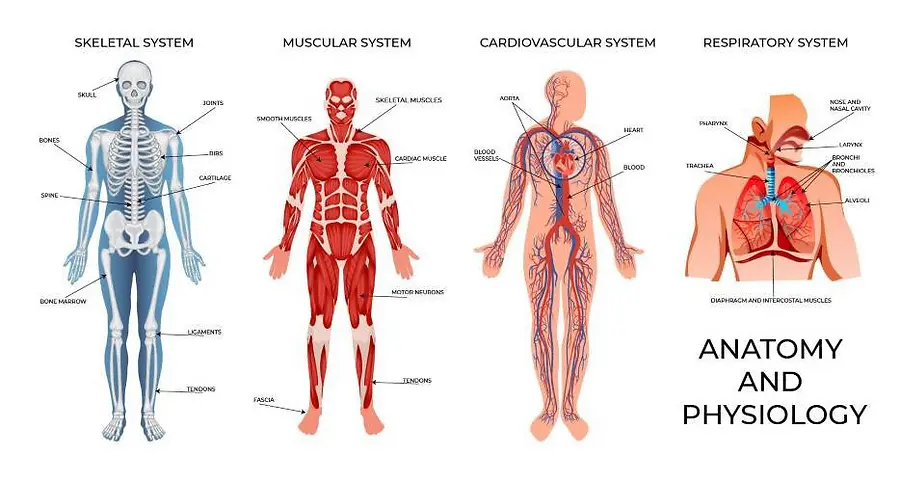
Anatomy and physiology are partner sciences that explain what the body is made of and how it works. Anatomy focuses on structure (the “parts”), while physiology focuses on function (what those parts do and how they do it).
Levels of organization
The body is organized in layers, from smallest to largest:
• Chemicals: atoms and molecules (like water, proteins).
• Cells: the basic units of life (nerve cells, muscle cells).
• Tissues: groups of similar cells working together (muscle tissue, nervous tissue).
• Organs: structures made of several tissues with a specific job (heart, lungs, stomach).
• Organ systems: groups of organs working together (digestive system, respiratory system).
• Organism: the whole human body.
Understanding anatomy and physiology means seeing how changes at one level (like cells) can affect the whole person.
Major body systems (very basic overview)
• Integumentary system: Skin, hair, nails; protects the body and helps control temperature.
• Skeletal system: Bones and joints; supports the body, protects organs, helps with movement, stores minerals.
• Muscular system: Muscles; allows movement, maintains posture, produces heat.
• Nervous system: Brain, spinal cord, nerves; controls rapid communication, sensation, and coordination.
• Endocrine system: Glands and hormones; controls slower, long‑term processes like growth and metabolism.
• Cardiovascular system: Heart and blood vessels; transports oxygen, nutrients, and wastes.
• Respiratory system: Lungs and airways; brings in oxygen and removes carbon dioxide.
• Digestive system: Mouth to intestines; breaks down food and absorbs nutrients.
• Urinary system: Kidneys, bladder, etc.; removes wastes and helps balance fluids and electrolytes.
• Reproductive system: Organs that produce sex cells and support reproduction.
Each system has its own structures (anatomy) and jobs (physiology), but they constantly interact.
Homeostasis
A core idea in physiology is homeostasis: the body’s ability to maintain a stable internal environment despite changes outside.
Examples:
• Keeping body temperature around 37°C.
• Keeping blood glucose and blood pressure within normal ranges.
Most homeostasis uses negative feedback loops: when something moves out of range, the body responds to bring it back to normal.
Basic anatomical terminology
• Position: “Anatomical position” = standing upright, facing forward, arms at sides, palms forward.
• Directions: superior (above), inferior (below), anterior (front), posterior (back), medial (toward midline), lateral (away from midline), proximal (nearer the trunk), distal (farther from the trunk).
• Planes: sagittal (left/right), frontal/coronal (front/back), transverse (top/bottom).