
Autism and Special Interests
Understanding Autistic Special Interests: Beyond Restriction to Neurocognitive Complexity and Well-Being

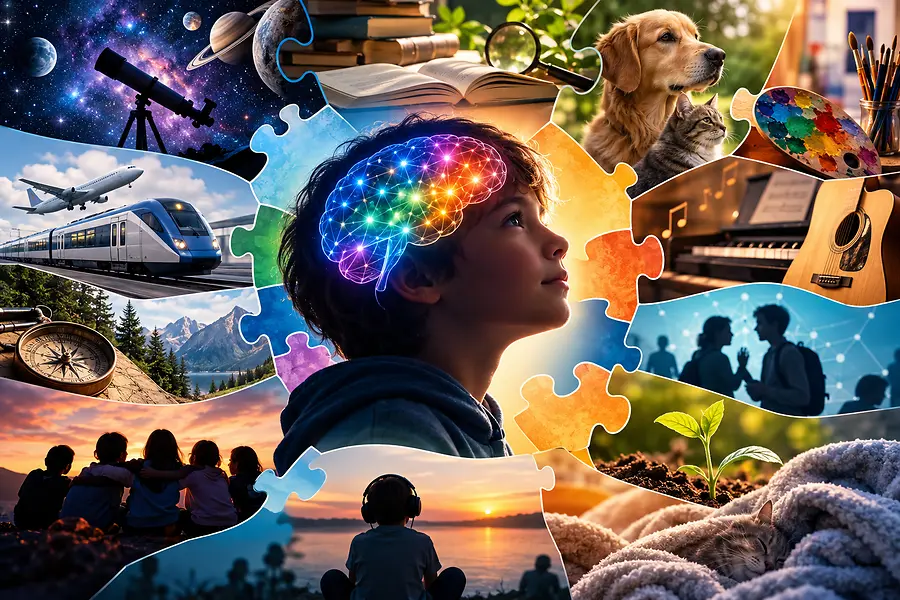
Autism Spectrum Disorder, also commonly known as ASD, is categorized as a neurodevelopmental condition characterized by differences in social communication and interaction, sensory processing, behavioral patterns, and focused or repetitive interests and activities. A frequently observed characteristic of ASD is the development of highly focused and personally meaningful interests, commonly referred to as special interests. Although special interests have historically been described primarily within the clinical framework of restricted and repetitive behaviors, contemporary understanding increasingly recognizes that they may serve important cognitive, emotional, motivational, and social functions.
Special interests can involve virtually any subject, including science, history, technology, transportation, animals, psychology, education, music, literature, fictional worlds, or highly specialized systems of information. What typically distinguishes a special interest from an ordinary hobby is not necessarily the subject itself, but the intensity, persistence, emotional significance, and degree of attention devoted to it.
This article argues that autistic special interests should be understood not simply as restricted behaviors, but as complex neurocognitive experiences that can support sustained attention, emotional regulation, learning, identity development, and social connection while also creating challenges with attentional disengagement, transitions, and competing demands when their intensity interferes with everyday functioning.
Attention, Motivation, and Cognitive Engagement
A defining characteristic of autistic special interests is their capacity to structure and maintain focus. Individuals on the autism spectrum frequently exhibit sustained concentration, thorough information gathering, precise recall, and notable perseverance when engaging with a topic of personal resonance. Conversely, completing externally assigned tasks or activities with minimal intrinsic value can present attentional challenges, contrasting sharply with the heightened cognitive absorption observed when exploring subjects of profound individual importance.
Rather than arising from oppositional tendencies, reluctant behavior, or cognitive limitations, these fluctuations in attention stem from a multifaceted interplay of executive function, neural reward mechanisms, environmental contexts, and intrinsic motivation. When environments support a natural alignment between focus and intrinsic interest, special interests frequently act as a springboard for developing deep, specialized expertise.
The Neuroscience of Special Interests
Neuroscience research suggests that reward and motivational systems may contribute to the intensity of special interests. Subjects that hold personal significance can trigger robust activation across neural networks governing motivation, reward processing, learning, and anticipation. This may help explain why an autistic individual can maintain prolonged attention toward a particular subject while experiencing significantly greater difficulty sustaining attention during activities that provide little intrinsic motivation.
Rather than stemming from a single brain region, neurotransmitter, or neural pathway, special interests emerge from a broader neurocognitive framework. Autism is neurologically heterogeneous, meaning that patterns of brain development and functioning differ considerably among autistic individuals. Special interests are viewed as arising from the dynamic interplay among multiple factors, including attentional focus, reward systems, cognitive processing, executive function, sensory engagement, predictability, and personal development.
Special Interests and Emotional Regulation
Special interests can also play an important role in emotional regulation. Autistic individuals may experience substantial sensory, cognitive, interpersonal, and executive demands while navigating environments that are not always designed around neurodivergent needs. Social uncertainty, sensory overstimulation, unexpected changes, competing demands, and sustained executive functioning can increase cognitive and emotional load.
Under these circumstances, engaging with a familiar interest may provide structure, predictability, and psychological stability. Returning to a special interest following a demanding school day, work shift, social interaction, or overstimulating environment may therefore represent considerably more than recreation. For some autistic individuals, engagement with the interest becomes a meaningful strategy for recovering from stress, reducing cognitive demands, restoring emotional equilibrium, and creating a sense of familiarity and control.
Hyperfocus, Transitions, and Attentional Disengagement
The regulatory importance of special interests may also help explain why interruption or forced disengagement can sometimes produce significant frustration or distress. When an autistic individual is deeply engaged with a personally meaningful activity, transitioning to another task may require disengaging attention from something that is simultaneously predictable, rewarding, emotionally regulating, and cognitively stimulating. The transition can place additional demands on executive processes associated with attentional shifting, inhibition, task switching, and cognitive flexibility.
The experience is sometimes informally described as hyperfocus, although hyperfocus itself is not a diagnostic criterion for autism and should not be considered a universal characteristic. From the individual's perspective, an abrupt interruption may nevertheless represent a substantial cognitive transition rather than simply being asked to stop an enjoyable activity. Advance notice, predictable stopping points, visual schedules, timers, written cues, and clear information about the activity that can be resumed may reduce the demands associated with these transitions.
Learning, Knowledge, and Intellectual Development
Special interests may additionally contribute substantially to learning and intellectual development. Repeated voluntary engagement with a subject creates extensive opportunities for information acquisition, memory consolidation, skill development, categorization, comparison, and analysis. Over months or years, sustained exposure combined with intrinsic motivation can produce considerable expertise.
An autistic child intensely interested in transportation, for example, may indirectly develop knowledge involving mathematics, engineering, geography, history, reading, classification, and systems thinking. Similarly, an adult's specialized interests may contribute to academic study, employment, creative activity, research, entrepreneurship, or advocacy. Educational environments can therefore benefit from treating special interests as potential pathways into broader learning rather than automatically attempting to suppress them.
Identity, Competence, and Psychological Well-Being
The psychological significance of special interests also extends beyond learning. They may contribute to identity, competence, autonomy, confidence, and subjective well-being. An individual who regularly encounters environments emphasizing areas of difficulty can experience an important sense of competence and mastery from possessing extensive knowledge or ability within a personally meaningful area.
A special interest may eventually become integrated into how an individual understands themselves and their relationship with the surrounding world. Importantly, an interest does not need to develop into a career, academic achievement, or economically productive activity to possess value. Enjoyment, curiosity, emotional regulation, psychological restoration, and personal meaning are legitimate outcomes in themselves.
Social Connection and Communication
Special interests can also provide pathways to social connection. The assumption that intense interests necessarily isolate autistic individuals is incomplete because shared interests can provide structured foundations for relationships and communication. Conversations centered around a common subject may contain less ambiguity than unstructured social interactions, potentially making communication more predictable and comfortable.
Interest-based clubs, professional communities, educational environments, online communities, and friendships may provide opportunities for autistic individuals to connect with others through shared knowledge and enthusiasm. Difficulties can nevertheless occur when conversational expectations differ. An individual may provide extensive information about a preferred subject without immediately recognizing subtle signals that another person wishes to change topics. Support can therefore focus on developing reciprocal communication and contextual awareness without treating enthusiasm itself as inherently inappropriate.
Stigma, Masking, and Suppression of Special Interests
Stigma surrounding autistic special interests can have important psychological consequences. Autistic individuals may repeatedly receive messages that they talk too much about a particular subject, care excessively about something, or should suppress interests that appear unusual to other people. Repeated criticism can encourage individuals to conceal enthusiasm, limit discussion of meaningful subjects, or suppress behaviors associated with their interests.
When this occurs as part of broader social masking, the individual may lose access to an activity that previously provided enjoyment, predictability, competence, and emotional regulation. A neurodiversity-informed perspective therefore distinguishes between behaviors that genuinely interfere with an individual's health or functioning and behaviors that simply differ from conventional social expectations.
When Special Interests Interfere With Daily Functioning
Recognizing the benefits of special interests does not mean that intense engagement can never create difficulties. In some circumstances, an interest may consume enough time or attention to interfere with sleep, nutrition, personal care, education, employment responsibilities, relationships, financial stability, or other essential activities. The intensity of an interest can therefore become clinically or functionally relevant when it significantly disrupts the individual's quality of life.
The appropriate question is not simply whether an autistic person has an unusually intense interest, but what function that interest serves, how the individual experiences it, and whether it supports or substantially interferes with everyday functioning. This functional approach avoids automatically labeling intensity as pathological while still recognizing circumstances in which additional support may be beneficial.
Overall, autistic special interests are best understood as complex experiences arising from the interaction of attention, motivation, reward, learning, emotional regulation, executive functioning, identity, and environmental context. Contemporary scientific understanding does not support viewing them exclusively as pathological behaviors that should be eliminated, nor should every special interest automatically be characterized as an exceptional ability. Their effects vary considerably among individuals and across environments.
For many autistic people, special interests provide significant sources of knowledge, pleasure, predictability, competence, emotional regulation, identity, and social connection. At particularly high levels of intensity, however, they may also create challenges involving transitions, attentional disengagement, competing responsibilities, or daily functioning. Effective support therefore involves preserving the meaningful and regulatory benefits of special interests while helping individuals develop strategies for managing transitions and balancing competing demands when necessary. Such an approach respects neurological differences while focusing intervention on autonomy, participation, psychological well-being, and overall quality of life.

It's my pleasure to be recognized as an Influential woman. Throughout my life, I have learned that some of our greatest challenges can become some of our greatest strengths. My journey has taken me from agricultural science to healthcare to personal growth in education, and now I’m shifting into more specialized education roles, disability advocacy, and diverse article writing topics. While my path has not always…





