B2B vs. B2C Marketing: What’s the Difference?
Understanding key strategies to connect with businesses and consumers effectively.

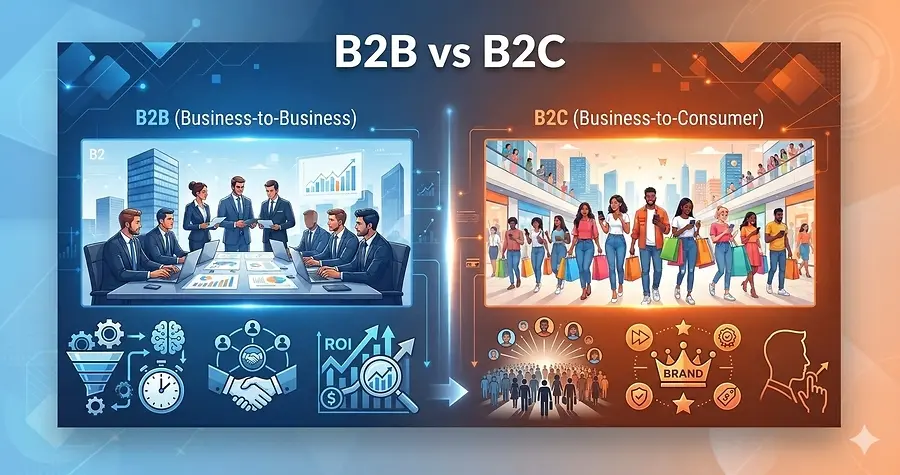
B2B vs. B2C Marketing: What's the Difference?
Choosing the right marketing approach starts with knowing your audience. B2B and B2C marketing share the same goal—connecting with customers—but often require different messaging, content, sales strategies, and relationship-building tactics. Marketing connects the right audience with the right message at the right time, but marketing to a business can look very different from marketing to an individual consumer.
This is where the distinction between B2B (business-to-business) and B2C (business-to-consumer) marketing matters.
While both strategies rely on many of the same marketing fundamentals—including strong branding, compelling content, audience research, and consistent communication—the methods behind them can differ significantly. Understanding those differences is essential for developing effective campaigns and creating relevant content.
What Is B2B Marketing?
B2B marketing, or business-to-business marketing, refers to one company promoting products or services to another business. These purchases are often complex, involving multiple decision-makers, larger budgets, longer sales cycles, and extensive research. As a result, B2B marketing focuses on expertise, reliability, efficiency, cost savings, return on investment, and long-term value.
What Is B2C Marketing?
B2C marketing, or business-to-consumer marketing, is when a company sells products or services directly to consumers. B2C purchases often happen quickly. Consumers may discover a product through social media, search, advertising, or word of mouth and decide to buy within minutes, hours, or days. B2C marketing often emphasizes emotion, convenience, price, brand identity, personal benefits, and customer experience.
Key Differences Between B2B and B2C Marketing
Although B2B and B2C marketing share many similarities, marketers should understand several important differences.
Target Audience: B2B marketing targets businesses and the professionals responsible for purchasing decisions, such as owners, executives, purchasing managers, engineers, operations teams, IT professionals, and finance departments. B2C marketing targets individual consumers, using factors such as age, income, location, interests, lifestyle, and buying behavior to define the audience.
The Buying Process: B2B purchasing decisions often involve researching vendors, comparing products, evaluating technical specifications, and obtaining approval from stakeholders. B2C buying decisions are usually more straightforward: a consumer discovers a product, may read reviews or compare prices, and then decides whether to buy.
The Sales Cycle: B2B sales cycles can take weeks, months, or longer, especially for complex or high-value purchases. B2C purchases are often much faster, sometimes happening within minutes or hours after a consumer sees an ad, visits a website, or reads a review.
The Type of Content: B2B and B2C audiences also tend to consume different types of content.
B2B buyers often want detailed information that helps them make informed business decisions, including:
- Case studies
- White papers
- Product specifications
- Industry articles
- Technical guides
- Webinars
- Demonstrations
- ROI information
- Customer testimonials
- Comparison guides
B2C audiences may respond more strongly to concise, visual formats, including:
- Short-form videos
- Social media posts
- Product photos
- Reviews
- Promotions
- Influencer content
- Email offers
- User-generated content
That does not mean B2B content needs to be boring or overly technical. Some of the most effective B2B marketing combines valuable information with engaging storytelling. The key is to provide the right information in the right format for each audience.
Emotional vs. Rational Decision-Making
B2B marketing is often described as rational, while B2C marketing is described as emotional. In reality, both involve a mix of logic and emotion.
B2B buyers may evaluate cost savings, productivity, reliability, and performance, but they also want to trust the company they choose and feel confident about post-sale support. For example, a manufacturer is not simply buying equipment; it may be choosing a supplier that could affect production, customer satisfaction, and its reputation. B2C buyers also use logic. They compare prices, read reviews, and research products before making a purchase. The difference is often how the value is communicated.
B2B example: Reduce downtime, improve productivity, and lower operating costs.
B2C example: Save time, simplify your day, and get more out of your purchase.
Both communicate value, but in different ways.
Price and Return on Investment
B2B purchases often represent a significant investment for a company.
A business may be purchasing equipment, software, consulting services, machinery, or an ongoing service contract. Because the investment can be substantial, buyers need to understand the potential return.
B2B marketers therefore need to demonstrate how a product or service can:
- Reduce costs
- Increase productivity
- Save time
- Improve efficiency
- Reduce downtime
- Minimize risk
- Increase revenue
- Improve overall performance
B2C consumers may also consider value and price, but their decisions are often shaped by convenience, personal preference, brand perception, and immediate benefits.
Customer Relationships
B2B marketing often emphasizes long-term relationships. A successful B2B customer may renew contracts, buy additional products, request ongoing services, or recommend the company to others. That makes trust and customer service especially important. B2C companies also benefit from loyalty, though the relationship may be more transactional depending on the product. For both audiences, the same principle applies: The relationship should not end when the sale is complete. Strong customer experiences can turn one-time buyers into repeat customers and brand advocates.
B2B vs. B2C Marketing: A Quick Comparison
image
Why Understanding the Difference Matters
One of the biggest mistakes a company can make is assuming that the same marketing strategy will work equally well for every audience.
A B2B manufacturer, for example, may not generate quality leads by relying exclusively on consumer-style promotions. Likewise, a B2C retailer may struggle if its marketing reads like a technical business proposal.
Effective marketing starts with understanding who you are talking to.
Before creating a campaign, businesses should consider:
- Who is the customer?
- What problem are they trying to solve?
- Who makes the purchasing decision?
- What information do they need?
- What factors influence their decision?
- How long does the buying process take?
- What does success look like for the customer?
The answers to these questions should influence everything from messaging and content to advertising channels and sales strategies.
The Lines Between B2B and B2C Are Blurring
Although the differences between B2B and B2C marketing still matter, the two approaches are becoming more similar.
Today's B2B buyers are also consumers. They expect convenient websites, personalized content, online reviews, and quick access to information in their professional buying experiences. B2B marketing can be professional while still being human, engaging, informative, and easy to understand.
The best B2B marketers recognize that they are communicating with people who have goals, concerns, challenges, and expectations—not faceless companies.
Conclusion: Choose the Strategy That Fits Your Audience
Whether your company operates in B2B or B2C, successful marketing starts with understanding your audience and the value you need to communicate.
B2B marketing typically requires education, trust-building, and proof of business value, while B2C marketing often relies more on emotion, convenience, brand experience, and personal benefits.
The strongest strategies are not defined by labels alone. They are built around how customers think, what they need to know, who influences the decision, and what motivates them to act. By understanding the differences between B2B and B2C marketing—and where they overlap—businesses can create more relevant messages, choose better channels, and build stronger customer relationships.
The best marketing strategy is not simply B2B or B2C; it reflects how your customers research, evaluate, decide, and buy.


