Before You Care for Another Patient, Remember This: You Are the First Patient
Prioritizing Your Own Well-Being as the Foundation for Compassionate Patient Care

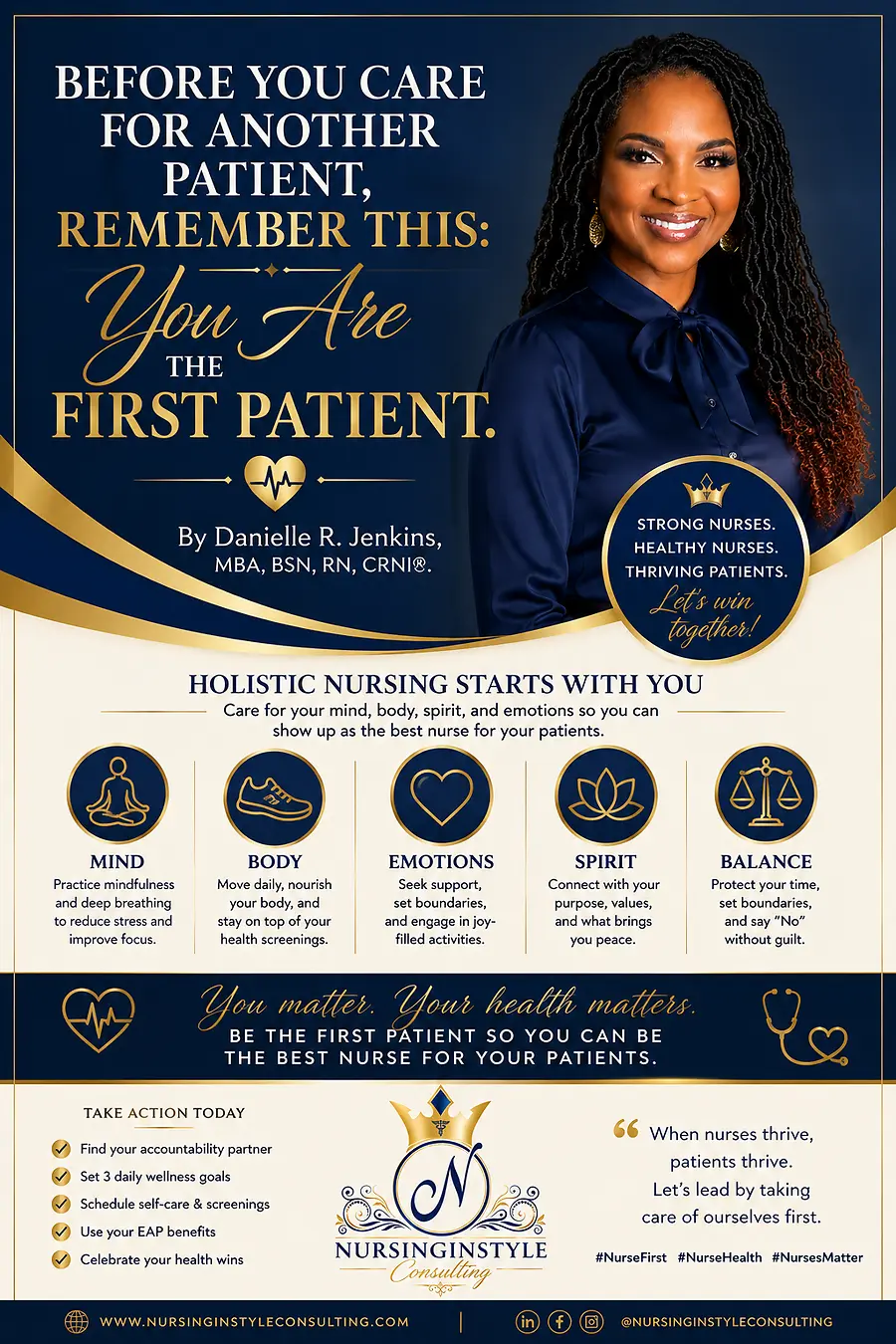
Before You Care for Another Patient, Remember This: You Are the First Patient
By Danielle R. Jenkins, MBA, BSN, RN, CRNI®
As nurses, we have dedicated our lives to caring for others. We assess, advocate, comfort, educate, and often sacrifice our own needs to ensure our patients receive the best care possible. Yet, in the midst of serving everyone else, many nurses overlook one critical patient:
Themselves.
Holistic nursing teaches us that true healthcare extends beyond physical symptoms. It is a comprehensive approach that considers the physical, mental, emotional, social, and spiritual dimensions of a person’s well-being. Holistic care recognizes that health is influenced by the continuous interaction of mind, body, emotions, and spirit. By addressing each of these interconnected dimensions, healthcare providers can promote overall well-being and support individuals in achieving their highest level of health.
As nurses, we understand these principles when caring for our patients.
The question is:
Why don’t we apply the same principles to ourselves?
The Forgotten Patient
I believe we miss the mark in holistic nursing when we fail to recognize that we are our own first patient.
Many nurses are battling physical illness, emotional exhaustion, stress, anxiety, depression, burnout, and spiritual fatigue while simultaneously caring for others. We show up for our patients regardless of what is happening within us. We push through headaches, skip meals, delay bathroom breaks, ignore warning signs, and convince ourselves that everyone else’s needs come first.
We’ve all heard the familiar safety instructions given before a flight:
“In the event of an emergency, secure your own oxygen mask before assisting others.”
Even if your child is sitting beside you.
The reason is simple:
You cannot effectively help someone else if you are unable to breathe yourself.
Yet nurses routinely ignore this principle every day.
We deprioritize our health because, somewhere along the way, we began believing that self-sacrifice was synonymous with compassion.
It is not.
In fact, caring for yourself is one of the most compassionate things you can do for your patients.
Listen to the Pings
I often encourage nurses to listen to the “pings” in their bodies.
You know the feeling:
- The headache you’ve ignored for hours
- The overwhelming fatigue you’ve been pushing through
- The anxiety sitting in your chest
- The bladder so full you can feel discomfort radiating through your lower back
These are not inconveniences.
They are messages.
Your body is communicating with you.
The question is whether you are listening.
Ironically, my first urinary tract infection occurred after becoming a nurse. I remember seasoned nurses telling me, “Don’t worry. It’ll be the first of many.”
I was shocked.
The normalization of neglecting our own basic physiological needs had become embedded in our culture.
At that moment, I made a commitment to become part of the solution.
I vowed not only to take care of myself but also to create environments where nurses under my leadership felt seen, valued, and empowered to care for themselves.
Because our health matters.
Seeing the Person Behind the Nurse
One of my favorite leadership practices is conducting a simple check-in at the beginning of meetings.
I ask people how they are feeling.
But I also observe:
Does what they are saying match their facial expressions?
Does their energy tell a different story?
I ask because I genuinely care.
I want my team members to know they are more than productivity metrics, staffing numbers, or job titles.
They are human beings.
They deserve to be seen.
They deserve to be valued.
And most importantly, they deserve permission to care for themselves without guilt.
Find Your Accountability Nurse
One of the most effective strategies I’ve implemented in my own life is having a health accountability partner.
My accountability nurse partner and I schedule our annual mammograms around the same time each year.
When one of us becomes busy and starts delaying appointments, the other provides gentle reminders until the task is completed.
Then we celebrate together.
Think about how often we celebrate our patients’ milestones:
- Improved blood pressure readings
- Weight loss goals
- Treatment completions
- Recovery
Why shouldn’t we celebrate ourselves with the same enthusiasm?
Every nurse deserves a cheerleader for their health journey.
The Reality Nurses Face
Research continues to confirm what many nurses already know.
According to Purdue Global, during the COVID-19 pandemic, 70% of nurses surveyed by HealthyNurse® reported placing the health, safety, and wellness of their patients ahead of their own.
Unsurprisingly, many also reported feeling down, sad, depressed, and emotionally exhausted.
While the pandemic may have highlighted the issue, this mindset existed long before COVID-19 and continues today.
If you don’t believe it, conduct your own self-assessment.
Ask yourself:
- Have I scheduled my annual physical?
- Am I up to date on recommended screenings?
- Have I exercised this week?
- Have I prioritized my mental health?
- Do I regularly engage in activities that replenish me?
Then ask a few nursing colleagues.
The answers may surprise you.
Applying Holistic Nursing to the First Patient
If we truly believe in holistic care, we must intentionally apply its principles to ourselves.
1. Find an Accountability Partner
Identify a trusted nurse friend, coworker, mentor, or family member who will help you stay accountable to your health goals.
Schedule screenings together.
Check in regularly.
Celebrate progress.
2. Establish Three Daily Wellness Goals
Create one goal for each dimension of wellness:
Physical: Drink adequate water, walk 20 minutes, maintain healthy blood pressure.
Emotional: Practice gratitude, journal, or engage in stress-reducing activities.
Spiritual: Pray, meditate, reflect, or spend time in nature.
Small daily actions create meaningful long-term change.
3. Embrace Complementary Wellness Practices
Holistic nursing encourages therapies that support overall well-being.
Consider incorporating:
- Aromatherapy
- Massage therapy
- Meditation
- Yoga
- Breathwork
- Mindfulness practices
In addition, commit to preventive healthcare by scheduling:
- Annual physical examinations
- Eye exams
- Mammograms
- Pap smears
- Prostate screenings
- Other age-appropriate health assessments
A Call to Action: Make Nurse Self-Care Non-Negotiable
Practice Mindfulness
Deep breathing can be completed in less than one minute.
Taking ten intentional breaths sends signals to the brain to relax, reducing stress hormones and promoting calmness.
One minute.
That’s all it takes.
And you are absolutely worth that minute.
Prioritize Physical Health
Move your body regularly through activities you enjoy:
- Walking
- Dancing
- Swimming
- Cycling
- Strength training
Then encourage others by sharing your journey using:
#NurseFirst #NurseHealth #NursesMatter
Let’s make nurse wellness visible.
Support Emotional Health
Seek support when needed.
Talk with trusted peers.
Engage a mentor.
Utilize counseling resources.
If your employer offers an Employee Assistance Program (EAP), use it.
These benefits exist for a reason.
Your emotional well-being matters.
Strengthen Spiritual Health
Connect with your beliefs, values, and purpose.
Whether through prayer, meditation, worship, reflection, or time in nature, nurture the part of yourself that provides meaning and resilience.
Protect Work-Life Balance
Learn to establish boundaries.
Remember:
No is a complete sentence.
Stop overcommitting to shifts, responsibilities, and obligations that compromise your health and well-being.
Protect your peace.
Protect your energy.
Protect yourself.
The Best Care Begins with You
The future of nursing depends on healthy nurses.
We cannot continue pouring from empty cups and expect to provide exceptional care indefinitely.
Holistic nursing reminds us that health is multidimensional and interconnected. As nurses, we must stop viewing ourselves as an afterthought and start recognizing ourselves as the first patient.
When we care for our minds, bodies, and spirits, we become stronger clinicians, more compassionate caregivers, better leaders, and healthier human beings.
Being the first patient isn’t selfish.
It’s responsible.
It’s necessary.
And it’s one of the greatest gifts we can give our patients.
Because when nurses thrive, patients thrive.
Let’s commit to winning together.
References
Purdue Global. (2023). The Importance of Self-Care for Nurses and How to Put a Plan in Place.
Tjale, A. A., & Bruce, J. (2007). A concept analysis of holistic nursing care in paediatric nursing. Curationis, 30, 45–52.


