BEYOND WILLPOWER
Why Intelligent, Accomplished Women Struggle with Food—and How Understanding, Not Willpower, Offers Real Freedom

On paper, it sounds straightforward. Yet countless intelligent, educated, high-achieving women continue to struggle with their weight, eating habits, and body image despite extraordinary success in every other area of life.
They lead organizations, raise families, manage teams, earn advanced degrees, and navigate complex professional responsibilities. They are strategic, resilient, and highly capable. Yet when conversations turn to food and weight, many find themselves trapped in a frustrating cycle of self-blame.
The problem is not a lack of intelligence.
The problem is not a lack of motivation.
And in many cases, the problem is not even food.
Emerging conversations in nutrition, behavioral health, and integrative wellness are revealing something many women have suspected all along: sustainable health is far more complex than calories, meal plans, or willpower alone.
A growing body of evidence and clinical experience points toward a more holistic truth. Our genetics, biology, stress levels, emotional well-being, life experiences, and relationship with ourselves all influence our eating behaviors and long-term health.
For professional women seeking meaningful answers, this shift offers something diet culture never could—freedom.
Traditional weight-loss programs tend to assume every body works the same way. If someone follows the plan, success is expected. If they don't achieve the desired outcome, the assumption is often that they simply weren't committed enough. Today, medication is offered to help fill the gap.
But real life tells a different story.
Some women naturally feel satisfied after a small meal. Others experience stronger hunger signals. Some individuals easily maintain their weight with little effort, while others must be highly intentional about nutrition and physical activity to achieve similar outcomes.
Genetics play a significant role in these differences.
Research continues to demonstrate that factors such as metabolism, appetite regulation, body composition, insulin sensitivity, and food preferences are influenced by genetic predisposition.
This doesn't mean we are powerless.
Rather, it means that effective wellness begins with understanding the body we have, rather than constantly fighting for the body we wish we had.
The most successful health journeys occur when women learn how their unique biology works and build sustainable habits based on that knowledge.
Instead of asking:
"Why can't my body respond like everyone else's?"
A more productive question becomes:
"What does my body need in order to thrive?"
That subtle shift changes everything.
Even when biology is acknowledged, another critical factor often remains unaddressed: emotion.
Many women know the experience firsthand.
A stressful day ends with an evening of mindless snacking.
A difficult conversation triggers an intense craving for comfort foods.
A celebration becomes an excuse to abandon healthy intentions.
A period of loneliness, burnout, or overwhelm leads to eating that has little to do with physical hunger.
For years, these behaviors have been labeled as failures of discipline.
But what if emotional eating is actually information?
What if it is a signal rather than a flaw?
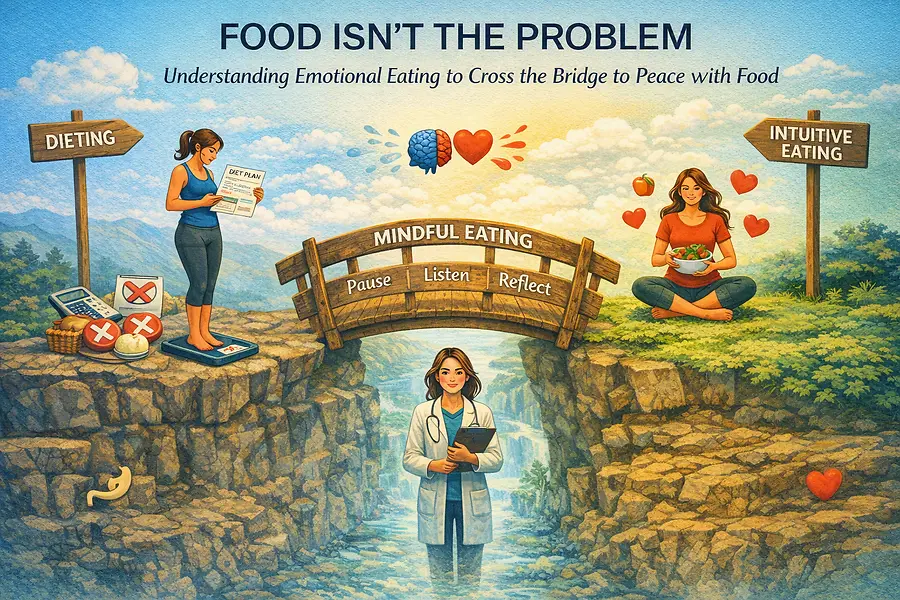
These are questions I explored in my new book, Food Isn't the Problem: Understanding Emotional Eating and Crossing the Bridge to Peace with Food. The book encourages readers to examine what lies beneath eating behaviors and challenges the assumption that food itself is the root issue.
Emotional eating often reflects deeper experiences such as stress, anxiety, loneliness, sadness, anger, fear, or overwhelm. Food can become a coping mechanism that provides temporary comfort or distraction when emotions feel difficult to manage.
Food is often the symptom.
The underlying emotional struggle is the cause.
Professional women face a unique set of pressures.
They are frequently expected to excel in multiple roles simultaneously:
- Executive
- Manager
- Entrepreneur
- Partner
- Mother
- Caregiver
- Community leader
Achievement becomes a way of life.
The challenge is that this mindset can unintentionally create unrealistic expectations around health. Many successful women approach wellness the same way they approach their careers:
Set the goal. Create the plan. Execute perfectly. Measure results.
Unfortunately, the human body rarely cooperates with a perfectionist strategy. Life happens.
Stress increases. Sleep suffers. Hormones fluctuate. Unexpected challenges arise. When perfection becomes impossible, many women interpret normal setbacks as personal failures.
The resulting shame often drives behaviors that create even greater frustration. This is where emotional eating frequently enters the picture. Food offers temporary relief from pressure.
Not because someone lacks self-control.
Because they are human.
One of the most valuable concepts in emotional eating recovery involves learning to distinguish between physical hunger and emotional hunger.
Physical hunger develops gradually. It is often accompanied by physical sensations such as stomach hunger, low energy, or decreased concentration. Most foods sound appealing when physical hunger is present.
Emotional hunger behaves differently. It appears suddenly. It often feels urgent. Specific foods become intensely desirable. The craving is less about nourishment and more about emotional regulation.
Learning to recognize this distinction creates an opportunity for awareness.
Instead of automatically responding to every craving with food, women can pause and ask:
"What am I feeling right now?"
"What happened before this craving appeared?"
"What do I actually need?"
These simple questions can reveal powerful patterns.
One of the most transformative ideas in Food Isn't the Problem that I have seen play out with client after client is the value of replacing self-judgment with curiosity. Rather than asking, "What's wrong with me?" learning to ask, "What am I needing right now?"
This approach may sound simple. In practice, it can be life-changing. Many women have spent years battling themselves. Criticizing themselves. Judging themselves. Monitoring every bite. Starting over every Monday. Promising that the next diet will finally be the one that works.
Yet self-criticism rarely produces long-term change.
Curiosity does.
Curiosity creates understanding. Understanding creates awareness. Awareness creates choice. And choice creates freedom.
The goal is not to eliminate every struggle with food.
The goal is to respond differently when struggles arise.
The future of nutrition is moving away from rigid food rules and toward a more comprehensive view of health.
Modern wellness embraces multiple dimensions:
Nutrition
Balanced eating patterns that support energy, health, and satisfaction.
Emotional Health
The ability to recognize, process, and respond to emotions in healthy ways.
Stress Management
Developing tools beyond food to cope with life's challenges.
Sleep
Supporting recovery, appetite regulation, and overall well-being.
Movement
Finding enjoyable physical activities that enhance quality of life.
Self-Compassion
Treating ourselves with the same grace we extend to others.
This broader perspective acknowledges something important. A healthy relationship with food may be just as valuable as the food choices themselves.
One of the greatest lessons I have learned in my own life, and that has driven me in a non-diet clinical practice, became the book's central metaphor: a bridge. The bridge of mindful eating takes you from the prison of chronic dieting to the freedom of intuitive eating by mastering mindfulness skills.
On one side exists the painful cycle of emotional eating, self-judgment, frustration, and repeated attempts to control food through willpower. On the other side lies greater awareness, self-compassion, understanding, and peace with food.
Crossing that bridge requires understanding rather than perfection.
This message resonates deeply with many people, especially women, because most have already proven that they can work harder.
The real question is whether working harder is actually the answer.
Perhaps what is needed is not more discipline.
Perhaps what is needed is more understanding. More awareness. More self-compassion. More willingness to listen to the body's messages.
For too long, success in health has been defined primarily by a number on a scale. But women's lives are richer and more complex than a single metric.
What if success looked like:
- More energy throughout the day?
- Less obsession with food?
- Greater confidence?
- Better sleep?
- Improved emotional resilience?
- Freedom from guilt after eating?
- Trust in your body's signals?
- Sustainable habits that fit real life?
These outcomes may not always generate dramatic before-and-after photos. But they create something far more meaningful: lasting well-being.
And for many women, that is the transformation they have been searching for all along.


