Bridging Food Science and Biotechnology: Shaping the Future of Sustainable Food
How food science and biotechnology can reshape sustainable food production for a growing global population.

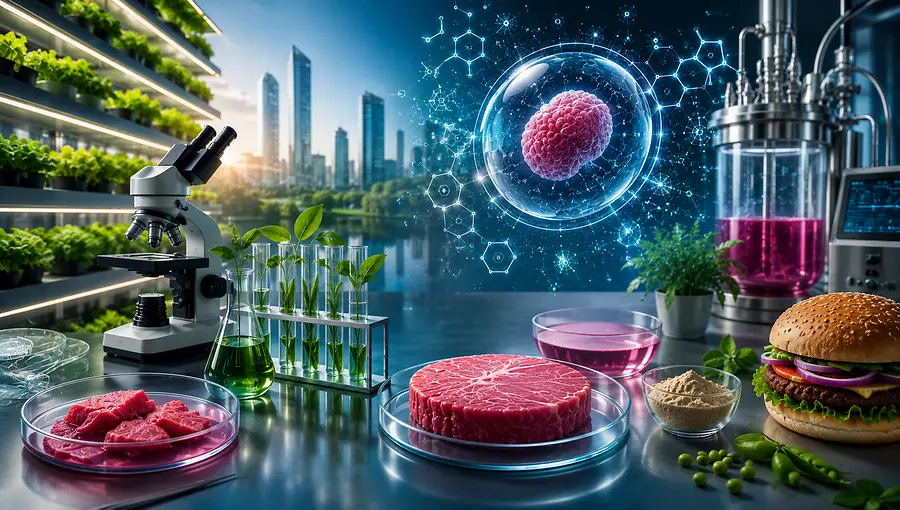
Bridging Science and the Future of Food
Food is more than a basic necessity. It connects health, culture, science, the environment, and our quality of life. Yet the way we produce food is facing increasing pressure from population growth, resource limitations, environmental concerns, and the need to provide nutritious and accessible food to a growing global population.
Throughout my journey in food science and biotechnology, I have become increasingly interested in what happens when these two disciplines come together. Food science gives us the tools to understand ingredients, processing, safety, nutrition, structure, and product development. Biotechnology expands those possibilities by allowing us to work with cells, biological systems, biomaterials, and new production approaches. At their intersection, I believe there is enormous potential to rethink how we produce food.
Beyond Conventional Protein Production
One of the most exciting areas of innovation is the development of alternative proteins. Plant-based foods, fermentation-derived ingredients, and cellular agriculture are creating new approaches to producing proteins and other food components.
Cellular agriculture is particularly fascinating to me because it brings together several disciplines that were once considered relatively separate: food science, cell biology, tissue engineering, biomaterials, and bioprocessing. Instead of viewing food production only through the lens of conventional agriculture, we can also ask how biological systems can be used to create food ingredients and structures in new ways.
My own research experience with cell culture and food-grade biomaterials has strengthened my belief in the importance of this multidisciplinary approach. For example, biomaterials can provide structures that support cellular attachment, growth, and organization while also contributing to the properties needed for a food application. This illustrates how concepts developed across different scientific disciplines can converge around a common challenge.
From Scientific Possibility to Practical Reality
Scientific innovation, however, is only the beginning.
A technology can perform beautifully in a laboratory and still face significant barriers before becoming a successful food product. Scalability, manufacturing efficiency, cost, food safety, regulatory requirements, nutritional quality, sensory properties, and consumer acceptance all influence whether an innovation can move from scientific concept to practical application.
This is where I believe the connection between traditional food science and emerging biotechnology becomes especially important. We should not think of new technologies as replacements for everything we already know about food. Instead, we can combine decades of knowledge in food processing, formulation, quality, and manufacturing with advances in biotechnology.
Having worked across both food manufacturing and biotechnology research has shaped the way I view innovation. Scientific discovery is exciting, but its real impact emerges when we can translate it into something practical, reproducible, scalable, and ultimately useful to people.
Sustainability Requires More Than One Solution
There is unlikely to be a single technology that defines the future of food. Different regions, populations, products, and supply chains have different needs.
For that reason, I see the future as a combination of approaches. Conventional agriculture will continue to play an essential role, while plant-based proteins, fermentation, cellular agriculture, improved food processing, and other emerging technologies may complement existing systems.
The goal should not simply be to create something because it is technologically possible. Innovation should address meaningful needs. Can we use resources more efficiently? Can we improve nutritional value or product functionality? Can we reduce waste? Can we build more resilient food-production systems? And, importantly, can we make these innovations accessible rather than limiting them to a small segment of society?
These are the questions that make sustainable food innovation both challenging and exciting.
Turning Curiosity Into Impact
For scientists entering this rapidly evolving field, technical expertise is essential, but so are curiosity, collaboration, and the willingness to cross disciplinary boundaries. Some of the most interesting opportunities emerge when we stop viewing food science, biotechnology, engineering, and cell biology as isolated fields.
I believe the next generation of food innovation will increasingly be shaped by scientists who can communicate across these disciplines and translate discoveries between the laboratory, manufacturing environment, and consumer product.
For me, that is what makes this field so meaningful. The future of food is not simply about creating new technologies. It is about using science thoughtfully to create solutions that are sustainable, practical, and capable of improving how we produce and experience food.
Bridging food science and biotechnology is one pathway toward that future—and we are only beginning to explore what may be possible.


