
Burnout Doesn't Always Look Like Collapse. Sometimes It Looks Like Your Best Quarter.
Why Rising Effort Is Your Most Honest Warning Signal—and What to Do Before It's Too Late

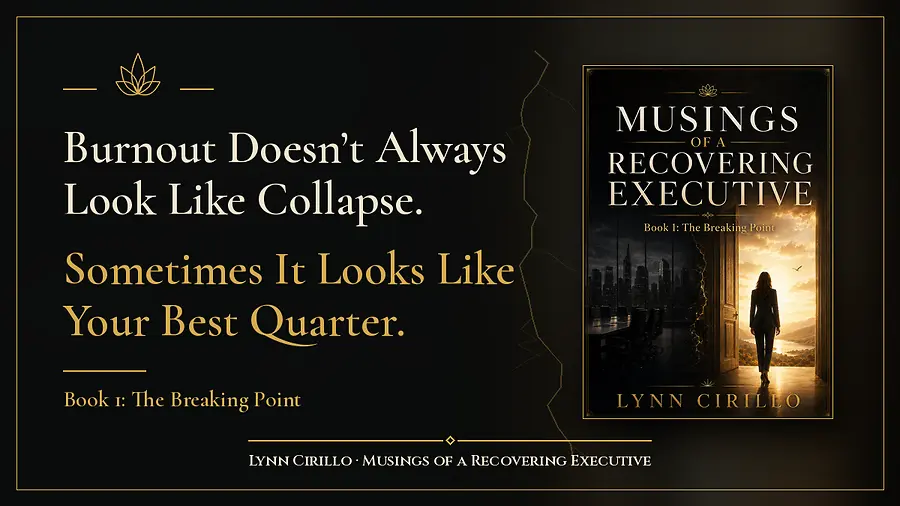
Why working harder is the last signal to fail, and the first one we should learn to question.
By Lynn Cirillo
Most of us carry a picture of burnout that looks like a crash. Someone stops answering email. Deadlines slip. A capable person suddenly can't get out of bed, walks out, or breaks down in a meeting.
That picture isn't wrong. It's just late.
For me, burnout never looked like that. It looked like showing up. It looked like delivering. It looked like more effort, poured into the same work, for less and less return. From the outside, nothing looked broken. Some of my most "successful" stretches on paper were the ones that were costing me the most.
In The Breaking Point, I wrote: "Burnout does not always arrive as collapse. Sometimes it arrives as persistence without relief."
I want to make the case that this is the version most organizations are worst at seeing and most individuals are best at hiding, often from ourselves.
Validation First: Your Results Don't Cancel Your Exhaustion
Before anything about systems or leaders, I want to speak to you directly, whoever you are and wherever you're doing your work.
Maybe you're the reliable one on your team. Maybe you're running a household, caring for a parent, finishing a degree at night, or holding a volunteer board together with tape and good intentions. Maybe you're early in your career and assume this level of tired is simply the price of entry.
If you're still functioning, still delivering, and something still feels wrong, I want to offer some validation: you are not imagining it. Exhaustion that doesn't resolve with rest is real, even if your results look fine. You don't need a crisis to earn the right to take it seriously.
Here's the line from my book I most wish someone had said to me years earlier: "Burnout, as I experienced it, was not a failure of resilience. It was the result of applying resilience to conditions that no longer deserved it."
Read that again if you need to. Your resilience isn't the problem. Where it's being spent might be.
Why Effort Is the Last Thing to Fail
Effort was always my answer. When something felt heavy, I leaned in. I refined. I worked harder. For a long time, it worked.
Then it gradually didn't. Not all at once. The return got smaller. As I wrote in Book 1, "Progress became maintenance." The results were still there, but nothing moved. "Effort no longer translated into movement." And honestly, "that disconnect was harder to tolerate than exhaustion itself."
Here's what makes this pattern so hard to catch: capable people have more effort in reserve than almost anyone. So when conditions get worse, we spend more. Output stays steady. And steady output is exactly what most organizations are watching.
There's a harder truth underneath it, too. "Effort can become a way to avoid deeper questions." As long as I was working harder, I didn't have to ask whether the work still fit or whether the environment still supported the way I wanted to lead. Busyness postponed the reckoning. I still catch myself doing it. Old habits surface, and pushing through still feels safer than pausing some days. The difference now is that I notice sooner.
What Organizations Get Wrong
They set the alarm for collapse. If your early warning system is falling performance, your most capable people will trip it last, sometimes on their way out the door. "Most organizations are measuring activity," I wrote. "Very few are measuring health."
They answer burnout with more resilience. Training people to endure more doesn't change the conditions they're enduring. It applies resilience to conditions that don't deserve it, which is the very thing that wore people down. Rest alone, I learned, "would not solve what was structural."
They celebrate the people who push through. We praise the person who made it work no matter what. We ask far less often why making it work required so much. When systems rely on exceptional individuals to function, they aren't strong. They're fragile.
They judge success in the moment. A quarter can look outstanding while the people producing it are quietly depleting. I came to see how performance could rise while well-being declined. "Time reveals what metrics conceal."
The Effort Signal Check
The shift I'm proposing is simple to say and hard to practice: treat rising effort as a signal, not as a solution. Before anyone pushes harder, whether that's you or someone you lead, run the Effort Signal Check.
Four signals to watch
- The Effort-Return Gap. More hours, more energy, and more workarounds are going in, but nothing is moving. Activity stays high while progress turns into maintenance.
- Recovery Drift. Recovery takes longer after every push. In my own case, my body noticed before my mind did. Tension lingered. I caught myself "bracing instead of engaging."
- Permanent Urgency. Every week is the exception. When "just this once" has lasted a year, it's no longer a sprint. It's a design.
- Repeated Work. The same problems get solved again and again. That's often a sign that someone's effort is compensating for something no one has fixed.
Three questions to ask before pushing harder
These are adapted from The Breaking Point, and they work for individuals, teams, and whole organizations:
- What is this effort protecting? A deadline? A reputation? Someone else's comfort? An old idea of who you have to be?
- What is it sustaining? A process that should be redesigned? A role that no longer fits? A gap leadership hasn't funded?
- What is it preventing us from seeing? This is the one that matters most. Effort is very good at keeping us too busy to notice what's actually wrong.
When effort finally stopped working for me, I eventually understood that "it was not betraying me. It was telling the truth." The Effort Signal Check is a way to hear that truth before it costs as much as it cost me.
What This Looks Like in Practice
- Add one question to one-on-ones. "Where are you working harder this month for the same result?" Then listen without rushing to reassure or fix.
- Track recovery, not just output. After a big launch, close, or crisis, notice how long it takes people to return to normal. If that time keeps stretching, the pace is the problem, not the people.
- Retire "pushed through" as the highest compliment. When someone rescues a project, thank them, and then ask what made the rescue necessary. Fix that.
- Ask what actually changed. In quarterly reviews, alongside "how much got done," ask "what actually changed?" Look for repeated work and maintenance dressed up as progress.
- Judge wins over time. Revisit big results six months later. Did they hold? Did the people who produced them?
- Fix conditions before adding support. A wellness benefit is not a substitute for a realistic workload. As I wrote, "People are accountable for how they show up. Leaders are accountable for what they ask people to show up to."
Questions to Sit With
For anyone:
- Where am I working harder for diminishing returns?
- What signals has my body been offering that I keep dismissing?
- What might my effort be keeping me from looking at?
For anyone who leads:
- Would my early warning system catch burnout in my most reliable person, or only after they're gone?
- Which of our wins depended on someone pushing through, and have we ever asked why?
- What would we see if we measured health as carefully as activity?
Effort Is Information
I still believe in hard work. I still care about results. What changed is how I read effort. It isn't a bottomless resource or proof of commitment. It's information, and it's often the most honest information we have.
If you're tired in a way rest doesn't touch, you don't have to wait for a collapse to listen. And if you lead others, you don't have to wait for one to act. "Supportive environments do not depend on heroes. They depend on design."
I explore burnout without collapse, the cost of high performance, and what it takes to stop proving and start listening in The Breaking Point, Book 1 of my Musings of a Recovering Executive series. Every chapter ends with Questions for Reflection to work through slowly. You can learn more at https://MusingsOfaRecoveringExecutive.com/the-book/, and about all six books at https://MusingsOfaRecoveringExecutive.com/the-series/.
About the Author
Lynn Cirillo is an author, leadership mentor, and founder of Grounded Leadership LLC, based in Cheyenne, Wyoming. A former executive vice president who oversaw people, technology, data, research, systems, and organizational change, she spent more than three decades in corporate America and executive leadership. She lives with ADHD, OCD, and dyslexia, and writes the six-book Musings of a Recovering Executive series about leadership, identity, boundaries, reinvention, and neurodiversity. Learn more at https://MusingsOfaRecoveringExecutive.com/.

Lynn Cirillo is an author, leadership mentor, and Founder and Principal of Grounded Leadership, LLC in Cheyenne, Wyoming. She brings nearly 40 years of professional experience across commercial real estate, corporate operations, research, and technology. Her six-book nonfiction series, Musings of a Recovering Executive, explores the journey from burnout and reinvention to boundaries, identity, neurodiversity, and…





