
Caregiving Was the Training
The Intersection Nobody Named: Where Caregiving Becomes Your Greatest Business Asset

Picture a street corner. Two blue signs crossed on a pole against the sky. Both of them blank.
That is where caregiving meets entrepreneurship. Everything I want to say starts there.
Nobody Has Named That Corner
An intersection has a name. Somebody put up the sign, somebody drew it on a map, and when you tell a person where to meet you, they know where to go.
Not this one.
If you are running a business and caring for someone you love at the same time, you are standing at a corner nobody has named. There is no sign telling you which direction you are supposed to be headed, and no one is coming to put one up.
There is no playbook because nobody wrote one, and nobody wrote one because, for a long time, the women doing this work were not the women publishing.
Four Generations in One Frame
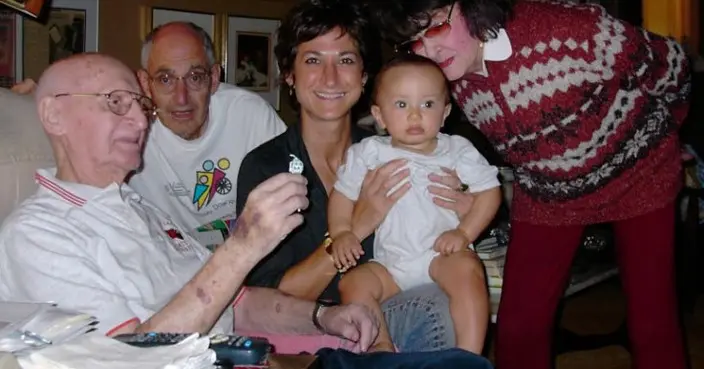
There is a photograph of four generations of my family. I am holding my son, a baby in my lap.
Around me are the generations before me, the people who took care of me. Then they grew older, and I took care of them.
I do not know what to call that exchange except a privilege. I walked each of them through the last part of their lives, and every one of those journeys was its own story, separate and particular, nothing like the others. I would not give back a single one.
I was doing it while running a business. And while raising my son as his only parent.
That is the sandwich generation, though the phrase makes it sound tidier than it is. Caregiving in two directions at once, up toward the people who raised me and down toward my child, with a law practice that needed me to show up as a lawyer the entire time.
Nobody handed me a schedule for that. There is no schedule for that.
But I want to be careful about how I say the next part, because this is not a hardship story. I was not merely surviving those years. I was inside the most meaningful work of my life, and it happened to be running alongside the rest of the most meaningful work of my life.
That is where I learned everything I know about this intersection.
What the Diagram Leaves Out
The academic research on women's entrepreneurship has a model for all of this. Three overlapping circles: societal cultural dimensions, gender role expectations and identities, and the entrepreneurial environment. Inside them, phrases like family embeddedness, social role theory, traditional gender norms, and uncertainty avoidance.
All of it is real, and I am glad researchers are naming it.
But no woman has ever gotten through a hard Tuesday by consulting a diagram.
On Tuesday, the gender role expectation is your brother assuming you will handle the doctor. Family embeddedness is your phone lighting up in the middle of a deposition. Uncertainty avoidance is you at eleven at night, deciding whether to sign the lease.
The research describes the weather. It does not tell you how to dress.
The One That Is Not a Circumstance
When I list the stressors at this intersection, they come out in this order: little to no personal time, family discord, complex emotions, feeling like a failure, cultural expectations, and taking care of yourself.
Notice where taking care of yourself landed. Last. I left it there on purpose, because that is where it actually sits.
The one I want to stay with is feeling like a failure.
That one is different from the others, because it is not a circumstance. It is a verdict.
And it is a verdict you reach by being graded on two scorecards at once, neither of which was designed with the other in view. The business scorecard gives you no credit for the hours at the hospital. The caregiving scorecard gives you no credit for making payroll.
So you look at both, come up short on both, and conclude that the problem is you.
It is not you. It is arithmetic. Two full-time scorecards, one person, and no column anywhere for what you are actually doing.
Read It as a Résumé
Here is what I have come to believe. Caregiving is not the tax you pay on your business. For a lot of us, it is the training.
Look at what the work actually demands.
- Time management, though not the calendar-app kind. The kind where you have ninety minutes and four obligations, and you triage in real time. Any operator alive would hire for that.
- Adaptability, because the plan changes at six in the morning, and you rebuild the entire day before coffee. Plenty of executives never learn that.
- Stress management, which in practice means you have learned to function while something important is unresolved. Most people cannot do that. Most businesses are permanently unresolved.
- Then there is communication. You have translated between doctors, siblings, insurers, and the person in the bed, each of whom needed a different version of the same truth. That is client work, and it is also sales.
- Financial literacy, because if you have navigated benefits, long-term care coverage, or the real cost of a placement, you have read documents most people would hand to somebody else.
- Networking, because caregivers build networks out of necessity. The nurse who calls you back. The neighbor. The aide who tells you the truth. That is relationship capital, built without a single business card.
- Problem-solving under constraint, with incomplete information, on a deadline you did not set. That describes every hard decision in business.
- Empathy, which it is fashionable to call a soft skill and which is the most commercially valuable thing on this list, because it is why clients stay.
- Leadership, exercised without any authority anyone granted you. No title, no org chart, no announcement. You decided somebody had to, and that it was going to be you.
- Vision, because you kept going when the return was uncertain and the credit was nonexistent.
Read that again and tell me it is not a founder's résumé.
Why I Do Not Use the Word Balance
This is where I part company with most of the advice aimed at women like us.
The advice says balance. Balance implies a scale. Two sides, a correct distribution, and a good day on which the pans sit level and you have won.
I have never once had that day, and I have stopped waiting for it.
What I have instead is Work-Life Being™. You are one person, not two competing accounts. The work and the love are not in a zero-sum fight over your hours. They are both just you, being. Some weeks the business gets most of it. Some weeks the person you love gets nearly all of it. Neither one is a failure of balance, because balance was never the goal.
I did not get there from a book. I got there as a sole parent building new ventures and finding the balance metaphor useless every single time I reached for it.
What I Would Ask You
There is no sign at that intersection. I cannot put one up for you.
But I can tell you what I know from standing in it. The skills you believe are keeping you from your business are the ones building it. You have simply never been handed a form on which to list them.
So make one.
Write down the ten hardest things you did last month as a caregiver. Then read them as though they were on somebody else's résumé.
And ask yourself who you would hire.
Sincerely,
Rebecca Adelman, Esq.

Rebecca Adelman, Esq., is a claims and risk management strategist, attorney, and entrepreneur whose 36-year career centers on helping organizations anticipate, manage, and prevent risk. As founder of Adelman Firm, PLLC — a certified Women's Business Enterprise she established in 2001 — she provides enterprise risk strategy, claims management, general counsel services, and litigation defense to healthcare systems,…





