Change Is the Only Constant — So Why Does It Still Feel This Hard?

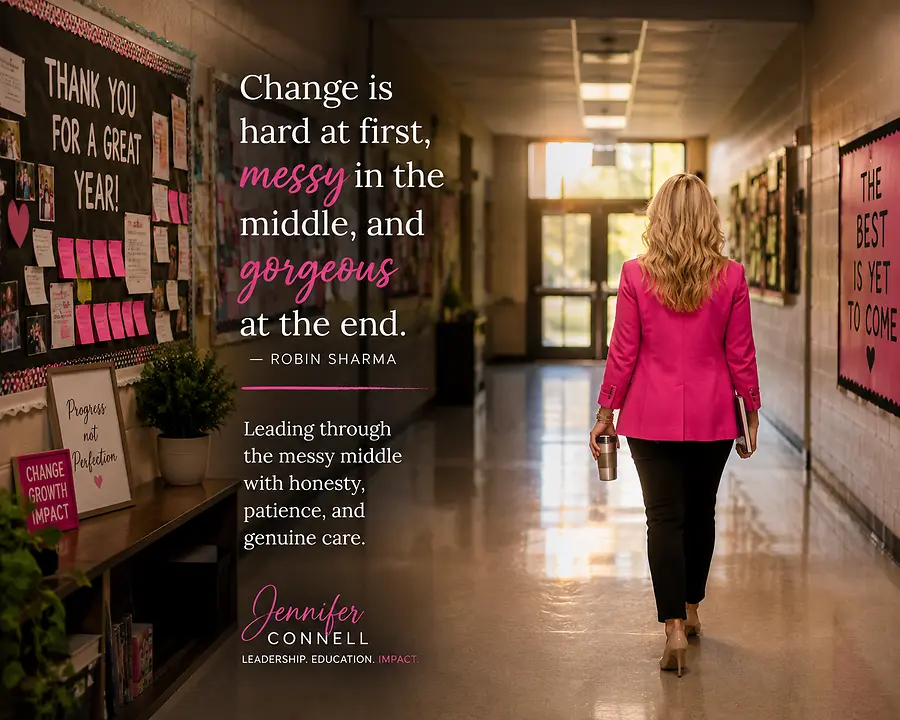
“Change is hard at first, messy in the middle, and gorgeous at the end.” — Robin Sharma
Every June, I find myself in the same reflective space. The school year is winding down, the hallways are buzzing with the particular energy that only the end of the year brings, and somewhere in the middle of celebrations and closings, there is a quieter conversation happening—one about what’s coming next.
This year, that conversation centers on a significant shift. A program that has been woven into the fabric of our district for ten years is changing. And true to form, the responses from staff have landed in three familiar places: openness, excitement, and resistance. After spending my career in schools, I can tell you this is not unique to this initiative, this year, or this district. This is simply what change looks like in human organizations.
And that got me wondering: why?
We live in change. So why does it still surprise us?
Education may be the field most defined by change. Curriculum evolves. Students change. Research shifts best practices. Leadership turns over. Technology transforms the classroom. There is no version of this work that stays still. And yet, when change is named, formalized, and directed at something people have built their practice around, the reaction is almost always the same.
I don’t think that’s a failure of leadership or a failure of staff. I think it’s deeply human.
Change, even good change, asks something of us that we rarely name out loud: it asks us to let go. When a program has existed for ten years, it isn’t just a program anymore. It is evidence of someone’s hard work. It is the thing a teacher has refined, believed in, and built part of their professional identity around. To change it is, in some small way, to ask them to grieve it first.
The three responses are all valid
When I look at the staff who are open, I see people with enough experience and security to trust the process, even when they cannot yet see the destination. When I look at those who are excited, I see people energized by possibility; they are already imagining what’s next. And when I see those who are resistant, I try to remember: resistance is rarely about the change itself. It is about what the change represents—uncertainty, loss of competence, or the quiet fear of what if I can’t do this as well?
All three responses deserve a seat at the table. Our job as leaders is not to eliminate resistance, but to understand it, honor it, and walk alongside it.
What can we do? And what do we have to accept?
I’ve spent time this spring thinking about whether there is a version of change management that prevents discomfort entirely. I don’t think there is. No amount of preparation, communication, or support will make change feel easy for everyone. Sharma is right—it will be hard at first. It will be messy in the middle.
What we can do is build the conditions that make the messy middle survivable:
- Name the loss. Acknowledge what is being left behind. Honoring the past doesn’t undermine the future—it actually makes people more willing to move toward it.
- Stay present in the discomfort. Leaders who disappear after an announcement leave a vacuum that fills with anxiety. Show up in the middle.
- Celebrate early wins, even small ones. In the messy middle, people need evidence that the change is working. Look for it and name it loudly.
- Give it time. The “gorgeous end” Sharma describes doesn’t come in month two. Trust the arc.
Closing the year, opening the question
As we head into summer, I’m not walking away with a tidy answer to why change is hard. I’m walking away with a deeper appreciation for how hard it is—and that this is not a problem to be solved, but a reality to be led through with honesty, patience, and genuine care for the people doing the work.
The change ahead is worth it. So are the people who will carry it forward—even the ones who need a little more time to get there.



