Climate Goals vs. Reality
The Energy Gap We Can No Longer Ignore

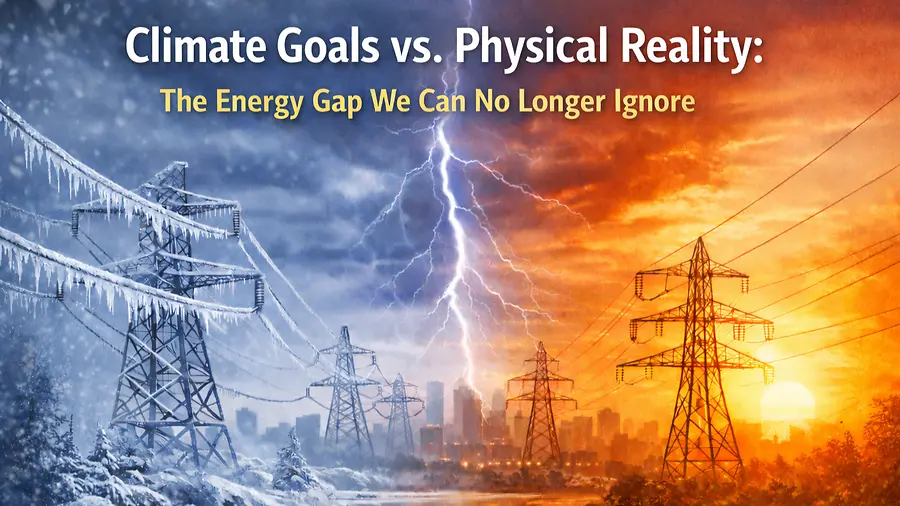
For more than a decade, governments, corporations, and international institutions have rallied around ambitious climate targets. Cut emissions in half by 2030. Reach net zero by 2050. Transition to clean energy fast enough to avert the worst impacts of global warming.
These goals are well-intentioned—and they are grounded in sound climate science.
But climate science, on its own, is only half the equation. The other half is physics. And physics does not negotiate.
The Demand We Didn’t Plan For
Global electricity demand is no longer rising gradually. It is accelerating. Transportation, heating, and industry are electrifying at unprecedented speed. Artificial intelligence and data centers are adding enormous, round-the-clock loads to power systems. Developing nations are increasing electricity use as living standards rise—rightly expecting reliable power, not rolling outages.
In short, we are asking the global grid to do far more, while simultaneously demanding that it emit far less.
That tension is no longer theoretical. It is already shaping real-world outcomes.
When Targets Meet the Real World
Wind and solar power have grown rapidly, and they will continue to play an important role in reducing emissions. But they are weather-dependent by design. They do not produce electricity on demand, and they cannot reliably meet sustained, high-density power needs without massive backup systems.
Energy storage helps—but today’s batteries are designed for hours, not days or weeks. They cannot carry power systems through prolonged cold snaps, heat waves, or low-wind periods. They cannot replace firm generation when electricity is needed most.
Many climate plans quietly assume these limitations will be solved later. Physics does not work on assumptions, aspirations, or promises.
Extreme Weather Is the Stress Test
This reality became painfully clear during the recent wave of extreme cold across the United States.
Recently, at least 150 deaths had been attributed to the extreme cold system that affected roughly 200 million people across two-thirds of the country. Tennessee, Mississippi, and New York were among the hardest-hit states. Hundreds of thousands of residents lost power—some for days—during life-threatening temperatures.
The causes of death tell a sobering story: hypothermia, carbon monoxide poisoning from unsafe heating during outages, fatal vehicle accidents on icy roads, falls, cardiac emergencies triggered by physical strain in extreme cold falls, and at least one fatal small plane crash.
These were not just weather disasters. They were energy failures under stress.
A System Built for a Climate That No Longer Exists
For most of the last century, the U.S. energy system was designed around a relatively stable climate. Seasonal patterns were predictable. Infrastructure was engineered for known temperature ranges and familiar extremes.
That climate no longer exists. Human-caused global warming is destabilizing long-standing weather patterns, producing what scientists increasingly describe as weather whiplash: rapid swings between extreme cold and extreme heat, severe ice storms, flooding rains, drought, and wildfire conditions.
Each swing places new strain on systems never designed for such volatility.
Extreme cold pushes electricity and natural gas systems to their limits as heating demand spikes. Power plants not engineered for sustained freezing conditions fail. Fuel supply chains break down. Solar panels are covered in snow. Wind turbines ice over. Transmission lines sag or snap under heavy ice loads.
Extreme heat brings a different—but equally dangerous—set of challenges. Electricity demand surges as air conditioning becomes essential for health and survival. Power plants lose efficiency. Cooling water becomes warmer or scarce. Transmission lines overheat and lose carrying capacity. Blackouts become more likely precisely when electricity is most needed.
None of this is hypothetical. We have seen these failures repeatedly, across regions and seasons.
Reliability Is a Life-and-Death Issue
Electricity systems are not abstract models. They power hospitals, water treatment plants, communications networks, food storage, and homes during extreme heat and cold.
When grids fail, the consequences are immediate and unevenly distributed. The elderly, the sick, caregivers, and families without access to backup power face the greatest risk. Outages last longer. Recovery takes more time. And the human cost rises.
A decarbonized energy system that cannot reliably meet demand is not a climate solution. It is a humanitarian risk. This is why energy reliability is not just a technical concern—it is a public safety issue. And increasingly, it is a women’s issue, because women so often bear responsibility for caregiving, household resilience, and community response when systems fail.
What the Grid Warnings Are Telling Us
This gap between climate ambition and physical reality is no longer subtle. Grid operators and federal energy analysts are issuing increasingly blunt warnings about reliability risks driven by rising demand, power-plant retirements, and insufficient firm capacity.
In several U.S. regions, reserve margins are tightening just as electricity use is accelerating—particularly from data centers, electrification, and extreme weather.
These warnings are not ideological. They are operational. They reflect a simple truth: electricity must be available when it is needed—not only when conditions allow.
Ignoring these signals does not advance climate progress. It delays corrective action until systems fail under stress.
The Missing Piece in the Climate Conversation
What remains surprisingly absent from many climate discussions is serious attention to firm, clean, always-available power—electricity that does not depend on weather, time of day, or season. This is where nuclear energy matters.
Modern nuclear power provides large amounts of electricity continuously, with near-zero carbon emissions during operation. It operates independently of weather, requires a relatively small physical footprint, and delivers capacity factors far higher than intermittent sources.
Equally important, nuclear power has one of the strongest safety records of any energy source when measured by deaths per unit of electricity generated—far safer than fossil fuels and comparable to, or safer than, many renewables when full system impacts are considered.
These are not theoretical claims. They are established facts, explored in depth in my award-winning book ATOMIC GREEN: Nuclear Power Can Stop Climate Change, and increasingly reinforced by the realities now confronting our energy systems.
A Reality-Based Path Forward
There is no realistic path to deep decarbonization without energy sources that:
- operate 24/7
- scale to meet rising demand
- stabilize the grid
- and produce minimal greenhouse gas emissions
Safe, clean nuclear power meets all of these requirements.
This does not mean abandoning renewables. Wind and solar play valuable roles in reducing emissions. But they work best as part of a balanced system—one anchored by firm power that keeps the lights on when the weather does not cooperate.
Climate strategies that exclude nuclear power are not bold. They are incomplete.
Climate Responsibility, Not Retreat
Acknowledging physical constraints is not climate denial. It is climate responsibility.
We do not need fewer climate goals. We need plans capable of delivering them—plans grounded in physics, engineering, reliability, and human needs.
The climate challenge is no longer about setting targets. It is about building energy systems that can actually reach them—safely, cleanly, and reliably. And that requires bringing nuclear power back into the climate conversation where it belongs: not as a last resort, but as a cornerstone of a livable, resilient, decarbonized future.