"Communication Is Key" Is the Worst Advice You Have Ever Been Given
Why Better Words Won't Fix Your Recurring Arguments—It's What You're Really Fighting About

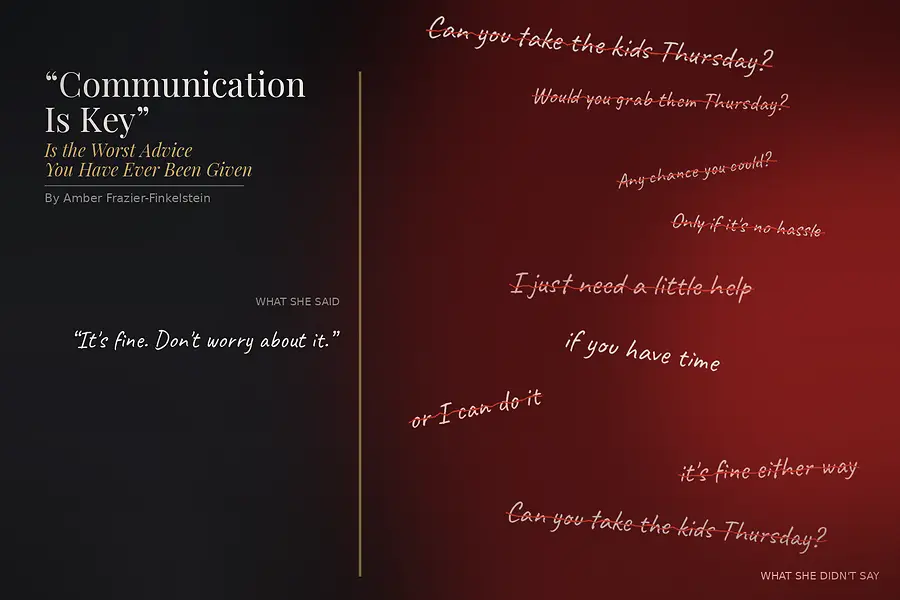
"Communication Is Key" Is the Worst Advice You Have Ever Been Given
By Amber Frazier-Finkelstein
Every woman I know has been told that communication is the key to her relationships, her marriage, her team, and her sanity. It is the advice on every podcast, in every workshop, in every HR training, and on every wedding card.
It is also the reason most of us keep having the same argument.
It is Tuesday. The dishwasher is full. You ask your partner if they can unload it.
They say, "I'll get to it."
You say, "You said that yesterday."
They say, "Why are you starting?"
Forty minutes later, you are no longer talking about the dishwasher. You are talking about last weekend, the in-laws, who said what at dinner in March, and the toilet paper roll.
Nobody knows how you got there. Both of you are convinced the other person started it.
You did not have a communication problem.
You had this same argument in November. And in August. And the Tuesday before that.
What were you thinking when the dishwasher conversation started?
Not about the dishwasher.
The same thing happens when an issue keeps coming up at work. The one-on-one that keeps getting tense. The project that keeps stalling. The person who goes quiet in the same kind of meeting. The conversation you have had with the same direct report three times this quarter.
The topic changes.
The reaction does not.
Here is what most people miss:
The topic is the costume. The argument is what is wearing it.
You keep trying to fix the costume.
"Communication is key" is the worst advice you have ever been given because it sends you back into the same conversation with better wording. It tells you to use "I" statements, softer tones, and active listening, yet none of that touches the real argument.
You are communicating.
You are simply communicating about the wrong thing.
With the wrong tools.
At the wrong layer.
Your shoulders know before your mouth does when the next round is starting.
Stop the conversation when that happens.
Not the relationship.
Not the meeting.
The conversation.
Then ask three questions.
Ask them out loud.
Write them down if you have to.
What did I say?
What might they have heard?
What keeps showing up no matter what the topic is?
The third question is the answer.
The first two are how you get there.


