Cybersecurity Is a Governance Question: Lessons From Three August 2026 Incidents
How three global cyber incidents reveal the path from technology risk to governance risk and reshape board-level oversight.

Introduction
Cyber incidents are often described through technical language: vulnerabilities, unauthorized access, encryption, compromised accounts, and system outages. Yet the consequences rarely remain within the technology function. They can affect personal information, organizational operations, public services, stakeholder confidence, and institutional resilience.
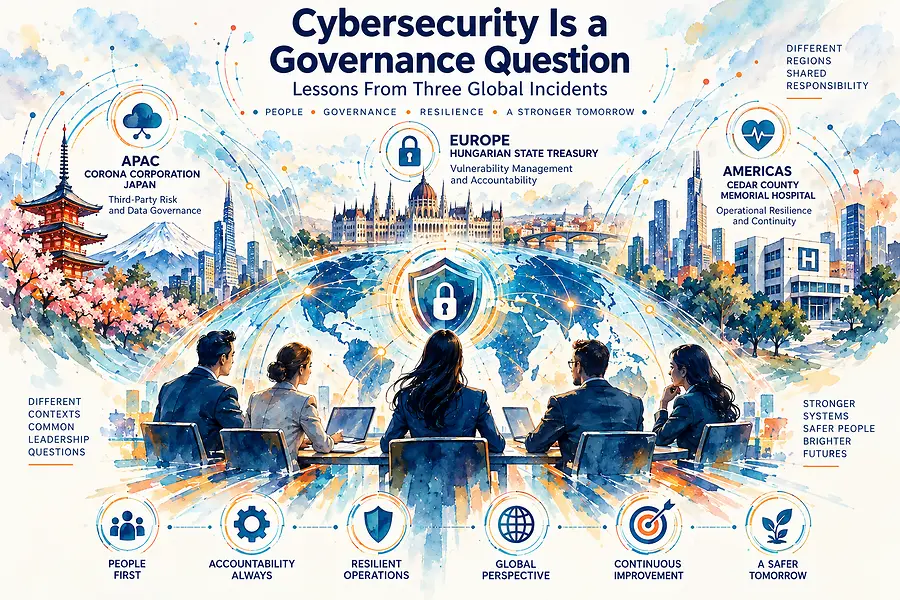
Three incidents reported in August 2026 illustrate this progression from technology risk to governance risk. In Japan, Corona Corporation disclosed unauthorized access involving an external cloud service used to manage construction information, with information relating to as many as 35,000 individuals potentially affected. In Hungary, a cyberattack affected the Hungarian State Treasury's agricultural and rural-development systems; subsequent reporting examined the possible exploitation of an internet-facing legacy system, while some technical details remained under investigation. In the United States, Cedar County Memorial Hospital experienced an IT disruption that resulted in systems being taken offline and temporarily affected its patient portal and electronic health record system.
These cases should not be interpreted as measures of the relative cybersecurity maturity of APAC, Europe, or the Americas. They are individual incidents occurring in very different institutional and operational environments. Their value lies instead in what they allow leaders to examine: how organizations govern technology dependencies, assign accountability, and maintain critical operations when controls fail.
This comparative approach reflects an important idea in Marc Goergen's Corporate Governance: A Global Perspective: governance does not operate through one universal system. Ownership, control, regulation, and institutional arrangements vary substantially around the world, and governance should be examined within those contexts.
Cybersecurity adds another dimension to that global governance discussion. The question for leadership is increasingly not simply whether cybersecurity controls exist, but whether the organization can demonstrate who owns the risk, what evidence supports assurance, who has authority to accept residual risk, and how the institution will remain resilient when prevention is insufficient.
1. Cyber Risk Extends Beyond the Technology Function
When technology supports the organization, technology risk becomes organizational risk.
Cybersecurity has traditionally been treated as a specialized technical responsibility. That distinction becomes difficult to maintain when technology underpins customer information, financial transactions, healthcare delivery, or government services.
The three August incidents illustrate different manifestations of this dependency. Corona's incident concerned information managed through an external cloud service. The Hungarian incident affected systems associated with public administration. Cedar County's disruption affected technology supporting healthcare delivery.
The governance implication is not that boards should manage technical security. Their role is different: they need sufficient visibility to understand which digital dependencies could materially affect organizational objectives and stakeholders.
This shifts the boardroom conversation from "Are we secure?" toward more useful questions: Which systems are critical? What happens when they become unavailable? Which stakeholders are affected? Who is accountable?
Human consequences belong in that discussion. Cybersecurity governance ultimately protects more than systems—it protects the people, services, and relationships that depend upon them.
2. Accountability Must Follow the Risk
A control without clear ownership can create the appearance of governance without ensuring accountability.
One of the most important distinctions in governance is between performing an activity and being accountable for its consequences.
Goergen's global perspective is useful here because it emphasizes that systems of ownership, control, and governance differ across institutional environments. His work explicitly cautions against assuming that a single governance arrangement provides a universally effective solution.
Cyber governance presents a similar challenge.
Responsibility can be distributed among boards, executives, CISOs, CIOs, business units, cloud providers, software vendors, and other external partners. Distribution of responsibility, however, must not result in ambiguity.
For significant cyber risks, leadership should be able to identify a clear chain:
Risk → Owner → Evidence → Authority → Decision
Who owns remediation? Who verifies that it occurred? Who receives an escalation when it does not? Who possesses the authority to accept the remaining risk?
The objective is not to centralize every cybersecurity decision at board level. It is to ensure that accountability remains visible as risk moves across organizational boundaries.
3. Digital Dependencies Must Be Governed
Organizations cannot effectively govern dependencies they have not identified.
Modern organizations operate through interconnected ecosystems of cloud providers, SaaS platforms, vendors, legacy applications, APIs, and infrastructure.
Corona's August disclosure provides a useful example. The company said an external cloud service used for construction-information management had been subjected to unauthorized access. Corona subsequently disabled and reset all user accounts associated with the affected service and reported the matter to Japan's Personal Information Protection Commission.
The lesson is broader than one cloud incident.
Organizations increasingly depend upon systems that they do not wholly operate themselves. Governance therefore needs to extend beyond the traditional organizational perimeter.
Boards and executives should understand which third parties support critical functions, what information those parties process, what assurances exist regarding their controls, how incidents must be reported, and what alternatives exist if a provider becomes unavailable.
Vendor management should therefore evolve from procurement administration into dependency governance.
4. Known Risk Requires Visible Remediation
Identifying a vulnerability is not the same as governing it.
Reporting surrounding the Hungarian State Treasury incident focused attention on an internet-accessible Oracle WebLogic environment. Cybersecurity experts interviewed by Telex indicated that the intrusion appeared to begin through a publicly reachable server running older software, although several details of the attack remained contested or under investigation.
That distinction matters. Governance analysis should avoid turning preliminary technical reporting into established fact.
Nevertheless, the incident illustrates a fundamental leadership question: What happens after a material vulnerability is identified?
Organizations can accumulate vulnerabilities because systems cannot immediately be patched, replaced, or taken offline. Sometimes operational constraints make temporary risk acceptance reasonable.
The governance failure occurs when temporary exceptions become invisible permanent conditions.
Material vulnerabilities should therefore have an accountable owner, remediation deadline, documented exception where necessary, compensating controls, and an escalation path.
Boards do not need vulnerability lists containing thousands of technical findings. They need visibility into unresolved exposures that could materially affect the enterprise—and evidence that management has made deliberate decisions about them.
5. Evidence Should Support Assurance
Governance should distinguish between believing that controls exist and knowing that they operate effectively.
Policies, dashboards, and cybersecurity frameworks are necessary, but their existence does not demonstrate operational effectiveness.
Effective oversight therefore requires evidence.
For a critical cloud provider, evidence might include assurance reports, contractual security obligations, and incident-notification requirements. For vulnerability management, it could include remediation aging, exceptions, and independent testing. For resilience, it may include restoration exercises and demonstrated recovery performance.
This is where cybersecurity governance intersects directly with corporate governance.
Goergen's treatment of corporate governance deliberately combines theory with critical examination of actual governance practice rather than assuming that formal arrangements automatically produce effective outcomes.
The same discipline should apply to cyber oversight.
The board-level question should move beyond:
"Do we have the control?"
toward:
"What evidence tells us the control is working?"
That shift—from assertion to evidence—is fundamental to credible oversight.
6. Communication Is Part of Cyber Governance
Organizations govern incidents partly through the quality of information available to decision-makers and stakeholders.
Cyber incidents develop under uncertainty. Initial facts may change as forensic investigations progress.
That creates a difficult leadership challenge: communicating quickly without presenting incomplete information as certainty.
The Hungarian case illustrates why this matters. Initial reports associated the attack with Russian servers, but Hungary's National Security Service subsequently told Telex that available investigative data did not establish Russian involvement.
Good governance therefore requires disciplined communication.
Boards should distinguish between what is confirmed, assessed, alleged, and unknown. Executives should ensure that emerging technical evidence is translated accurately for nontechnical decision-makers. External communications should similarly avoid overstating attribution or impact before investigations support those conclusions.
Trust can be damaged not only by the incident itself but by inconsistent or premature communication afterward.
Cyber communication is therefore not merely a public-relations responsibility. It is part of governance because decision quality depends on information quality.
7. Resilience Begins Where Prevention Ends
A mature organization plans for controls to fail without assuming the organization must fail with them.
The Cedar County Memorial Hospital incident illustrates this principle particularly clearly.
On August 14, the hospital experienced an IT-network disruption. It responded by temporarily taking certain systems offline and pausing network access. This affected internet services, the patient portal, and the Electronic Health Record system. Importantly, the hospital reported activating downtime procedures across departments while systems were restored.
That response highlights the distinction between cybersecurity and cyber resilience.
Security attempts to prevent or contain harmful events. Resilience asks whether critical organizational functions can continue when disruption nevertheless occurs.
For boards, this means recovery capability deserves attention alongside prevention expenditure.
Leadership should know which services must continue, how long the organization can operate without particular systems, whether manual alternatives are viable, how dependencies affect restoration, and whether recovery plans have actually been exercised.
A resilient organization does not assume that every attack can be prevented. It prepares to continue functioning when prevention is insufficient.
8. Governance Must Learn Across Systems
Global differences should become a source of governance learning rather than simplistic comparison.
Comparing incidents from Japan, Hungary, and the United States does not establish that one governance model is superior to another.
Goergen's global approach makes precisely this broader point: governance arrangements emerge from different ownership structures, institutional environments, and regulatory systems, and there is no single perfect system of corporate governance.
Cyber governance should adopt the same intellectual discipline.
Organizations can learn from incidents occurring elsewhere without assuming that the underlying governance environments are equivalent.
Corona raises questions about external-service dependencies. The Hungarian incident raises questions about vulnerability management, legacy technology, and escalation. Cedar County highlights operational continuity when digital infrastructure becomes unavailable.
Taken together, they demonstrate the value of cross-system learning.
The competitive and institutional advantage will increasingly belong to organizations capable of converting external incidents into internal questions: Could this happen here? What dependency would be involved? Who would own the decision? What evidence would we require? How would we continue operating?
That is how incidents elsewhere become governance intelligence at home.
Three Real-World Applications
Application 1: Corona Corporation, Japan — Governing Beyond the Enterprise Boundary
On August 28, Corona Corporation disclosed that unauthorized access had occurred involving an external cloud service used to manage construction information. The company said names, addresses, and construction-related documentation relating to as many as 35,000 people could potentially have been affected. At the time of its disclosure, Corona said it had not confirmed unauthorized use of the information and that investigation into the cause, scope, and intrusion route was continuing.
Corona disabled and reset all accounts for the affected external service and reported the incident to Japan's Personal Information Protection Commission.
For governance leaders, the broader lesson is not that external cloud services are inherently unsafe. It is that outsourcing technology does not eliminate organizational dependency on that technology.
Boards therefore need visibility into critical external systems, the information they contain, assurance mechanisms, access controls, incident obligations, and contingency arrangements.
The governance perimeter must increasingly follow organizational dependency, rather than simply organizational ownership.
Application 2: Hungarian State Treasury — Governing Vulnerability and Uncertainty
The August cyberattack affecting the Hungarian State Treasury's agricultural and rural-development environment presents a different governance challenge.
The Treasury confirmed the incident, while subsequent reporting examined claims concerning the attacker's access, ransomware activity, and the possible role of an internet-facing Oracle WebLogic system. Officials stated that customer data had not been affected based on information available at the time, while some broader claims about the incident remained disputed or unconfirmed.
The case therefore offers two governance lessons.
First, vulnerability management needs accountability. Legacy technology and unresolved vulnerabilities should not disappear into technical backlogs without ownership, deadlines, exceptions, and escalation.
Second, boards must govern uncertainty itself. During an evolving cyber investigation, decision-makers may simultaneously encounter verified facts, forensic assessments, attacker claims, and media reports.
Effective oversight depends upon distinguishing among them.
Governance is therefore not merely obtaining information. It is ensuring that decision-makers understand the quality, provenance, and uncertainty of that information before acting upon it.
Application 3: Cedar County Memorial Hospital, United States — Resilience as a Governance Capability
Cedar County Memorial Hospital's August incident demonstrates another dimension of cyber governance: continuity.
After detecting an IT-network disruption on August 14, the hospital temporarily took certain systems offline and paused network access. Its internet, patient portal, and Electronic Health Record system were affected. The organization reported that it activated established downtime procedures across departments to maintain clinical care while infrastructure was restored.
This is where cybersecurity becomes inseparable from organizational resilience.
A board can oversee significant investment in prevention and still face an incident. The governance question then becomes whether the institution can continue delivering its essential purpose.
For healthcare, that purpose is patient care. For a financial institution, it may be payments. For government, public services. For manufacturers, production.
The broader leadership lesson is straightforward: recovery capability should be governed with the same seriousness as prevention capability.
Organizations should know not only how they intend to stop an attack, but how they intend to function during one.
Conclusion: From Cybersecurity Oversight to Cyber Governance
The three August 2026 incidents occurred in different countries, sectors, and institutional environments. They should not be treated as evidence that one region governs cybersecurity more effectively than another.
Their significance lies elsewhere.
Together, they show that cyber risk travels through dependencies, accountability structures, information flows, and operational systems.
Goergen's global perspective reminds us that corporate governance cannot be separated from the institutional context in which organizations operate. His comparative approach focuses on both the characteristics shared among governance systems and the characteristics that distinguish them.
Cybersecurity deserves the same treatment.
There may be no universal governance structure appropriate for every organization, but there are increasingly universal questions that leadership must be capable of answering:
What are we dependent upon?
Who owns the risk?
What evidence demonstrates that controls are effective?
Who has authority to accept residual risk?
What happens when those controls fail?
The next evolution of cyber governance may therefore be less about giving boards more technical information and more about giving them better decision information.
Technology teams protect systems. Executives manage organizations. Boards govern accountability, risk, and long-term resilience.
Cybersecurity connects all three.
People first. Systems strong. AI smart.


