Designing the Preschool Classroom Environment to Support the Whole Child
Creating intentionally designed developmental ecosystems that foster cognitive, social-emotional, physical, and creative growth through responsive environmental design and pedagogical practice.

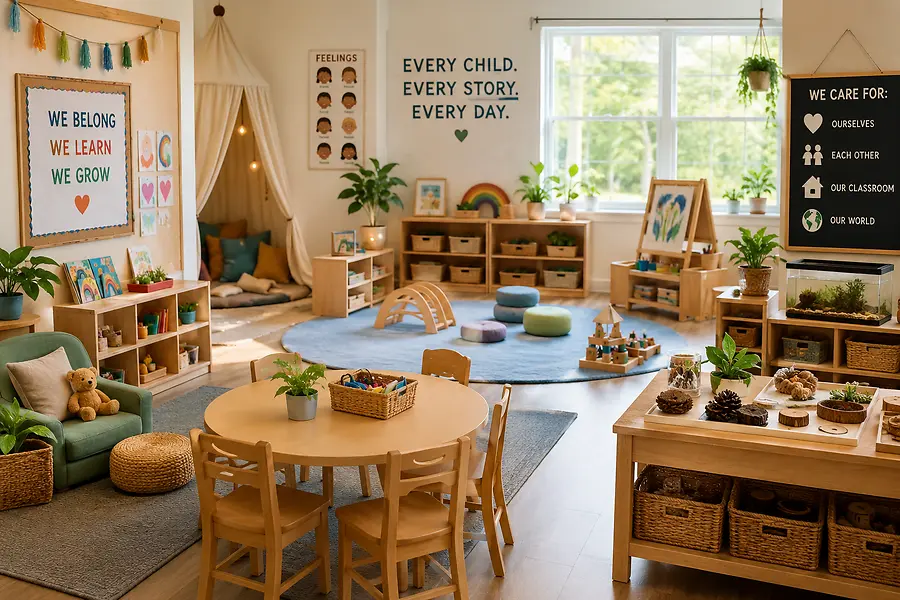
Designing the Preschool Classroom Environment to Support the Whole Child
The preschool classroom environment constitutes a critical dimension of high-quality early childhood education because it shapes children's opportunities to learn, communicate, establish relationships, regulate emotions, develop autonomy, and construct meaning from their experiences. Early childhood development is multidimensional and dynamic, encompassing cognitive, physical, linguistic, social-emotional, and adaptive domains that develop interdependently rather than in isolation.
Consequently, an effective preschool classroom should not be conceptualized solely as a setting for academic instruction or preparation for kindergarten. Rather, it should function as an intentionally designed developmental ecosystem that responds to children's individual abilities, interests, identities, cultural and linguistic backgrounds, and diverse approaches to learning. Developmentally appropriate practice emphasizes the importance of creating responsive learning environments grounded in knowledge of child development, individual variation, and children's social and cultural contexts (National Association for the Education of Young Children [NAEYC], 2020). From this perspective, the classroom environment becomes an active pedagogical component that can cultivate children's agency, competence, curiosity, belonging, and capacity to participate meaningfully in their learning communities.
Physical Environment and Developmental Engagement
The physical organization of the preschool classroom has substantial implications for children's engagement, independence, and development. Clearly defined and intentionally arranged learning areas for dramatic play, literacy, mathematics, science, sensory exploration, art, construction, music, and fine-motor activities create opportunities for children to investigate concepts through multiple modalities. Such environments reflect the principle that young children learn most effectively through active engagement, exploration, play, and social interaction.
Importantly, learning centers should not be understood as isolated academic stations. A single experience can simultaneously support multiple developmental domains. For example, block construction can promote spatial reasoning, early mathematical thinking, fine- and gross-motor coordination, language development, creativity, problem-solving, persistence, and social negotiation. When children collaboratively determine what to construct, assign roles, communicate their ideas, and resolve disagreements, they are simultaneously developing cognitive and interpersonal competencies.
This integration illustrates why early childhood curriculum should avoid unnecessarily fragmenting learning into discrete academic subjects. Instead, developmentally appropriate environments provide experiences through which children construct knowledge across interconnected domains.
The physical environment also contributes to children's emerging executive-function abilities. Materials that are organized, visually identifiable, accessible, and positioned within children's reach allow children to exercise choice and participate in classroom routines with progressively less adult assistance. Structured routines, labeled resources, defined activity zones, visual aids, and predictable schedules help children transition smoothly, stay engaged, take initiative, follow expectations, and complete tasks independently.
The Division for Early Childhood emphasizes intentionally designing physical, social, and temporal environments to promote children's access, participation, engagement, and learning. These considerations are especially important in inclusive classrooms because children vary widely in communication, attention, sensory processing, motor development, and developmental readiness.
Social-Emotional Development, Belonging, and Identity
Beyond equipping classrooms with age-appropriate learning resources, nurturing the whole child demands a deliberate effort to foster a sense of security, inclusion, and healthy interpersonal connections. When classrooms serve as welcoming physical and psychological environments, young learners are empowered to build genuine connections, share their perspectives, actively engage in learning, and confidently explore their surroundings. As a result, the early childhood environment must intentionally convey to both children and their families that they are respected and integral members of the educational community.
The environment can communicate inclusion through family photographs, culturally and linguistically diverse literature, dolls and dramatic-play materials representing varied identities, multilingual resources, adaptive materials, and representations of diverse abilities and family structures. These elements should be selected thoughtfully rather than used merely as decorative symbols of diversity. The NAEYC (2019) identifies equity, identity, and belonging as central considerations in high-quality early childhood education. Meaningful representation can therefore support children's developing self-concept while simultaneously encouraging empathy, respect, perspective-taking, and appreciation for human differences.
A classroom designed for belonging also recognizes that children's identities are shaped through their interactions with adults, peers, materials, language, and institutional structures. When children consistently encounter representations of themselves within classroom books, photographs, dramatic-play materials, and learning experiences, they receive an implicit message that their experiences and identities matter. Conversely, environments that exclude or inaccurately represent particular groups can communicate marginalization. Consequently, culturally responsive environmental design should be understood as an essential pedagogical practice rather than an optional enhancement.
Environmental Design and Emotional Regulation
Emotional regulation is another essential consideration in whole-child classroom design. Preschool-aged children are still developing the neurological, cognitive, linguistic, and behavioral capacities necessary to independently regulate emotions, attention, impulses, and responses to sensory stimulation. Consequently, educators should recognize regulation as a developmental process that often requires adult support and environmental scaffolding.
Classrooms can facilitate regulation by incorporating quiet areas, comfortable seating, sensory materials, opportunities for movement, predictable routines, and spaces where children can temporarily reduce environmental stimulation. These areas should not function as punitive "time-out" locations. Instead, they should be intentionally designed as supportive spaces where children can pause, receive assistance with regulation, and develop strategies for identifying and responding to their emotional and sensory needs.
Teacher-child relationships are equally important within this framework. Educators contribute to children's regulatory development through co-regulation, emotional modeling, responsive communication, explicit instruction in emotional vocabulary, and consistent yet supportive expectations. Research examining classroom interactions has demonstrated the significance of instructional and emotional support for children's developmental and academic outcomes. Thus, the physical environment and interpersonal environment should be viewed as interconnected components of children's developmental support systems.
Inclusion, Accessibility, and Learner Variability
An environment designed to support the whole child must recognize developmental variability as a fundamental characteristic of early childhood rather than an exception to the norm. Children of the same chronological age can demonstrate substantial differences in language, communication, attention, motor abilities, social interaction, self-regulation, and problem-solving. Effective educators therefore design environments that anticipate variability rather than assuming that all children will engage with materials and routines in identical ways.
Universal Design for Learning (UDL) provides a useful framework for addressing learner variability through multiple means of engagement, representation, and action and expression. Rather than designing instruction around an assumed "average" learner and introducing accommodations only after difficulties arise, educators can incorporate accessibility into the initial design of the classroom and curriculum.
Examples include adaptive writing and art materials, visual communication systems, sensory resources, flexible seating, accessible shelving, assistive technology, and learning materials that provide varying degrees of complexity. Such supports can reduce unnecessary barriers to participation and increase children's opportunities to demonstrate competence. Within this framework, inclusion is not conceptualized as an individualized intervention added to an otherwise standardized classroom; rather, accessibility becomes an embedded characteristic of the learning environment.
This approach also has implications for educators' understanding of disability and developmental difference. When an environment creates barriers to participation, the challenge may not reside exclusively within the child. Environmental design, instructional expectations, sensory conditions, communication systems, or classroom routines may contribute to the difficulty. A responsive educator therefore asks not only, "What does this child need to change?" but also, "What can I change about the environment to increase this child's access, participation, and success?"
Play as a Foundation for Whole-Child Learning
Play represents one of the most significant mechanisms through which preschool children develop integrated competencies. Developmentally appropriate environments provide substantial opportunities for child-directed play alongside intentional, teacher-supported experiences because play naturally integrates cognitive, linguistic, physical, social-emotional, and creative development.
Dramatic play, for example, provides opportunities for symbolic representation, language development, perspective-taking, negotiation, and social problem-solving. Construction activities encourage spatial reasoning, mathematical thinking, planning, persistence, creativity, and collaborative problem-solving. Outdoor play supports gross-motor development while simultaneously providing opportunities for sensory exploration, scientific inquiry, social interaction, and appropriately managed risk-taking. Art, music, and movement offer additional avenues through which children can communicate ideas and emotions that they may not yet possess the linguistic ability to articulate.
Accordingly, play should not be positioned as an activity that occurs only after "real learning" has been completed. In early childhood, play is itself a significant context for learning. When educators intentionally observe, scaffold, and extend children's play, they can identify emerging competencies and introduce new vocabulary, concepts, questions, and challenges without undermining children's agency. A well-designed classroom therefore protects sufficient time and space for sustained play while simultaneously recognizing the educator's role as an intentional facilitator of learning.
The Educator as Environmental Designer and Reflective Practitioner
Although the physical classroom is important, the educator ultimately determines how effectively the environment functions as a developmental resource. Skilled early childhood educators continuously observe how children interact with materials, spaces, routines, peers, and adults and use those observations to inform environmental modifications. Assessment should therefore serve not merely as a mechanism for documenting children's skills but also as a tool for understanding development and informing pedagogical decision-making.
Environmental design should consequently be understood as an ongoing reflective process rather than a task completed before the academic year begins. If children consistently struggle to transition between learning areas, for example, educators should investigate whether the difficulty may be related to the physical arrangement of the classroom, unclear expectations, excessive sensory stimulation, insufficient transition time, or limited visual supports. Similarly, if particular materials are rarely selected by children, educators might examine whether the materials are accessible, culturally relevant, developmentally appropriate, or sufficiently engaging.
This reflective orientation represents a significant shift in professional practice. Instead of interpreting children's difficulties exclusively as individual deficits, educators consider the reciprocal relationship between the child and the environment. Such an approach is consistent with inclusive early childhood practice because it recognizes that environmental conditions can either facilitate or constrain children's participation.
Balancing Predictability, Flexibility, and Autonomy
High-quality preschool environments must also balance predictability with flexibility. Consistent routines provide children with a sense of security and help them develop independence, behavioral regulation, and an understanding of classroom expectations. However, excessive rigidity can restrict children's agency and fail to accommodate individual developmental differences.
An effective environment therefore establishes predictable structures while maintaining flexibility in how children participate, communicate, transition, and demonstrate their learning. Children should have meaningful opportunities to make choices, pursue interests, revisit experiences, engage in sustained play, and gradually assume greater responsibility for classroom routines. This balance is particularly important because autonomy is not synonymous with the absence of structure. Rather, developmentally appropriate autonomy emerges when children are provided with structured opportunities to make meaningful decisions within supportive boundaries.
When educators intentionally balance structure and responsiveness, classroom management becomes less dependent upon continuous adult direction. Instead, the environment itself provides organizational cues that support children's developing self-regulation, decision-making, and independence. In this sense, effective classroom design can function as a form of preventive guidance by reducing unnecessary barriers and making expectations more understandable and attainable.
Conclusion
Designing a preschool classroom to support the whole child requires educators to conceptualize the environment as an active pedagogical influence rather than merely the physical setting in which instruction takes place. The arrangement of furniture, accessibility of materials, sensory conditions, cultural representation, opportunities for play, classroom routines, and quality of teacher-child interactions collectively shape children's educational experiences and developmental trajectories.
A whole-child approach recognizes that academic learning cannot be meaningfully separated from communication, creativity, physical development, emotional regulation, social relationships, identity, autonomy, and belonging. Developmentally appropriate and inclusive classroom environments therefore provide children with opportunities not merely to prepare for kindergarten but to develop the foundational competencies, relationships, confidence, curiosity, resilience, and sense of agency necessary for continued learning.
Ultimately, designing the preschool classroom around the whole child is both a pedagogical commitment and a professional responsibility. The most effective environments are not static spaces filled with educational materials; they are responsive ecosystems that evolve in relationship to the children who inhabit them. When educators intentionally design environments that promote accessibility, belonging, exploration, autonomy, and meaningful interaction, the classroom becomes an essential instrument through which children are empowered to participate, construct knowledge, develop relationships, and experience themselves as capable members of a learning community.


