
Detoxing in Mid-Life: A Wholistic Approach to Nourishment, Not Deprivation
Nourish Your Body Daily: Why Consistent Support Matters More Than Restrictive Cleanses During Mid-Life Transitions

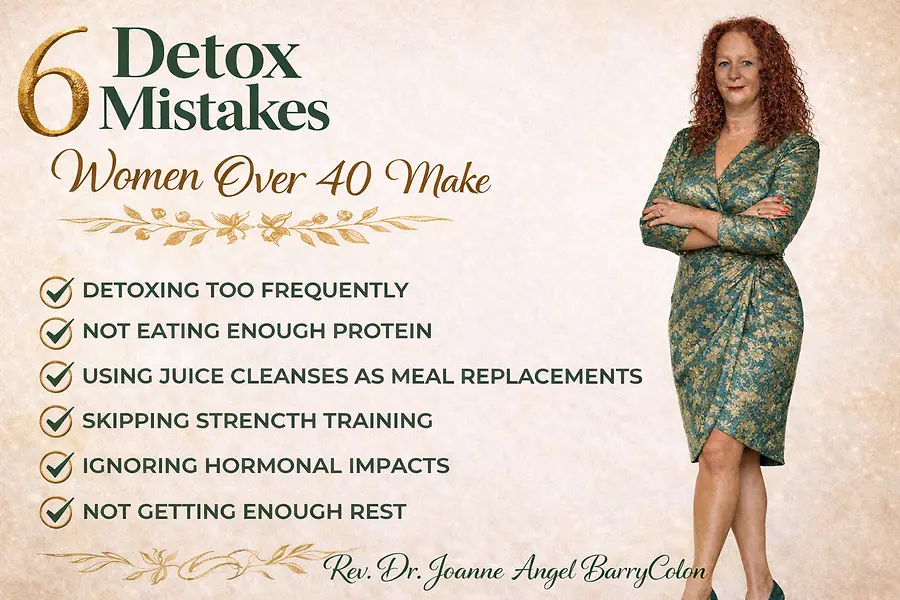
Detoxing in Mid-Life: A Holistic Approach to Nourishment, Not Deprivation
In today’s world, detoxing has become a popular ritual—marketed as a quick fix to reset the body, release toxins, and restore balance. Yet for women in mid-life, perimenopause, and menopause, the question is not simply, “How often should I detox?”
The deeper, more powerful question is:
“How can I support my body so it functions in harmony without constant cleansing?”
Because here is the truth many overlook—your body was designed to detox every single day.
Your liver filters.
Your kidneys eliminate.
Your lymphatic system circulates.
Your breath releases.
Your skin purifies.
Detox is not something your body occasionally does—it is something your body is always doing.
The Mid-Life Shift: From Depletion to Nourishment
As women transition into mid-life, the body begins to shift hormonally, metabolically, and energetically. What once worked in your 20s and 30s—skipping meals, doing juice cleanses, or fasting for long periods—can now create imbalance rather than healing.
During perimenopause and menopause, your body is asking for:
- stability
- nourishment
- consistency
Not extremes.
Frequent detoxing—especially restrictive approaches—can lead to:
- muscle loss
- slowed metabolism
- hormonal disruption
- increased fatigue
Muscle, in particular, becomes essential in mid-life. It is directly connected to your metabolism, strength, bone health, and even hormonal balance. When detoxing is done too often—especially without adequate protein—the body may begin to break down muscle tissue to survive.
This is not healing. This is depletion.
Daily Detox: The Foundation of True Wellness
Instead of thinking about detox as something you “start and stop,” begin to see it as a daily lifestyle practice.
True detox happens through the small, consistent choices you make each day.
Hydration is your first medicine. Drinking water—especially with added minerals—supports your kidneys, digestion, and cellular function.
Nourishment is your second pillar. Eating balanced meals that include protein, healthy fats, fiber, and carbohydrates ensures your body has the tools it needs to repair, rebuild, and release what it no longer needs.
Movement is your third form of detox. Walking, strength training, and stretching stimulate the lymphatic system, which does not move on its own. Your body needs motion to release stagnation.
Breath is your fourth detox pathway. Deep, intentional breathing allows your body to release carbon dioxide and regulate the nervous system, reducing stress-related toxicity.
When these daily practices are in place, your body detoxes naturally—without shock, stress, or deprivation.
Monthly Reset: Honoring the Rhythm of the Body
For women, the body thrives on rhythm. Whether you are still cycling or have transitioned into menopause, aligning with a monthly reset can be deeply supportive.
This is not about restriction—it is about intentional lightness.
Once a month, for one to three days, you may choose to:
- eat lighter meals such as soups, steamed vegetables, and clean proteins
- reduce sugar, alcohol, and processed foods
- increase hydration
- prioritize rest and reflection
This gentle reset gives your digestive system a break while still honoring your body’s need for nutrients.
For those who feel called, aligning this reset with the moon—such as the new moon for release or the full moon for awareness—can deepen your connection to your body’s natural cycles.
Deep Detox: When Less Is More
Stronger detox programs—such as juice cleanses, extended fasting, or highly restrictive protocols—should be approached with caution in mid-life.
If used at all, they should be:
- infrequent (no more than once or twice per year)
- supported with proper nutrition
- aligned with your body’s needs, not external trends
Why? Because deeper detoxes can elevate cortisol (your stress hormone), disrupt blood sugar, and accelerate muscle breakdown.
In mid-life, preserving your muscle, energy, and hormonal balance is far more important than chasing rapid results.
Detox as a State of Being
Detox is not about punishing your body for what you ate yesterday.
It is not about shrinking yourself.
It is not about extremes.
Detox is about creating an internal environment where your body can do what it was designed to do—effortlessly and naturally.
When you nourish your body consistently:
- your energy stabilizes
- your digestion improves
- your hormones begin to balance
- your mind becomes clearer
- your body releases what it no longer needs
Without force.
A New Perspective for Women in Mid-Life
This is a season of wisdom—a time to move away from an “all-or-nothing” mindset and into a space of deep listening.
Your body is not asking to be cleansed every week.
Your body is asking to be supported every day.
So instead of asking, “How often should I detox?”
Begin to ask:
“How can I honor my body today?”
Because when you do that, detox becomes a natural byproduct of living in alignment.
And that is where true healing begins.

Rev. Dr.Joanne Angel BarryColon is the Founder of Wholistic Fitness NY LLC. She has over 4 decades of experience in health, fitness, nutrition, and wellness, and has blended many healing modalities into her practice over the last 15 years. Rev. Dr.Joanne is a wholistic integrative teacher, certified wholistic personal trainer, reiki master, medical astrologer, and master of numerology, and she has a B.S. in Health,…





