Dilemma of The Influential Leader
How Expert Leaders Accidentally Become Invisible by Explaining Too Much

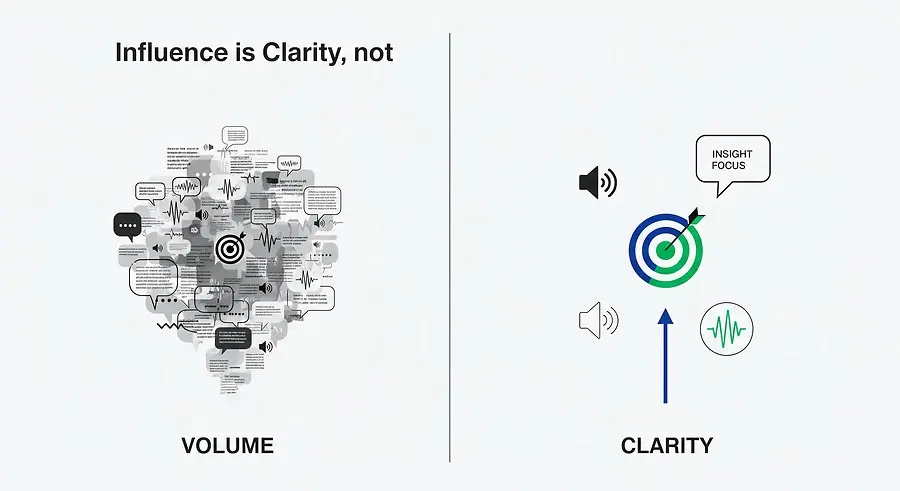
Dilemma of the Invisible Leader
Influence Doesn’t Require Speaking Up—It Requires Being Understood
There is a common misconception in the modern professional world that influence is a product of volume—meaning that to gain attention, a leader needs to raise their voice, increase their frequency, and maintain a ubiquitous presence across platforms.
However, influence rarely depends on how much noise a leader makes. Rather, it lies in the quality of their clarity.
Most leaders remain invisible not because they lack valuable ideas, but because those ideas are buried under the weight of over-explanation. Especially in technical and analytical roles, strong insights often get lost within too many qualifiers, excessive context, and a drive for total accuracy that inadvertently hides the main point.
Clarity is not simplification or reduction; it is a sophisticated form of structural design. It is the ability to separate signal from noise and guide attention deliberately. The most influential voices don’t say more—they decide what not to say, building a path toward the message rather than burying it in explanation.
The Expert’s Dilemma: Why Leaders Stay Invisible
Invisibility in leadership often stems from a fundamental misunderstanding: the “expert’s dilemma.” Many high-performing leaders operate under the belief that maintaining credibility requires absolute transparency, including every variable, caveat, and methodological nuance.
This profound sense of responsibility to be “perfectly accurate” before being understandable inadvertently creates a barrier to engagement. When leaders attempt to disclose everything to avoid misinterpretation, they often overwhelm their audience.
The result is a low signal-to-noise ratio. By trying to explain every detail, leaders risk burying their most valuable insights. When you attempt to say everything, you often end up communicating nothing that your audience can actually retain or act upon.
The “invisibility” of a leader is frequently a byproduct of this dilemma: the belief that total accuracy requires total disclosure of every variable, caveat, and methodological detail.
High-performing experts often feel a profound responsibility to make everything “perfectly accurate” before making it understandable, which inadvertently creates a barrier to engagement.
When leaders have all the answers at hand, they may feel compelled to explain everything they know, resulting in a signal-to-noise ratio too low to deliver the message effectively. In trying to ensure nothing is misinterpreted, they often end up saying nothing that the audience can retain or act upon.
The gap between being a high performer and being a person of influence is rarely a matter of raw talent; it is a matter of translation.
Influence requires a shift from informing—the act of dumping data—to influencing—the act of reframing complexity into actionable insight.
Turning Intelligence Into Noise
I learned this the hard way—through experience, not theory.
My background in strategic planning and analytics led me to approach every challenge with a systemic mindset. I felt compelled to account for every possible variable and outlier. I fell into the trap of believing that credibility required absolute transparency, which led to communication that was over-explained and cluttered.
I believed that providing every detail was necessary to prevent any chance of being misunderstood.
However, this pursuit of total accuracy obscured my insights, turning intelligence into noise. By focusing on every methodological nuance and caveat, I built a barrier that prevented my audience from extracting actionable value.
This is the “expert’s dilemma”: in trying to say everything, I ultimately failed to deliver a message that could be retained.
By trying to explain everything I knew, I ended up explaining nothing.
Overthinking Your Insights
High-performing individuals often operate under the expert’s dilemma: a self-imposed responsibility to clarify every nuance of a situation. This drive stems from a desire for total accuracy—ensuring that no detail is misinterpreted and no aspect of their logic is misunderstood.
However, this commitment to exhaustive disclosure frequently backfires. By attempting to include every caveat, variable, and methodological detail, leaders inadvertently create a barrier to engagement, making it difficult for their audience to extract anything meaningful or actionable.
In their effort to prevent misinterpretation through total disclosure, high performers often end up saying nothing that their audience can retain or use to drive real-world impact.
The Root Cause: The Challenge of Translation, Not Thinking
The gap between efficiency and influence is rarely caused by a lack of intelligence or understanding. It lies in the inability to translate complex insights into something practical and actionable.
When a leader feels responsible for ensuring perfect accuracy before communicating their message, they often overload it with background information and context, making it difficult for others to comprehend.
Clarity isn’t about stripping away information. It is a deliberate and strategic decision to structure insights so the message can shine through.
Influential leaders don’t feel the need to say more—they choose what to leave out so the message becomes self-evident.
Clarity Is About Structure, Not Reduction
Leaders in technical fields often ask themselves: “If I simplify this, will I lose its depth?”
That’s where many get stuck.
Clarity doesn’t mean stripping away information. It means creating a structure for your insights.
Clarity is the skill of:
- Filtering out distractions
- Prioritizing core information
- Guiding the audience’s attention deliberately
A complex insight doesn’t require simplification—just better framing.
For example, where an AI founder might say,
“We are leveraging a multi-agent orchestration layer with retrieval-augmented generation to minimize hallucination rates across high-dimensional vector spaces,”
a leader says,
“We built an AI that gives you the right answer every time, with minimal error and the highest probability of accuracy.”
Same information—different level of influence.
Bridging the Gap Between Expertise and Influence
One of the key differences between a highly efficient expert and an influential leader is the ability to bridge the gap between informative and influential communication.
An analyst may explain every variable that influenced performance. An influential leader focuses on outcomes—identifying what actually drives performance without getting lost in complexity.
This transition redefines a leader’s role: moving from informing—often a data dump—to influencing, where complexity is distilled into clear, actionable insight.
Instead of detailing methodology across multiple variables, an impactful leader highlights the result—what drives performance and what is no longer relevant.
Influence doesn’t mean becoming louder than the system around you. It means becoming clearer than the noise within it.


