Dramatic Play as an Integrated Approach to Learning and Development in Early Childhood Education
Integrating imaginative play as a comprehensive pedagogical framework for child-centered learning and development.

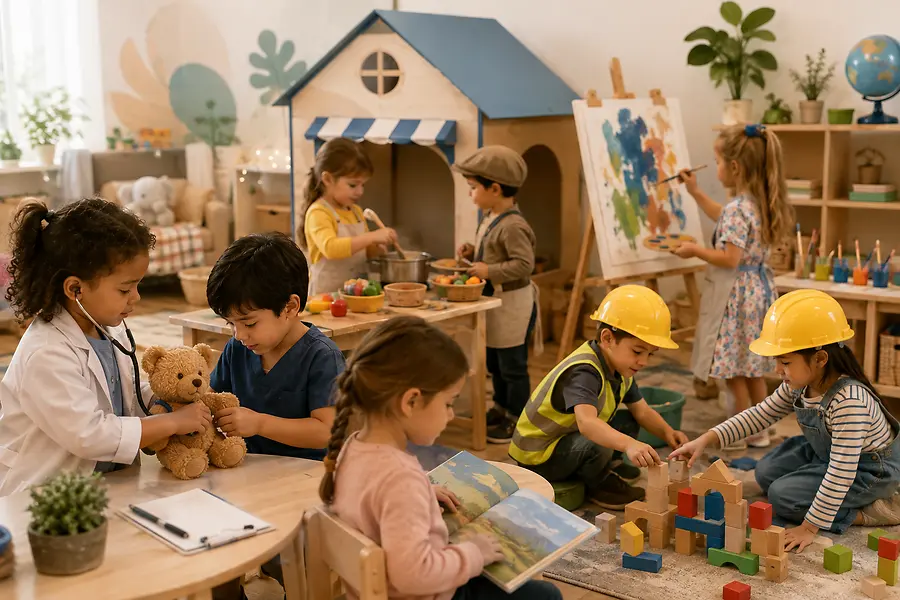
Dramatic Play as an Interdisciplinary Context for Early Childhood Learning
Dramatic play represents a significant component of developmentally appropriate early childhood education because it provides children with opportunities to construct knowledge through imagination, social interaction, communication, and active engagement with their environment. From a constructivist perspective, play is not simply a recreational activity but an important context in which children organize experiences, experiment with social roles, develop symbolic thinking, and negotiate meaning with others. Vygotsky (1978) emphasized the social dimensions of learning, suggesting that children's cognitive development is strengthened through interactions with more knowledgeable individuals and peers. Within dramatic play, the educator therefore assumes the role of an intentional facilitator who establishes an engaging environment while providing sufficient flexibility for children to exercise autonomy. Teachers can incorporate dramatic-play themes into curriculum planning; however, these themes should not become rigid, teacher-directed activities. Instead, educators should observe children's interests, experiences, cultural backgrounds, and developmental abilities and use this information to create meaningful opportunities for child-directed exploration. For example, a teacher might establish a veterinary clinic after observing children's sustained interest in animals, providing stuffed animals, appointment forms, writing materials, medical props, informational books, and photographs. Children can subsequently determine whether they want to assume the roles of veterinarians, pet owners, receptionists, animal-care specialists, or other roles they independently create. This balance between planning and children's agency reflects developmentally appropriate practice because educators establish purposeful learning environments without unnecessarily controlling the direction of children's play (National Association for the Education of Young Children [NAEYC], 2020).
Although dramatic play should provide substantial opportunities for child-directed decision-making, educators remain responsible for establishing developmentally appropriate boundaries that protect children's physical and emotional well-being. Appropriate limits should primarily address safety, respectful communication, equitable participation, appropriate treatment of classroom materials, and behaviors that could harm or exclude others. Rather than immediately intervening in every disagreement, teachers can recognize conflict as an opportunity to scaffold children's development of negotiation, perspective-taking, emotional regulation, and collaborative problem-solving skills. For instance, when two children want to assume the same role in a pretend restaurant, the educator might encourage them to identify possible solutions, such as taking turns, creating two similar roles, or reorganizing the restaurant so both children can meaningfully participate. Educators can further extend learning through open-ended questions such as, "How could we solve this problem?" or "What materials would your restaurant need to serve customers?" Such questioning encourages children to engage in higher-order thinking without replacing their ideas with adult-directed solutions. Teachers should also monitor dramatic play for stereotypes or exclusionary patterns and introduce materials representing diverse families, occupations, abilities, languages, and cultural experiences. Consequently, effective facilitation requires educators to continuously observe, document, assess, and respond to children's play while preserving the spontaneity that makes dramatic play developmentally meaningful.
The educational significance of dramatic play becomes even more apparent when it is intentionally connected with other learning centers, particularly literacy, mathematics, science, and art. Within the literacy center, children can create menus, shopping lists, signs, prescriptions, appointment schedules, advertisements, letters, or other functional forms of print that are subsequently incorporated into dramatic play. These experiences strengthen emergent literacy because reading and writing occur within meaningful social contexts rather than exclusively through isolated academic exercises. Mathematics can similarly become embedded within pretend experiences when children count objects, exchange pretend money, compare quantities, organize materials by attributes, measure ingredients, identify numerals, or solve practical problems. A classroom grocery store, for example, might require children to count produce, identify prices, organize items into categories, determine how many objects a customer needs, and use pretend currency during transactions. Such experiences demonstrate that mathematical concepts have authentic applications within children's everyday environments. Integrating academic content through play can therefore strengthen conceptual understanding by allowing children to actively apply emerging knowledge rather than merely reproduce information presented by an adult.
Science and art centers provide additional opportunities for extending dramatic play across the early childhood curriculum. A classroom garden center, for example, could allow children to investigate seeds, soil, plant structures, weather, and the basic requirements for plant growth before assuming the roles of gardeners, farmers, scientists, or market employees during dramatic play. Educators might encourage children to make predictions, document observations, classify natural materials, and discuss environmental changes, thereby connecting scientific inquiry with imaginative representation. Within the art center, children can design costumes, construct props, create signs, paint scenery, make puppets, or develop three-dimensional materials that become part of their dramatic-play scenarios. A farm-market project could integrate all four learning areas as children investigate plant growth in science, count and categorize produce in mathematics, create advertisements and shopping lists in literacy, and construct market signs or representations of fruits and vegetables through art. Through operating their own classroom market during dramatic play, children can practically apply these learning experiences as they collaboratively solve emerging problems and negotiate roles. This interdisciplinary approach supports cognitive, linguistic, physical, creative, and social-emotional development simultaneously while demonstrating the interconnected nature of knowledge. When educators intentionally integrate dramatic play across learning centers, play becomes a sophisticated pedagogical context through which children investigate concepts, communicate ideas, practice emerging skills, and construct increasingly complex understandings of their social and physical worlds.
This approach is consistent with the 2021 NAEYC Professional Standards and Competencies because effective dramatic-play experiences require educators to understand children's developmental characteristics and individual differences, implement developmentally and culturally responsive teaching practices, and intentionally integrate meaningful content across curriculum areas. Furthermore, educators must engage in reflective and ethical professional practice when determining how much guidance to provide, how to respond to individual children's needs, and how to create environments in which all children can meaningfully participate. Dramatic play therefore should not be conceptualized as separate from academic learning or as an activity reserved exclusively for unstructured periods of the school day. Instead, it represents an interdisciplinary instructional framework through which educators can integrate literacy, mathematics, science, art, social-emotional learning, and communication while maintaining the child-centered principles fundamental to early childhood education. Through purposeful environmental design, observation, scaffolding, and responsive interaction, teachers can transform dramatic play into a meaningful context for inquiry and knowledge construction. Most importantly, preserving children's agency within these experiences allows them to become active participants in the learning process, strengthening independence, creativity, collaboration, and the capacity to transfer emerging knowledge across contexts.


