
Exploring the United Airlines' Island Hopper!
Discover the world's most unique aviation experience: United Airlines' legendary Island Hopper route across Micronesia and the Marshall Islands.

Good morning, travelers!
I thought it would be a good idea to explore one of the most unique aviation experiences in the world today—and an absolute must for aviation enthusiasts!
I speak of United Airlines' legendary Island Hopper! Seriously, that's its unofficial name. Oh, it has an official flight number and designation, as all flights do (always UA 154 and UA 155, to either Honolulu or Guam), but no one else and no other airline offers this route.
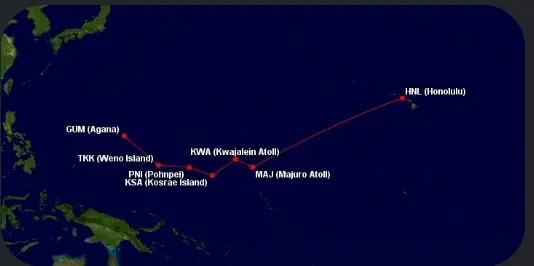
The Island Hopper is a daily service departing from and arriving in Honolulu, Hawaii, on a 14–16-hour routing from Honolulu or Guam. It literally island-hops across the remote atolls of Micronesia and the Marshall Islands between Honolulu, Hawaii, and Guam. Specifically, it serves Majuro and Kwajalein Atolls, Pohnpei Island, and Chuuk Atoll before continuing to either Honolulu or Guam, depending on the direction of travel.
Transiting passengers often remain on the aircraft during brief ground turnarounds (sometimes lasting only 45 minutes) while local passengers deplane, security checks are performed, and any needed cargo is unloaded. Cargo is often a necessity on these islands, more so than usual, as these daily-to-weekly flights from the mainland (as Honolulu is considered) are often the only chance the islands' grocery stores have to resupply their stocks. Passengers are often required to switch seats and verify their luggage, as rigorous onboard security sweeps are performed at each destination by United ground staff or, at Kwajalein Atoll, U.S. Army personnel.
These flights are not cheap, but they make for a great use and arbitrage of miles or United's PlusPoints. The total cash cost of the Island Hopper in Economy Class for the entire journey is around $4,000 USD in 2026 dollars.
The Island Hopper route is uniquely flown using specially modified Boeing 737 aircraft (the 737-800 is common, but United is switching to the 737 MAX 8 in 2027) carrying extra life rafts, spare parts, and an onboard mechanic to handle minor repairs at remote stops where maintenance infrastructure is severely limited. This, in turn, limits passenger capacity, which drives up ticket prices.
It is also necessary to mention that, upon landing at Kwajalein Atoll, you are landing on an active military installation: Bucholz Army Airfield, operated by the U.S. Army at the Reagan Space and Missile Test Range. The atoll is one of three defended by the U.S. Army Kwajalein Atoll (USAKA), which is stationed at the Reagan Test Range sites, with its headquarters at Kwajalein and launch sites at Wake Island and the small Aur Atoll nearby. As a result, passengers are not allowed to take any photos out of the windows, must keep window shades shut, and are not allowed to deplane without express written permission from the U.S. Army or the Department of Defense. This is, in essence, a quasi-secret installation in the Pacific Ocean, along the same lines as the naval outpost on the Indian Ocean island of Diego Garcia or Area 51 in Las Vegas, Nevada (though the latter example is likely a poor comparison, as pop culture has eliminated the surface-level secrecy of that installation).
The entire journey is a treat for history buffs, as it is essentially a trip through time. Every destination along the route—Kwajalein, Chuuk, and Guam—was a battlefield during World War II and a crucial "stepping stone" during Admiral Nimitz's island-hopping campaign of 1942–1945.
Thank you all for joining us today and learning about what is likely the most unique route in aviation. In the next article, we'll go over the Alaska "milk run"—another lifeline route essential for people who live in these remote territories, where road-building is impossible. Join Brooke In The Air Travel for so much more!

Brooke is the founder and chief operator of Brooke In The Air Travel LLC, a company she formed shortly after graduate school in 2022. She holds a Bachelor’s degree in history and sociology, plus a Master’s degree in history, and has since dedicated her life to travel and unraveling the complex mysteries of flights, connections, hotel bookings, etiquette, and in general “how to travel” with the least hassle…





