From Chaos to Consistency
Transform Your Scattered Days Into Steady, Productive Ones With a System That Works

By Jessica Martin
Owner, Jessica Martin Business Consulting
Creator of Your Guide to a Standard Workflow Booklet & Presentation Kit
Leaders know the signs: tasks falling through the cracks, deadlines sneaking up out of nowhere, and good employees who feel busy all day but can't say what they actually accomplished.
So, what if I told you that consistency doesn't have to depend solely on your memory?
You can create a system, and once you adopt the right one, it becomes a reliable framework for consistency.
After years of working across food service, distribution, corporate supply chain operations, municipal government, and legal administration, I've watched the same pattern play out in every industry. The people who succeed aren't simply the ones working the hardest—they're the ones following the same five steps every single day.
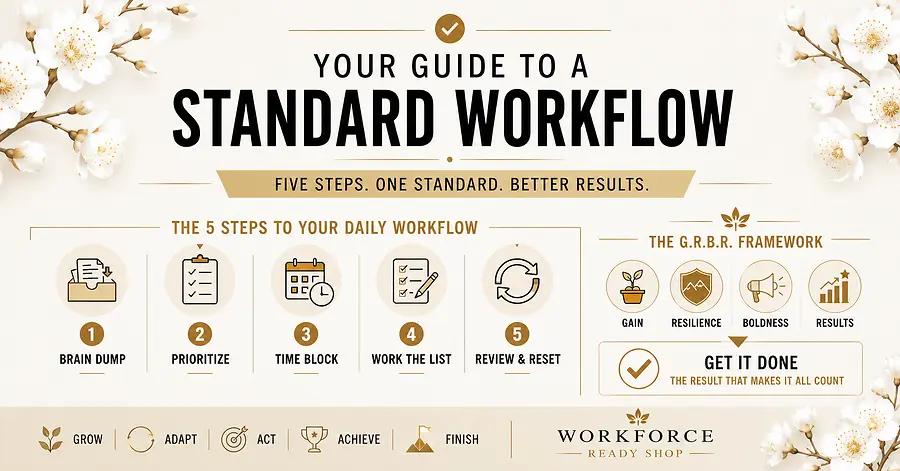
I built that pattern into a training system called Your Guide to a Standard Workflow, anchored by a standard workflow system and a goal-setting framework I call G.R.B.R. Together, they help readers move from scattered to steady and productive in a matter of weeks.
What a Standard Workflow Actually Is
A workflow isn't just a basic to-do list. It's the sequence of steps that carries tasks from "I should probably start this" to "Done—and done well."
Most people never define their day. They simply react to whatever is right in front of them.
That's not a workflow.
That's survival mode.
And survival mode doesn't scale.
A standard workflow gives every day the same structure, allowing your energy to go toward achieving results instead of figuring out what to do next.
The Five Steps to Building Your Daily Workflow
Step 1: Brain Dump the Night Before
The chaos pattern: Starting the day already behind and trying to remember everything at once.
The fix: Clear your mind onto paper before you clock out. Tasks, deadlines, half-formed ideas—get them out of your head so they stop costing you sleep.
Step 2: Prioritize Your List
The chaos pattern: Treating every task like an emergency.
The fix: Sort tasks by urgency and importance, then ask yourself honestly: What must happen today, and what can wait until tomorrow?
Step 3: Time Block Your Day
The chaos pattern: Letting the day happen to you.
The fix: Assign your priorities to specific blocks of time and protect those blocks from distractions.
Step 4: Work the List
The chaos pattern: Adding ten new tasks midday and losing your focus entirely.
The fix: Execute with intention. New requests and distractions will come—write them down for tomorrow's Brain Dump and stay focused on today's priorities.
Step 5: Review & Reset
The chaos pattern: Ending the day unsure of what you accomplished and carrying that uncertainty home.
The fix: Spend five minutes reviewing what you completed, move unfinished tasks to tomorrow's list, and close the day with a plan instead of guilt.
Five steps.
Every day.
That's the entire system:
Clarity. Priority. Time. Focus. Reset.
The G.R.B.R. Framework: Why You're Doing It
A workflow creates a system for moving through your day.
G.R.B.R. explains why that system matters.
Together, they create a process that not only drives results but also gives you meaningful accomplishments worth celebrating outside of work.
A workflow without purpose leads to burnout.
Purpose without a workflow never gets off the ground.
Gain: Build skills and relationships. Every task is an opportunity to improve and become a valuable resource for your team, your organization, and your family.
Resilience: Embrace challenges. The day won't always go as planned. Resilience is what keeps the workflow moving forward.
Boldness: Speak up and take initiative. Don't wait for permission to solve the problem in front of you.
Results: Set measurable goals and celebrate your wins. Progress that isn't acknowledged often goes unnoticed.
Get It Done: Follow through consistently. Not occasionally. Not only when it's convenient. This is the pillar that brings all the others together.
The Integration Effect
This is where most training programs fall short.
They teach a process or they teach motivation—but rarely both.
A standard workflow without G.R.B.R. becomes mechanical. Tasks get checked off, but no one grows.
G.R.B.R. without a workflow becomes empty inspiration. People feel motivated on Monday and scattered again by Wednesday.
Put the two together, and something different happens.
The Brain Dump becomes an act of resilience, clearing your mind so tomorrow's challenges don't catch you off guard.
Time Blocking becomes an act of boldness, allowing you to claim your day instead of letting it claim you.
Working the List becomes daily proof of your commitment to Get It Done.
Review & Reset is where results are recognized and growth is acknowledged.
Where to Start
Start with one day.
Tonight, do a Brain Dump. Nothing fancy—just get everything out of your head.
Tomorrow morning, prioritize your list and time block your schedule before opening your inbox.
Work the list.
At the end of the day, spend five minutes reviewing what you accomplished and ask yourself which G.R.B.R. pillar showed up the most.
Don't try to master all five steps and all five pillars at once.
Build the habit one day at a time, and consistency will follow.
Get It Done Is a Choice
You can continue managing the chaos—the missed deadlines, the mental clutter, and the days that blur together—or you can adopt a system that turns effort into momentum.
The employees and organizations that thrive aren't the ones with the most talent or the longest hours.
They're the ones who've mastered the fundamentals of a workflow they trust and believe in the purpose behind it.
Structure doesn't build itself.
The only thing left to decide is when you'll start building it.
Simple steps.
Bold pillars.
A standard worth building.


