From Ghosting to Vampires - Part I
From Ghostwriting in the Shadows to Writing Her Own Story: A Decades-Long Journey

Reprinted from Writer’s Digest, June 9, 2023
The alien romance you just downloaded because someone raved that it was hot, hot, hot? That might have been me. The next MI6-worthy James Bond storyline? Also me. The YA fantasy readers swear they could read again and again? Could be me too.
That’s because I’m a ghost.
A ghostwriter, specifically.
My dual identities—ghostwriter and author—did not develop together or overnight. After my dad and I stomped across several college campuses and I ultimately chose Southern Methodist University’s school of journalism, I spent years balancing athletic training as my day job with contributing articles on the side. Writing was something I loved, but for a long time it lived in the margins of my life.
My first book was published at 42, and I was deep into my fifth novel when I stumbled into the world of ghostwriting and editing. At the time, I was active in an Austin writers’ guild, and my only understanding of a ghostwriter was someone who wrote in another’s name—like those who continued the legacy of Louis L’Amour, V. C. Andrews, or Ernest Hemingway. Some of those works were unpublished originals, but others were crafted in the authors’ styles by ghosts like me.
What I quickly learned is that most of my clients aren’t heirs to literary estates—they’re busy people with great ideas and no time, or English-language learners who need clarity, or aspiring authors who can’t get their stories organized. And this work—helping others bring their books to life—became my full-time career for the past decade. I especially love guiding first-time indie authors as a one-stop shop to help them write, package, and publish books they can be proud of.
But make no mistake: ghostwriting comes with its own unique challenges. Every ghost or editor needs a circle of trusted listeners—wise readers, fellow writers in the trenches, people with whom we can anonymously share “bytes” of client dilemmas. Very few clients enjoy having their ideas picked apart, after all. My proofreader and I even have standing Friday lunches to decompress over the week’s battles. Developing healthy critique habits, strong market instincts, and a thick skin takes time, experience, and more than a few hard knocks.
Once you hang out your shingle, the work moves fast. After just a few years freelancing with platforms like Upwork and the James Innes Group, I’d already worked with clients around the world on everything from novellas to multi-book fantasy sagas, from screenplays to stage plays. I’d ghosted self-help, how-to, spiritual, technical, academic, and inspirational books. I’d written résumés, revised LinkedIn profiles, and handled a long menu of genres: YA, children’s, adult fantasy, true-story adaptations, memoirs, paranormal, sci-fi, romance, thriller, horror, and action-adventure. If it required words, I probably touched it.
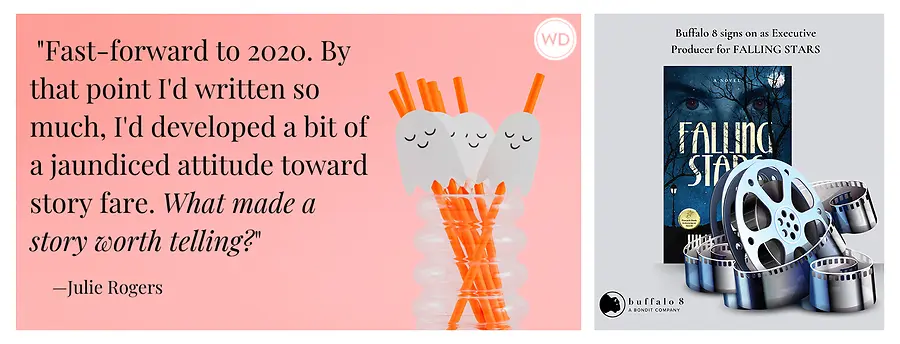
By 2020, however, burnout had crept in. I had written so many stories—thousands of pages—that I started wondering what made a story worth telling. Then the world shut down. I lost both of my parents within two years. I stepped away for 14 months and didn’t write a single word for myself. Still, I kept a running list of story ideas that sparked while finishing work for everyone else. Eventually, I asked my intuitive writer-friend and longtime listener, Lois DiMari, the question I’d been avoiding: Which of these stories is worth me writing—as myself? She chose Falling Stars. I had a good feeling about it too.
I’d studied vampire lore since grade school and had already ghosted three vampire books—grim, dystopian novels set amid future world wars, clan hierarchies, and militarized wastelands. Those vampires were feral creatures, driven by power and survival.
But with Falling Stars, I wanted to return to the romantic vampire—the mythic beginnings found in the ancient Greek tale of Ambrogio and Selene, the young adventurer and the temple maiden who inspired some of the earliest vampire legends. I cast Viscount Claudius Fallon as a sick dhampyre, a vampire-human hybrid whose greatest struggle isn’t bloodlust but congenital leukemia.
The nine-year-old boy in the story, Tommy Lucas, believes Fallon—the local urban legend—is still alive. Tommy himself has paroxysmal nocturnal hemoglobinuria (PNH), a rare blood cancer, and sees his condition as proof that he too must be a vampire.
His belief isn’t entirely irrational. Historical “vampires” may have been people with porphyria, an inherited disease common among Eastern European nobility in the Middle Ages. Like PNH, porphyria caused sun sensitivity, darkened urine, and intolerance to sulfur-rich foods like garlic. Medieval doctors even prescribed drinking animal blood to supplement heme levels. Severe sunburn sometimes caused the skin to recede from the gums, exposing the teeth—classic vampire imagery. Tommy sees all of this and convinces himself he is a sick vampire too.
Falling Stars had been sitting on my bucket list for decades. In the darkest moments of 2020, I wasn’t sure I’d ever return to it—or write anything for myself again. Grief is a strange, unpredictable process. One day a switch flipped, and I felt the spark again.
I’d originally outlined Falling Stars as a screenplay treatment and pitched it at the Maui Writers’ Conference in 2001 to Alison Rosenzweig, producer of Windtalkers. It wasn’t green-lighted, so I tucked it away with the others. In 2021, twenty years later, I pulled it out again and realized I was finally ready.
Now I tell all my clients the same thing: If a story idea suits up and shows up, it’s there for a reason. Trust that. Yours is next.
A sequel to this article is coming soon: how I came full circle to crafting Falling Stars as a screenplay in 2024 and signing on with Buffalo 8 as Executive Producer.


