Germany’s biggest architectural regret? (Airport analyses #6) - BER
The story of Berlin Brandenburg Airport

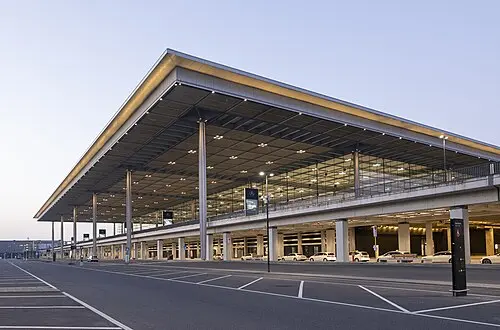
Welcome back value-travelers! Today we're reviewing one of my personal all-time favorite airports. This airport is located back in Germany, and is arguably one of the newest airports in the world, even if it isn't the biggest or flashiest. I refer, of course, to Berlin's new Willy Brandt Berlin-Brandenburg International Airport (or simply known by its IATA code: BER or its official German name, Flughafen Berlin Brandenburg). Often, as is the case with numerous airports in the world, it is simply known as Berlin Airport, though this can be confusing as Berlin technically has two airports nearby.
If a taxi, Uber, or hotel transfer driver asks which airport you mean, simply say "die neu flughafen" or "the new airport," and I guarantee, they'll understand. Berlin is categorized as an international city and because of that, 90% of the population of Berlin speak English to some degree. All you have to do is at least attempt to speak German as a common courtesy out of politeness sake, and many people will often be more than happy to converse in English with you.
Airlines and Hub Status
Berlin-Brandenburg International Airport mostly has flights to European metropolitan and leisure destinations as well as a number of intercontinental services. As such, the airport serves as a base for Condor Airlines, EasyJet, Ryanair, Eurowings, and Sundair Airways; a low-cost carrier hub.
Don't misunderstand, Berlin-Brandenburg International Airport is a central point for long-haul international travel, but it is regarded as a "spoke" and not a "hub." Berlin regards this as a bit of an insult, as Lufthansa was supposed to move its base operations to the German capital yet this did not happen as they preferred to have their primary hub kept at Frankfurt-am-Main, and their secondary hub at Munich (München). Lufthansa does fly to Berlin, but it is not their hub.
No air carrier calls Berlin home except for various LCCs in Europe, as mentioned. It is similar for international carriers; American Airlines does not fly to Berlin at all, while Delta only offers flights to and from Berlin to New York-JFK, and United only flies to and from Berlin to Newark, New Jersey, based from their Newark-Liberty fortress hub.
A Brief History
A brief history will help explain this. After the fall of the Berlin Wall in 1989, and following German reunification in 1990, Berlin once again became the German federal capital; leaders made plans to recognise the city's increased importance by constructing a large commercial airport. The existing airports - Tegel, Schönefeld and Tempelhof - were aging and becoming increasingly congested with rising passenger numbers they could not handle.
To ensure the economic viability of the project, they pursued the single airport concept, or SAC: the new airport would become the sole commercial airport for Berlin and Brandenburg. They planned to close Tegel, Schönefeld and Tempelhof upon opening the new airport, then ban all commercial aviation from any other airport in Brandenburg, forcing all aircraft to utilize Berlin-Brandenburg International Airport. (A quick note on German pronunciation here, the umlaut, or the two dots over vowels, "ö" is pronounced akin to the English "oo" sound.)
On the 2nd of May in 1991, the Berlin Brandenburg Flughafen Holding GmbH (BBF) was founded, owned by the states of Berlin and Brandenburg (37% each) and the Federal Republic of Germany (the remaining 26%), ensuring a public-style ownership of the airport.
An attempt at genuine privatization of the airport failed. This occurred when the company Hochtief-IVG submitted its bid in February 2002, eleven years after the airport concept was devised and submitted, the BBF board consisted of Manfred Stolpe, who would become Federal Minister of Transportation; Klaus Wowereit, who replaced Eberhard Diepgen as Mayor of Berlin and chair of the board, and Matthias Platzeck, who replaced Stolpe as Minister-President of Brandenburg.
The board determined that the proposal would not be practical and voted on 22nd of May 2003, twelve years after Berlin began its airport concept, to scrap the privatization plan. Hochtief, an Essen-based construction firm, and IVG (a massive real estate company headquartered in the former West German capital of Bonn) received approximately €50 million compensation for their planning effort, and otherwise walked away worth nothing when they originally expected to own an airport.
Ultimately, the new Berlin airport would be planned, owned and operated by BBF Holding Company, a public entity. Shortly afterwards BBF Holding became Flughafen Berlin Brandenburg GmbH (FBB) and remained under the ownership of the states of Berlin (a city-state in itself), Brandenburg and the federal government. On the 13th of August in 2004, the Brandenburg state ministry for infrastructure and regional policy granted approval for the development of the old Schönefeld Airport into the new Berlin Brandenburg International Airport.
Essentially, after thirteen years, and endless debates about public or privatized ownership of an airport that hadn't been constructed yet, nothing had changed since 1991, just after Reunification and an airport that was constructed to symbolize such unity.
A lengthy legal battle ensued, as local residents filed lawsuits against the ministry's decision. The dispute ended only on the 16th of March in 2006, when the Federal Administrative Court of Germany finally ruled against the agitated citizens who lived in the vicinity of the new airport. The court did, however, impose stipulations on flight operations at the new Berlin Brandenburg airport.
The construction permit was granted only under the court-imposed condition that once operational, the number of people living in the approach path would be lower compared to the situation surrounding the three existing airports - Tegel, Schönefeld and Tempelhof, resulting in numerous people being paid to move to new homes. Therefore, it was ultimately judged as mandatory for Tegel and Schönefeld to close (Tempelhof was already decommissioned by 2008, Schönefeld was "considered to be tabled" for closure at a later date).
It was now 2008, and I remind you this airport was submitted for construction in 1991, a duration of seventeen years taken up by bureaucratic debates, court hearings, corporate boardroom haggling, and as an aside, a few monetary issues as well. Seventeen years had passed, and the airport was a real structure only on the drawing board.
Berlin Brandenburg Airport was originally planned to open in October 2011, five years after starting initial construction in 2006 (construction was paused during the court battles).
However, the project encountered a series of successive delays due to poor construction planning, execution, management, and corruption. The Airport finally received its aircraft-operational licence in May of 2020, and opened for commercial traffic on 31 October 2020, 14 years after construction started and 29 years after official planning was begun. Schönefeld's refurbished passenger facilities were incorporated as Terminal 5 (in short, instead of shutting that airport down, it was incorporated into Berlin Brandenburg as Terminal 5) in late October of 2020. While all other airlines completed the transition from Tegel to Berlin Brandenburg Airport by a final date of 8th November in 2020.
Construction Problems
The Fire Protection System
Interestingly, the sole most significant cause for the continuing delays to the airport was the fire protection and alarm system. A simple consideration was actually anything but. In the terminal building, the fire system was not built according to the construction permit and failed the mandatory acceptance test necessary to open the airport. FBB proposed an interim solution employing up to 700 human fire spotters, which the building supervision department of the local Dahme-Spreewald district (where the airport was located) quite obviously rejected. Inspectors uncovered flaws in the wiring, programming and implementation of the highly complex system designed by Siemens and Bosch.
The system automatically controls all sprinklers, smoke extractors and fire doors in the entire airport. For aesthetic reasons, designers decided that the terminal would have smoke extraction ducts in its ceiling but that they would not blow exhaust to its rooftop. These ducts were simply just for show. During a fire, smoke would be pumped from the ceiling into a shaft running down and through the basement below the structure. This required the natural rising behaviour of hot air in the shaft to be reversed. Achieving this act on the scale necessary for this airport is a unique undertaking and, so far, this elaborate smoke extraction system has not nearly worked as planned.
To meet the acceptance test requirements, large scale reconstruction work of the fire system was needed. It turned out that the lead designer of the fire safety system was not a qualified engineer. While his business cards read "engineer" it turned out he was simply a draftsman (he drafts designs for engineers to build and implement). His hearing and subsequent termination delayed the airport's opening even further, meaning that limited service during the pandemic (another hurdle that slowed the airport gaining operational acceptance), Berlin Brandenburg Airport did not gain full operational status until 2024-2025.
Poor Workmanship and Planning
Another (and the second) major factor impacting on the construction of the airport was insolvency of general planner Planungsgemeinschaft Flughafen Berlin Brandenburg International Gmbh, and the dismissal of the Gerkan, Marg and Partners architects. Inspectors had uncovered many examples of poor workmanship due to a lack of proper supervision and documentation, most notably concerning the wiring. Reports have surfaced about cable conduits that held too many cables or held cables in incompatible combinations, such as phone lines next to high voltage wires.
A total of 60 kilometers (or 37 miles) of cooling pipes were allegedly installed with absolutely no thermal insulation. To correct this, the demolition of numerous walls was judged as necessary. Furthermore, exterior vents appeared to be in numerous improper locations, which allowed rainwater from the western facade to enter them and contaminate the airport's HVAC system.
Financing
Financing was a gigantic mess. Let me explain. By 2009, the projected construction cost was budgeted at €2.83 billion. FBB raised the financing for the project by a credit raising of €2.4 billion, a bank deposit of €430 million by the FBB partners, and an additional €440 million of equity capital provided by FBB.
During construction, it became clear that the airport's costs would significantly increase as a result of initial underestimates, construction flaws, and increased expenses for soundproofing nearby homes to comply with court orders. On 5th of May in 2016, the Federal Administrative Court finally decided in favour of 25,500 plaintiffs (were this in the United States, this would be termed a class-action lawsuit) and a total cost of over 50 million Euro was charged to the airport for the soundproofing of residents' homes.
The added key directive of the verdict for the airport's situation was that critical fire-rooms (corridors, terminal centers, other vital areas likely to be flammable in the case of fire) on the airport's grounds must be provided with adequate ventilation if windows are closed for noise, and the airport authority must also determine how air inside the structures can be vented, an issue painfully familiar to the Berlin Brandenburg Airport authorities by this point. The issue was similar for local residents, as the airport had to take responsibility for residents' ventilation capabilities in their homes.
By 2012, the series of delays in opening the airport was expected to lead to a number of lawsuits against FBB from various entities with the now-defunct Air Berlin (see my GermanWings article for more information there) announcing its intentions of such a move though it wouldn't get the chance to pursue its lawsuit before financial insolvency.
The bottom fiscal line is that later that year in late 2012, expenditures for Berlin Brandenburg Airport totaled €4.3 billion Euro, almost twice the originally anticipated figure. By that time, the airport's construction was not even remotely complete.
It became clear in November 2015 that the financial concept of the airport was fundamentally flawed. The main purpose of the many stores planned at the airport was to serve passengers who were changing planes, assuming that Berlin would be a big international hub. It was acknowledged in 2015 that competition between the hubs was already too intense.
In essence, Frankfurt Airport to the far southwest by Frankfurt-am-Main, and London Heathrow would resist losing passenger shares without a price war and that few if any airlines would abandon their hubs for Berlin. The only remaining potential airline for operating a hub was Air Berlin, which was, at the time, in severe financial difficulties and did not plan to provide long-distance service at any point. Thus, why I mentioned that Berlin Brandenburg Airport is a hub only for low-cost carriers at the start of this article. Deutsche Bahn (German Railway) also sued for non-usage of the ghost station (colloquial for an unopened train station) below the airport in 2012, with the airport having to pay damages. To learn more about Deutsche Bahn, see my article dedicated to exploring the story of them in entirety.
On the 13th of January in 2018, BBF requested an additional €2.8 billion Euro for extensions until 2030. I know this section is getting long, but it is important to understand that Berlin Brandenburg Airport may not be the biggest or most important airport in Europe, but it is certainly the most expensive, though I reiterate, I personally loved this airport and rank it above Frankfurt and München in favorability.
The 2019 annual report from BER's operating firm was criticized by the political party, The Left (Die Linke, in German), as extremely short and not transparent; cash flow concerns amounted to an immediate €1.5 billion by 20th of June in 2020. On 13th of July 2020, prosecutors filed a complaint on suspicion of falsifying the balance sheet. This investigation is ongoing, disrupted by the COVID-19 pandemic.
Naming the Airport
Naming the airport was a huge concern. During much of the planning and construction phase the new airport was known as Berlin Brandenburg International Airport, abbreviated BBI. It was then discovered that the IATA code BBI already referred to Biju Patnaik Airport (also known as Bhubaneswar Airport) in India. When the planned opening date of 2 June 2012 drew nearer, the FBB launched a marketing campaign introducing the BER branding, reflecting the new airport code.
In 2007, the FBB board decided that Berlin Brandenburg Airport would be given a second name, honouring a person with a distinctive link to the city of Berlin. On the 11th of December 2009, the decision was made in favour of Willy Brandt. The Nobel Peace laureate of 1971 served as mayor of West Berlin from 1957 to 1966 and as West German chancellor from 1969 to 1974. Berlin mayor Klaus Wowereit and Minister-President of Brandenburg Matthias Platzeck, both members of the SPD (the Social Democratic party, which Brandt led from 1964 to 1987) led the effort to add Brandt's name to the airport.
Other suggested honorees for naming rights of the airport included (runners-up, if you will) Claus Schenk Graf von Scharffenberger (of Operation Valkyrie fame, when he, as a member of the SS, attempted to assassinate Adolf Hitler in 1944), Albert Einstein and Marlene Dietrich (the German-American Hollywood actress, and icon of the Golden Age of Hollywood. All three were suggested by members of the Christian Democratic Union), Gustav Stresemann (nominated by the Free Democratic Party, a noted Weimar-era statesman, chancellor, and foreign minister who served until 1929), and Otto Lilienthal (advocated by the Green Party).
The Terminals
Before this article gets too long, we'll quickly go over the terminals. The U-shaped main terminal building of Berlin Brandenburg Airport, named Terminal 1 and consisting of sections A, B (gates 01-25), C and D. They are the same company that designed the hexagonal Terminal A at Tegel Airport, which opened in 1974. At BER, the terminal sits between the two runways, creating a so-called midfield airport above the underground train station. The terminal has four public levels, designated 0, 1, 2 and 3.
The check-in area is located in the public area at Level 1 and houses 118 counters organised in eight clusters, called check-in aisles. Planners anticipate that a significant number of passengers will use the more than 100 self check-in machines that will be installed. Additionally, by May of 2015, two extensions had been added to both sides of the main check-in area, containing 12 more check-in counters and eight security lanes each to avoid overcrowding of the main hall. Major operators at Terminal 1 are easyJet, the Lufthansa Group, Condor, Aegean Airlines, Air France-KLM, British Airways, Turkish Airlines, United Airlines, and Qatar Airways, amongst others. Certainly an eclectic, if disorganized, group of carriers.
Plans for a separate low-cost airline terminal costing €200 million were released in March 2016. Construction for the now-named Terminal 2 with section B (gates 30-45), which was originally constructed as part of Terminal 1, began in 2018 and finished in time in September of 2020 to provide further capacity especially for low-cost carriers and handle overflow from Terminal 1 itself. Terminal 2 was opened on 24 March 2022 with Ryanair as the primary tenant, but in November 2022, Wizz Air also moved its operations to the new terminal. The original intended user of the facility, Eurowings, ironically, remained in Terminal 1.
Terminal 5 (no, I didn't skip Terminals 3 and 4. It is simply 1, 2, and 5) is made up of the former terminal facilities of old Berlin Schönefeld Airport, which were refurbished and renamed from sections A, B, C, and D to K, L, Q, and M, respectively. In 2019, it was decided to leave the old facilities operational to provide more capacity for the expected passenger volume. Terminal 5 was scheduled to be operated until the inauguration of the planned Terminal 3 by 2030 (still under construction as of this writing).
In January 2021, a vaccination center opened at Terminal 5 to administer COVID-19 vaccines not just to passengers, but residents of Berlin as well. The vaccination center also remained open after the closure of the terminal to flights, serving vaccines only to permanent residents of the Berlin area.
In March 2022, Terminal 5 was converted into a makeshift shelter to house refugees fleeing Russia's invasion of Ukraine. There are no updates on this facility as of 2026.
The Runways
Lastly, I will iterate the runway situation. Berlin Brandenburg Airport has two parallel runways. With a spacing of 1,900 metres (6,200 ft), they allow simultaneous instrument approaches, a feat that only one other airport allowed in the world until the FAA put a stop to it based on landing width; San Francisco International Airport (SFO) in the United States.
The northern runway of BER is the southern runway of the old Schönefeld Airport and has been in use since the 1960s. To adapt it for the new airport, it has been renovated and lengthened. To lend context to the discussion, BER covers 3,632 acres of land.
All in all, BER is a collectively disappointing architectural and community-affecting endeavor. I've been through BER twice now and each time, it feels very welcoming and warmly cordial. I can see the errors, of course, but I feel the airport is on the right path with hospitality and warm feelings from all the airport's various staff. This feeling gives me hope for what the airport could become in the near-future. I hope this gave you a lot to think over, and for a more personal touch, join us at brookeintheairtravel.net!