Growth in the Chaos
Why operational excellence is the hidden engine of organizational success.

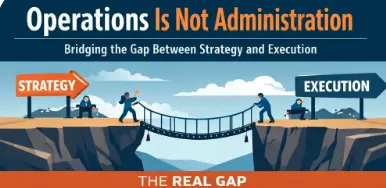
Strategy Doesn’t Fail. Execution Does.
Every organization has a strategy.
A vision statement on the wall.
A three-year plan in a board deck.
A set of goals leadership aligned around at the last retreat.
What far fewer organizations have is the infrastructure to execute it.
That gap—between strategy and execution, intention and outcome—is not a strategy problem.
It’s an operations problem.
And until operational excellence is treated as a form of strategic leadership—not an administrative function—organizations will continue to wonder why their best plans stall.
I’ve spent 14 years inside that gap.
Here’s what I’ve learned:
The systems that hold an organization together are not background work.
They are the work.
The Misconception That’s Costing Organizations Millions
There is a persistent—and expensive—belief across corporate and nonprofit environments:
Operations is a support function.
The people who manage logistics, track data, maintain processes… while “real” leaders focus on vision and growth.
That framing is wrong.
And organizations pay for it in ways they rarely trace back to the source.
- No governance systems → inconsistent decisions
- No KPI framework → leaders flying blind
- No operating cadence → reactive execution
- No knowledge systems → every departure becomes a disruption
None of this is administrative failure.
It is strategic failure.
What Actually Breaks When Operations Is Weak
When operational leadership is undervalued, the symptoms are predictable:
- High performers leave due to unclear accountability
- Boards and funders lose confidence due to inconsistent reporting
- Growth stalls because infrastructure cannot support scale
I’ve seen nonprofit organizations with transformational missions struggle—not because their programs were weak, but because no one built the systems to support them.
I’ve seen corporate teams miss targets quarter after quarter—not because the strategy was wrong, but because there was no execution architecture behind it.
The mission wasn’t the problem.
The infrastructure was.
What Operational Excellence Really Means
Operational excellence is not busywork.
It’s not documentation no one uses.
It’s not dashboards that collect dust.
It is the intentional design of systems that allow an organization to deliver—consistently, at scale, and across leadership transitions.
- KPI architectures that create visibility
- Governance frameworks that define ownership
- Operating cadences that turn strategy into action
- Knowledge systems that preserve continuity
These are not administrative tasks.
They are strategic assets.
Why Some Organizations Scale—and Others Stall
The organizations that execute consistently share one thing in common:
Their leaders treat operational infrastructure as a strategic priority.
They:
- Build systems before they’re needed
- Define accountability before performance breaks
- Document processes before key people leave
- Design reporting before stakeholders start asking hard questions
That’s not over-preparation.
That’s leadership.
It’s Time to Redefine Strategic Leadership
Chief of Staff.
Director of Operations.
Strategic Program Leader.
These are not support roles.
They are architects of organizational performance.
They don’t just execute vision.
They make vision executable.
Strategy without operations is intention.
Operations without strategy is activity.
Together, they are execution.
Final Thought
The most undervalued competitive advantage in any organization is not a better strategy.
It’s a leader who can build the systems that make the strategy work.
Not just present it.
Not just refine it.
Build it.
Because in the end, organizations don’t fail because they lacked ideas.
They fail because they couldn’t execute them.


