Heart-Led Discernment:
Finding Clarity Through Expanded Consciousness

In impractical times, the next clear step may begin with turning down the noise and listening inward.

The heart knows. The mind can learn to partner. When we quiet the noise and tune into our deeper knowing, we expand our perception and discover new possibilities for moving forward with clarity and purpose.
Explore heart-led discernment and expanded consciousness to hear your inner signal, widen your perspective, and choose a grounded next step.
Sometimes the next clear step begins with making room to hear yourself.
The world is loud.
There's always another opinion, another expert, another reason to doubt what you sense.
Information and expertise matter. They can help us see what we've missed and make better decisions. But they can't do our discernment for us. And when stress has become the background music of everyday life, taking in still more information may not be what helps us find our way.
Sometimes the next step begins with a sacred-and brief-pause. Long enough to turn down the noise and hear the quieter signals moving beneath it.
The heart knows. The mind can learn to partner.
When the noise settles, we have more room to notice what matters.
When I talk about heart-led discernment-and this distinction matters-I don't mean treating every feeling or sudden insight as fact. I mean learning to listen for the deeper signal that can get buried when the mind is busy managing, planning, explaining, comparing, and trying to keep us safe and on track.
Those mental capacities are useful and practical. Trouble starts when the brain has to run every part of our lives on its own. Then even a simple next step can feel like a full committee meeting: one voice raises objections, another imagines worst-case scenarios, and someone keeps asking for more data-all while the safety alarms and what-ifs run on overdrive.
Enter the heart's superpower: discernment.
Remember the Sorting Hat in Harry Potter? One thing the heart is really-I mean, really-good at is sorting the noise from what feels meaningful and worth our attention.
The heart's discernment helps sort what deserves our attention.
For a long time, many of us have been taught to prize analysis and treat the body's responses as unreliable-or irrelevant. We don't have to choose between clear thinking and embodied awareness. We can make room for both. The brain helps us evaluate, organize, question, and act. The heart and body offer other signals: what feels important or aligned, what feels uncomfortable, and what may need a closer look.
That information deserves curiosity, not automatic obedience. A body signal can reflect a current boundary, an old fear, a value we care about, a cue we haven't consciously named, or a mix of all of those. The work is learning our own distinct patterns and letting the mind help us test what we sense.
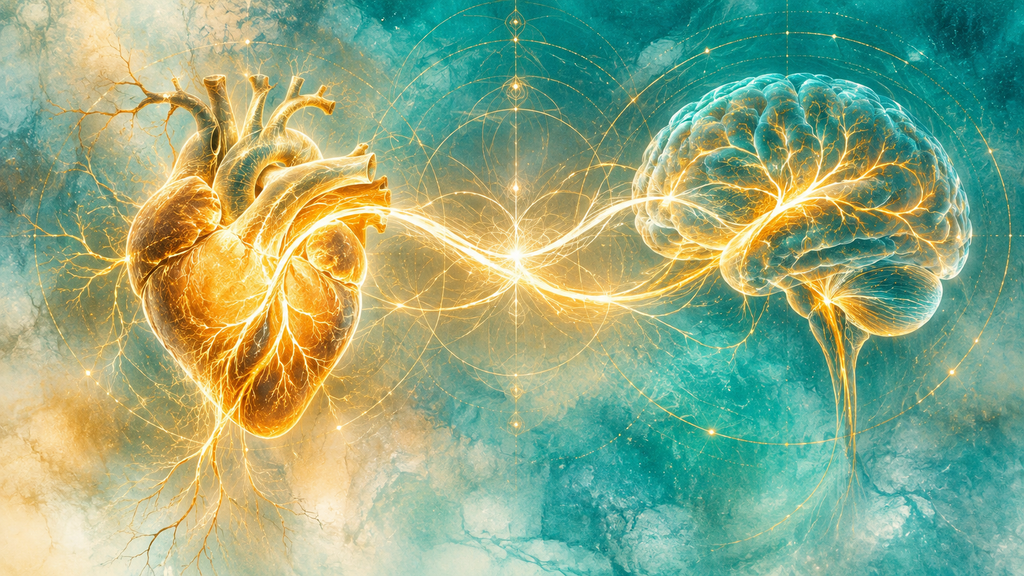
The heart and brain are in constant communication. What might we discover when we learn to pay attention to both?
HeartMath researchers - which I absolutely love and admire their integrity as a progressive, cutting-edge Institutional entity - have also studied physiological responses during experiments with randomly presented emotional and calm images, measuring activity in the heart and brain.
HeartMath researchers - which I absolutely love and admire their integrity as a progressive, cutting-edge Institutional entity - have also studied physiological responses during experiments with randomly presented emotional and calm images, measuring activity in the heart and brain.
They've spent decades investigating how the heart and brain communicate and how heart rhythms relate to emotion, cognition, and perception.
In two studies on physiological responses to randomly presented calm and emotionally arousing images, researchers measured activity in the heart, brain, and nervous system. They reported significant differences in the body's responses before the images appeared. In Part 1, the researchers reported greater heart-rate deceleration before future emotional images than before calm ones.
In Part 2, they reported that both heart and brain showed pre-stimulus responses, with heart activity appearing to precede brain activity in their measures. These findings put the body at the center of an important scientific inquiry into intuition and information processing. (McCraty, Atkinson & Bradley, Part 1; Part 2; HeartMath, The Science of the Heart)
Their papers report anticipatory differences in those measures. These findings are important and intriguing because they bring physiological evidence to a cutting-edge question: how does the body register subtle information before it reaches conscious awareness, and what might those deeper signals contribute to intuition?
Researchers often call this presentiment or predictive anticipatory activity. Dean Radin has spent years exploring this fascinating question, and a 2012 meta-analysis of 26 reports found a statistically significant overall effect: the body's physiological responses sometimes shifted before an unpredictable stimulus appeared. This research opens an intriguing window onto the deeper signals our bodies may register before conscious awareness catches up-and invites us to keep exploring what those signals can teach us about intuition.
IONS is making an important contribution to the study of inner knowing and consciousness. In a peer-reviewed qualitative study, researchers analyzed accounts from 521 adults who described experiences they called "noetic," including intuition, inner visions, meditation or hypnosis, and insights that influenced their decisions. The study brings people's first-person experiences into focused research, revealing meaningful patterns in how these experiences arise and shape their lives. (Wahbeh et al., 2022)
That distinction is key in my work with clients. Many people have learned to dismiss the body's felt signals before they've had a chance to understand them. I invite them to get curious: What might this sensation be responding to? Does it feel familiar? What changes when we slow down and explore it?
Our hearts and bodies communicate in unique, personal, energetic, sensory, and symbolic language - through internal vision, feeling, hearing, sensing, knowing among others. As we learn our own patterns-ease, tension, resonance, contraction-we add valuable information to the decision-making process. The brain can help us question, get curious, and blend that information strategically with what is flowing through the higher sense super-powers of the heart, which, helps us notice what deserves our attention in the first place.
Think of heart-led discernment as an ancient human technology: an innate capacity we can awaken to and calibrate to as a beneficial practice. Science can study parts of how attention, feeling, and confidence influence decisions; it cannot, by itself, settle the meaning we make from our own spiritual experience.
Expanded states offer another vantage point

What becomes possible when we expand beyond ordinary awareness? Expanded states of consciousness invite us to explore deeper dimensions of perception, uncover meaningful insights, and bring that wisdom into the lives we're living now.
Near-death experiences and other (potentially) spiritually transformative experiences raise profound questions about what consciousness may be capable of perceiving beyond ordinary awareness. The University of Virginia's Division of Perceptual Studies investigates near-death experiences, altered states of consciousness, and other experiences that challenge familiar assumptions about the relationship between mind and body. (UVA Division of Perceptual Studies)
IONS' research into noetic experiences brings first-person accounts of inner knowing into thoughtful, systematic study. In one peer-reviewed study, 521 adults described experiences such as intuition, inner visions, meditation, hypnosis, and insights that shaped their decisions. This work offers a valuable picture of how people experience inner knowing and the meaningful role it can play in their lives.
My work explores these questions through expanded states of consciousness, helping my clients integrate what they discover beyond the veil into the life they're living now. By entering a broader field of perception, notice what emerges, and bring those insights back to the choices and relationships in front of us. When a transformational insight becomes lived knowing, it can open the way to profound, paradigm-shifting change.
The goal isn't to escape reality. It's to access the treasure trove of wisdom available to each of us when we learn how to listen. We follow the soul-aligned breadcrumbs, bringing our inner signals into conversation with what's happening around us. As these insights come into harmony, they can guide us toward a fuller, more authentic life-one grounded in inner congruence.
A grounded practice for noisy times

Not every next step requires more information or external action. Sometimes the most profound shifts begin within, when we quiet the noise, listen to our inner signals, and allow a new perspective to emerge.
A wider view can help reveal one grounded next step. When you feel caught in the static, try this:
Pause. Give yourself a moment before reaching for another answer. Let your attention settle. Clear your schedule for a spell.
Notice. What are you feeling in your body? Not what you felt when you woke up, or the knee that often bugs you. Right now, get a fresh scan of what that body of yours is experiencing right no. Is there a sensation, persistent thought, tightness?
Acknowledge. Let it know that you are aware if it. Acknowledge it silently within.
Get curious. What might this sensation be if it were a shape, texture, color. Let your imagination run wild - nothing wrong with making it up - Imagination is the language of the subconscious. Have a chat. In your mind, invite a dialog with that shape/color/texture/feeling. What does it need?
Responding to Unmet Needs. Listen openly to what it has to say. Then, imagine, in whatever way shows up, doing for it what it needs. No judgment.
Notice the shift. Tune back in. What, if anything has shifted. Let that shift be enough or continue the internal communication.
Deep breath. When you're ready to conclude, take a deep breath, letting all of the insight to anchor deep within the cells of your body.
Let the rest go. If anything less than positive is still moving through you, imagine releasing it into the warmth of the sun's light. Take a few minutes to bask in the good feelings before returning to your day-or let yourself drift into a nap.
Inner work can transform how we meet the world-and sometimes show us that what's needed is internal recalibration, not another external action. By listening inward, we can distinguish a grounded next step from the pressure to react, fix, or prove. We can move forward with greater clarity, or pause, trusting the deeper knowing that has come into view.
You don't have to cross a threshold alone
Sometimes the old story no longer fits, but the next one hasn't come into view. That threshold can feel disorienting. It can also be a place of real possibility.
In my one-on-one concierge work, we explore what may be shaping your experience beneath the surface and what becomes possible when your perspective widens. Then we bring what you discover back into your lived choices. We begin with a free, no-obligation discovery call to see whether the work is a good fit.
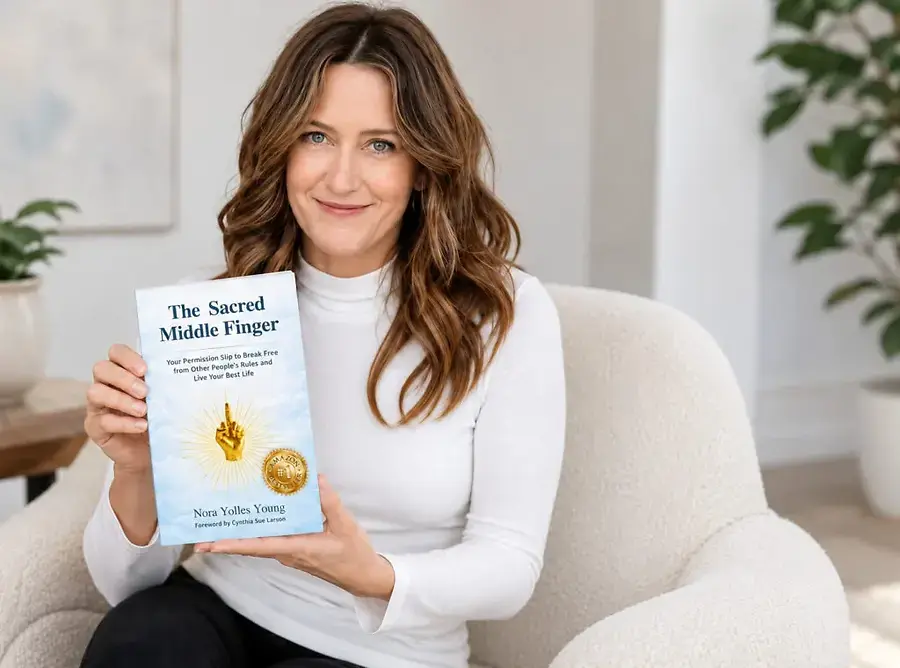
For facilitators, my Soul Connection Hypnosis Certification Training runs online October 28-December 10, 2026. And my book, The Sacred Middle Finger, is for anyone ready to question the rules they've inherited and trust their own inner compass.
The world may be loud. You still have a signal.
In The Sacred Middle Finger, Nora Yolles Young invites you to turn down the noise of other people's expectations, trust your inner knowing, and embrace the freedom to live a life that truly fits you.
Explore your consciousness. Expand your possibilities.
Research Sited: McCraty, R., Atkinson, M., & Bradley, R. T. (2004). Electrophysiological Evidence of Intuition: Part 1. The Surprising Role of the Heart. The Journal of Alternative and Complementary Medicine, 10(1), 133-143.
McCraty, R., Atkinson, M., & Bradley, R. T. (2004). Electrophysiological Evidence of Intuition: Part 2. A System-Wide Process?. The Journal of Alternative and Complementary Medicine, 10(2), 325-336.
HeartMath Institute. The Science of the Heart.
Mossbridge, J., Tressoldi, P. E., & Utts, J. (2012). Predictive Physiological Anticipation Preceding Seemingly Unpredictable Stimuli: A Meta-Analysis. Frontiers in Psychology, 3, 390.
Wahbeh, H., Fry, N., Speirn, P., et al. (2022). Qualitative analysis of first-person accounts of noetic experiences. F1000Research, 10, 497.
University of Virginia Division of Perceptual Studies. DOPS Research.

Nora Yolles Young is a board-certified hypnotherapist, author, speaker, and founder of Young Integrative Consulting LLC. For more than 15 years, she has helped high-achieving women, entrepreneurs, and leaders navigate profound personal and professional transformation through transpersonal hypnotherapy, expanded states of consciousness, and holistic coaching. She is the creator of the Soul Connection Hypnosis…