Heat & the Human Body
Understanding the Health and Infrastructure Crisis Behind Extreme Weather Patterns

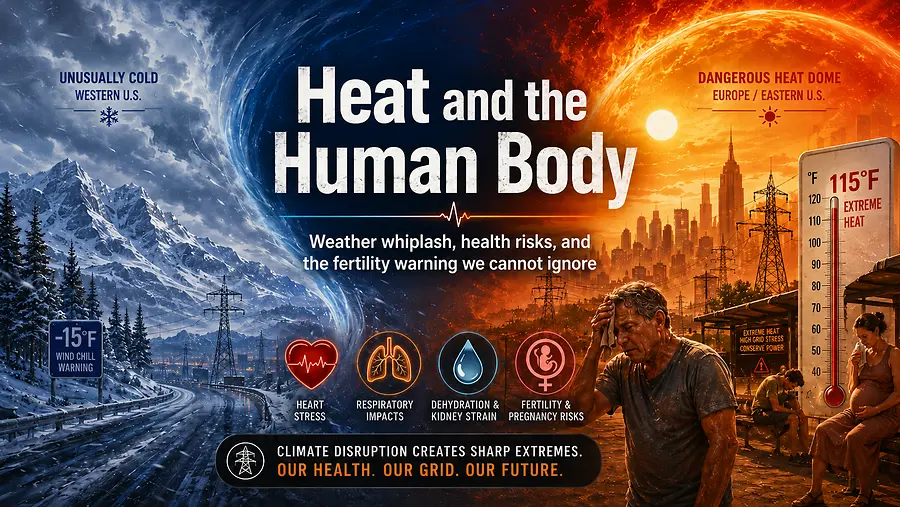
Climate Change, Weather Whiplash, and the Human Cost of Extremes
Climate change does not always arrive as a single dramatic disaster.
Sometimes it arrives as a strange map.
One region bakes under a dangerous heat dome. Another shivers under an unusual cold front. Europe breaks heat records while parts of the western United States face unseasonable cold, wind, and even freezing temperatures in places where people are not expecting winter-like conditions in late June.
To many people, that looks confusing.
How can the planet be overheating if another region is suddenly cold?
The answer is that climate change does not mean every place is hot every day. It means the entire climate system is being pushed out of the patterns we built our lives around. A warmer atmosphere can hold more moisture. Heat waves can become stronger and longer. Droughts can deepen. Storms can intensify. Weather patterns can get stuck. And the jet stream can help create sharp contrasts between regions.
That is why “global warming” is better understood as “global disruption.”
This week, that disruption is visible on both sides of the Atlantic.
Europe has been gripped by extreme heat, with Germany reporting a provisional temperature of 41.3°C (106.3°F) near Saarbrücken as the heatwave moved east. Roads have buckled. Rail systems have been stressed. Health warnings have spread across countries. In the United States, forecasters are warning of a dangerous heat dome across much of the central and eastern part of the country, with heat indices expected to reach dangerous levels in many communities.
At the same time, parts of the U.S. West are experiencing the other side of the pattern: an unseasonably cold system, strong winds, possible high-elevation snow flurries, and freezing nighttime temperatures in places such as the Tahoe region.
This is weather whiplash.
And it matters because the human body was not built for whiplash.
Heat Is Not Just Uncomfortable
For too long, heat has been treated as an inconvenience.
We complain about it. We stay inside. We turn up the air conditioning. We drink something cold. We wait for evening.
But extreme heat is not just unpleasant—it is dangerous.
The human body survives heat by cooling itself, mostly through sweating and circulation. When the air is too hot, too humid, or too persistent, that cooling system can begin to fail. If the body cannot shed heat fast enough, internal temperature rises. That can lead to heat exhaustion, heatstroke, organ damage, and even death.
Heat also worsens existing illnesses. It places extra strain on the heart, lungs, kidneys, and brain. It can aggravate cardiovascular disease, respiratory problems, diabetes, kidney disease, and mental health conditions. It can interfere with sleep, which makes people more vulnerable the next day. It can make medications less effective or more dangerous. It can increase the risk of accidents, especially for outdoor workers, older adults, children, unhoused people, and people without reliable cooling.
Heat is not one hazard. It is a multiplier. It makes other vulnerabilities worse.
The Nighttime Problem
One of the most dangerous features of heat waves is warm nights.
If daytime heat is intense but nighttime temperatures drop, the body gets some relief. Buildings cool. People sleep. The elderly and medically fragile have a chance to recover.
But when nights stay hot, the danger rises.
Warm nights mean the body remains under stress for longer. Sleep becomes difficult. Dehydration accumulates. Air conditioners run continuously. Electricity demand stays high. People without cooling get no recovery window. Cities, with their pavement and buildings, often hold heat long after sunset.
That is why heat domes can be so dangerous.
A heat dome occurs when a strong area of high pressure traps hot air, like a lid over a region. The heat builds day after day. Moisture can make it feel even hotter. Relief may not arrive for days. The longer the heat lasts, the more dangerous it becomes.
This is not just a weather event. It is a public health event.
Fertility and Pregnancy Are Part of the Story
There is another health issue we do not discuss enough: reproductive health.
Extreme heat can affect pregnancy, birth outcomes, and fertility.
Pregnant women are more vulnerable to heat because the body must work harder to cool both the mother and the developing baby. Even a short period of high heat can increase stress on the body. Research has linked heat exposure during pregnancy with higher risks of complications, including high blood pressure disorders, preterm birth, low birth weight, and stillbirth.
That should get our attention.
A heat wave is not only a problem for people who are already old or ill. It can affect babies before they are born.
Heat can also affect fertility. Male reproductive health is especially sensitive to temperature. Sperm production depends on the body maintaining a lower temperature in the testes than in the rest of the body. Studies have found that high ambient temperatures can reduce sperm quality, including sperm count, concentration, motility, and morphology.
This does not mean one hot day makes someone infertile.
It does mean that repeated or prolonged heat exposure is another way climate stress reaches deep into human health.
Reproductive health is not a side issue. It is one of the ways climate change touches the next generation.
Cold Shocks Still Matter Too
The current pattern also reminds us that climate disruption includes cold shocks.
When parts of the U.S. West face freezing temperatures, high winds, or possible snow flurries while other regions bake, that does not disprove climate change. It shows the unevenness of a disrupted atmosphere.
Cold extremes still happen. Sudden cold can damage crops, stress livestock, endanger people without proper shelter, and create dangerous travel conditions. Strong winds can increase wildfire danger even when temperatures are not extreme. Rapid shifts from heat to cold—or cold to heat—can also stress the body, especially for people with heart and lung disease.
This is why “weather whiplash” is such an appropriate phrase.
The danger is not only that one place gets hotter. The danger is that systems built for one range of conditions are being forced to operate outside that range more often.
Homes, farms, hospitals, schools, power grids, roads, railways, water systems, and human bodies all have limits. Climate change is testing those limits.
Infrastructure Is a Health Issue
When extreme heat arrives, public health depends on infrastructure.
Air conditioning matters. Cooling centers matter. Shade matters. Water systems matter. Emergency services matter. Hospitals matter. Transportation matters. Electricity matters.
A heat wave becomes far more deadly when the power fails.
That is why the grid is now part of public health.
During heat domes, electricity demand rises sharply as homes, businesses, hospitals, nursing homes, schools, and cooling centers run air conditioning. If the grid is weak, old, overloaded, or dependent on stressed fuel supplies, heat becomes more dangerous. If blackouts occur during extreme heat, the consequences can be deadly.
The same is true during cold shocks. Heating systems, medical equipment, communications, water pumps, and emergency services all depend on electricity.
A reliable grid is not a luxury. It is survival infrastructure.
Fossil Fuels Make the Problem Worse
Here is the painful irony.
As heat grows more dangerous, people need more electricity for cooling. But if that electricity comes from fossil fuels, we add more greenhouse gases to the atmosphere, making future heat worse.
That is not a solution. It is a trap.
We need cooling, but we cannot solve heat by burning more coal, oil, and gas. We need stronger grids, but not grids that deepen the climate crisis. We need reliable electricity, but not reliability purchased by locking ourselves into more fossil-fuel dependence.
This is where climate policy, health policy, and energy policy meet.
A hotter world needs more clean electricity—not less. And it needs that electricity to be reliable.
Clean Firm Power Is a Public Health Tool
Solar and wind are essential. Batteries are essential. Transmission, efficiency, demand management, weatherization, and better building design are essential. We need shade trees, reflective roofs, stronger water systems, better heat alerts, cooling centers, and protections for outdoor workers.
But we also need firm, clean power that can operate around the clock.
That is where nuclear power belongs in the conversation.
Nuclear power provides large amounts of safe, low-carbon electricity day and night. It does not depend on sunshine or wind. It does not emit carbon dioxide while generating electricity. It can help support the reliable clean grid we need as heat waves intensify, electricity demand rises, and more of modern life depends on continuous power.
This does not mean nuclear is the only answer. It means the answer is incomplete without firm, clean power.
When heat waves threaten health, a dependable clean grid becomes a life-saving system.
Heat Reveals Inequality
Extreme heat also exposes inequality.
People with money can often escape it: better air conditioning, better housing, backup power, shaded neighborhoods, reliable transportation, and flexible work schedules.
People without those advantages face higher risk.
Outdoor workers may have to keep working through dangerous heat. Renters may live in poorly insulated buildings. Older adults may hesitate to use air conditioning because of electricity costs. Low-income neighborhoods often have fewer trees and more pavement. Unhoused people may have no safe place to cool down. Pregnant women, infants, and people with chronic illness may face risks they did not create and cannot easily avoid.
This is why heat planning must be local and practical.
Communities need cooling centers that people can reach. They need clear warnings in multiple languages. They need checks on elderly and medically fragile residents. They need protections for workers. They need access to water. They need reliable power. They need public health systems prepared before the crisis begins.
Climate adaptation is not abstract. It is the difference between life and death.
The Warning We Should Not Ignore
The current heat domes in Europe and the United States, alongside unusual cold in parts of the West, are not isolated curiosities. They are part of a pattern: more extremes, more strain, more disruption, and more risk to the human body.
- Heat affects the heart.
- Heat affects the lungs.
- Heat affects the kidneys.
- Heat affects the brain.
- Heat affects pregnancy.
- Heat affects birth outcomes.
- Heat affects fertility.
- Heat affects sleep, work, food, water, and safety.
And when extreme heat collides with a strained grid, the risk grows.
The question is not whether we can tolerate a few hot days.
The question is whether our communities, our infrastructure, and our energy systems are ready for a hotter, more unstable world.
Right now, the honest answer is: not yet.
But that can change.
We can build stronger grids. We can expand clean electricity. We can protect vulnerable people. We can design cooler cities. We can reduce fossil fuel dependence. We can preserve and expand clean firm power. We can treat heat as the public health emergency it has become.
Weather whiplash is warning us. The human body has limits. So does the power grid. And delay will make the heat worse.