How I Approach Organizational Challenges
Understanding what's really happening in your organization before deciding what needs to change.

Have you ever felt that something in your organization was not working, but you could not quite put your finger on what was missing?
The team is busy. The plan looks reasonable on paper. People are doing their jobs. Yet the work is not moving the way you expected.
That is the kind of question I love working through.
My first instinct is to get curious.
Who is involved? What is supposed to happen? Where does the work slow down? When do decisions get made? Why was a particular process designed that way? How does the work actually get done?
And one of my favorite questions:
What is already working well?
We are naturally inclined to focus on problems. An organization can have ten things working well and one thing that is not, and that one problem will probably dominate the next meeting.
There is nothing wrong with addressing problems. But when we focus exclusively on what needs fixing, we can overlook valuable information about what the organization is already doing right.
Perhaps a team has developed an effective handoff. A manager has established an operating rhythm that keeps everyone aligned. A process is clear and consistently followed. A technology tool genuinely makes the work easier. Governance provides clarity without creating unnecessary obstacles.
I want to understand those successes just as much as the challenges.
What makes them work? Are the right people involved? Are responsibilities clear? Is the process supported by the technology? Are decisions being made at the appropriate level?
And perhaps most importantly, can that success be replicated elsewhere in the organization?
Understanding an organizational challenge requires looking beyond how the work is supposed to happen.
I want to understand how people experience the work, how information moves, where responsibilities intersect, and what people have already figured out through experience.
That means listening before analyzing.
Sometimes I begin with a business process questionnaire to establish a common understanding of the work. Sometimes the better starting point is a series of process interviews with the people who perform it. Stakeholder analysis helps me understand who is involved, who makes decisions, who is affected, and where expectations may differ.
These methods provide structure for asking questions, but they should never prevent us from following an important answer somewhere unexpected.
One of the most valuable parts of this work is separating facts, assumptions, and perceptions.
Two people can describe the same process differently without either person being dishonest or careless. They may participate at different points, rely on different information, or experience different consequences.
I want to understand those differences.
What can we verify? What are we assuming? What do people believe is happening, and why? Where does the documented process differ from actual practice?
Perceptions matter because they influence how people make decisions and perform their work. But perceptions are not necessarily a complete picture. Good analysis requires us to recognize the distinction.
The same discipline applies when something is working well. Understanding why a successful practice works is what allows us to determine whether it can be sustained, adapted, or applied somewhere else.
When an initiative is struggling, I may use an initiative execution diagnostic to examine its underlying structure.
Is the objective clear? Do the right stakeholders understand their responsibilities? Are activities properly sequenced and resourced? Is there a workable process for managing decisions, risks, changes, and accountability?
The initial problem may not be the underlying problem.
A stalled initiative may point to unclear decision rights. A training concern may reveal inconsistent procedures. A technology issue may turn out to be a workflow problem that software alone cannot resolve.
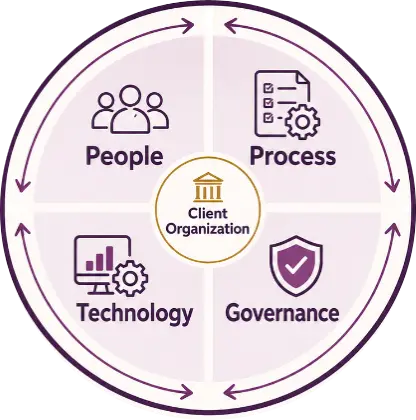
That is why I examine People, Process, Technology, and Governance as interconnected parts of an organizational system.
Each can influence the others. A change in one area often creates consequences somewhere else.
This perspective also helps identify why certain parts of an organization are performing particularly well. When people understand their roles, processes support the work, technology is useful, and governance provides appropriate direction, the resulting alignment can teach us a great deal.
Once we understand what is happening, we can begin determining what needs to change—and what should remain in place.
At Sparrow PMP, our approach follows a Plan–Execute–Assess discipline.
Planning establishes direction and the structure needed to move forward. Execution puts that structure into practice. Assessment helps us understand whether the approach is working and what adjustments are necessary.
It is not simply a sequence of three steps that ends when a project is complete. It is a practical way to keep learning as the work progresses.
Sometimes the outcome is a clearer operating model. Sometimes it is a redesigned process, more defined responsibilities, better governance, or a realistic implementation plan. Often, it is a combination.
And sometimes we discover that the organization already has an effective solution—it simply has not been recognized, documented, or applied more broadly.
The important thing is that the recommendation fits the organization, the people doing the work, and the challenge we have actually identified.
I do not believe every organizational problem requires a sweeping transformation.
Sometimes meaningful progress begins with a few well-placed questions, a clearer understanding of how things fit together, and practical changes that people can sustain.
And sometimes the answer is already inside the organization.
The first step is taking the time to understand it.
Jennifer L. Morris, PMP, founded Sparrow PMP LLC and brings nearly 20 years of professional expertise in strategic planning and organizational transformation. She has supported major federal agencies including the Department of Defense and Veterans Affairs, specializing in strategic planning, operational assessments, and workforce development. Active in professional organizations, Jennifer is committed to leadership…
More from Our Leaders