How I Learned to Let AI Handle the Administrative Work So I Could Focus on the Human Work
How AI workflows freed me from administrative busywork to focus on the relationships and strategic thinking that actually matter.

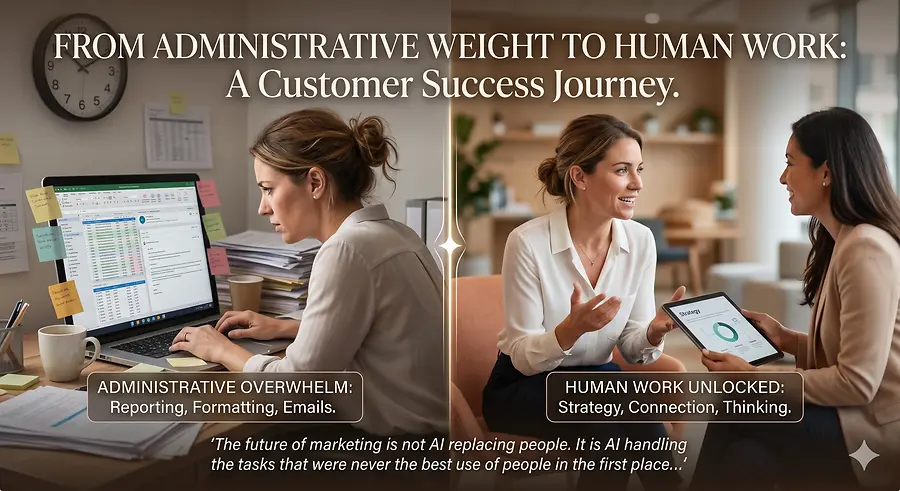
There is a version of my job that looks like this: pulling reports, formatting decks, drafting follow-up emails, organizing data, and scheduling the next check-in before the current one has even ended. For years, that version of my job quietly ate the best hours of my day.
I am a Senior Customer Success Manager at BrightEdge Technologies, where I have spent the last seven years helping some of the world's largest global brands figure out how to show up and stay visible in an increasingly complex digital landscape. My clients are sophisticated, their needs are urgent, and the relationships I have built with them are genuinely meaningful to me. But for a long time, the administrative weight of managing 40-plus enterprise accounts was sitting on top of those relationships like a ceiling.
Then I started building AI workflows, and everything changed.
What I mean by AI
I want to be clear about what that means, because I think the term AI gets thrown around in ways that feel either terrifying or oversold. What I am talking about is practical. I started identifying the tasks in my day that were repetitive, time-consuming, and honestly did not require my judgment or my humanity, and I handed them to AI.
- Summarizing call notes.
- Drafting first versions of client communications.
- Pulling together performance data into a digestible format before a renewal conversation.
- Building the skeleton of a presentation so I could walk in and focus on the story rather than the slide deck.
The human work
What happened on the other side of that was the part nobody tells you about. When you stop spending your best energy on the administrative layer of your work, you suddenly have so much more of yourself to give to the parts that actually matter: the strategy conversations where a client needs someone to think alongside them, the moments in meetings where you notice something is off and ask the question nobody else thought to ask, the relationships that turn a renewal into a five-year partnership because the client feels genuinely seen.
That is the human work. And it was always there, waiting for me to have room for it.
I am now building toward a career where AI workflow design is not just something I do to make my own job easier. It is something I want to help entire teams do. Because I believe the future of marketing is not AI replacing people-it is AI handling the tasks that were never the best use of people in the first place, so that the humans in the room can focus on creativity, connection, and the kind of thinking that no algorithm can replicate.
If you are a woman in business who has ever felt like the administrative layer of your work is crowding out the work you actually love, I want you to know there is a way through it. You do not have to be a technologist to start. You just have to be willing to ask: what in my day does not actually need me?
Start there. The human work will be waiting on the other side.


