How Talented People Keep Proving Themselves Into a Corner
Redefining High Performance: Moving Beyond the Need to Constantly Prove Yourself

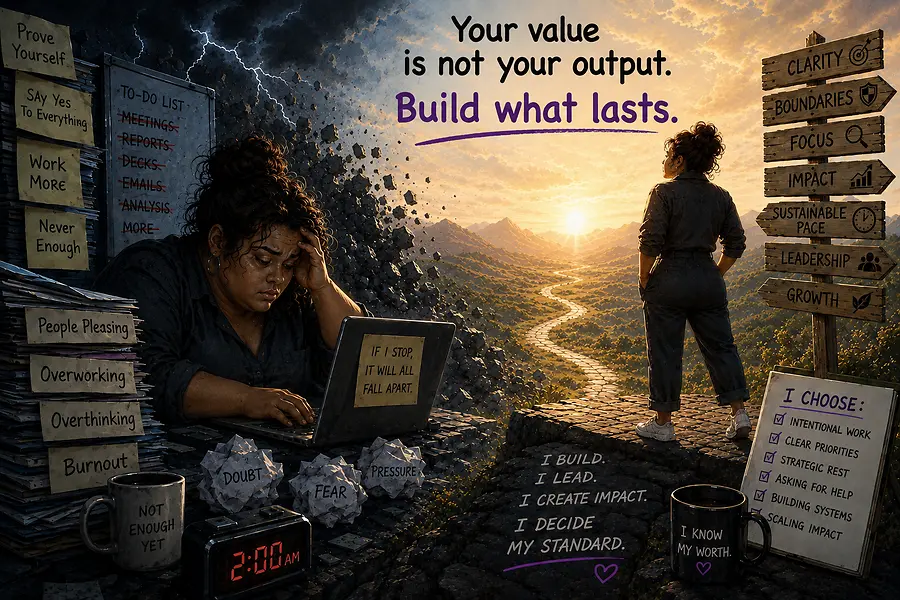
If you have built your career by consistently exceeding expectations, proving yourself can become incredibly effective. You learn faster, anticipate what people need, take ownership, and become someone others can depend on. That ability creates opportunities, especially when you are competing for a role or stepping into a new one.
It can also quietly teach your brain a powerful association: performance creates security.
I know that pattern because I built much of my career within it. I entered rooms without the credentials I thought people expected, so I made results my proof. I learned quickly, anticipated problems, and carried whatever was necessary to succeed. Every achievement strengthened my career while reinforcing an internal equation between how much I produced and how much value I brought.
Our brains learn through repetition and reinforcement. When extraordinary effort repeatedly leads to recognition, opportunity, or security, the behavior gains meaning. Rest can create discomfort. Asking for help can feel exposing. A reasonable workload can leave us wondering whether we should be doing more. Eventually, the pressure begins coming from within us.
I recently reached my 30-day mark in a new role, and I can feel that familiar instinct showing up. I want to learn everything quickly, contribute immediately, anticipate every need, and prove that choosing me was the right decision. Experience allows me to recognize the pattern while I am living it, and recognition still requires practice. I have to remind myself that clear priorities protect the quality of my work, boundaries create consistency, asking for help brings the right expertise into the room, and my capacity deserves intention.
That reminder has become part of how I define high performance. Leadership asks me to understand where my effort creates the greatest impact and how my decisions, communication, systems, and relationships create value beyond what I can personally produce. The pace I establish today is also teaching people what they can consistently expect from me tomorrow.
My dad used to tell me, "Nobody will save you." Those words continue to gain meaning throughout my career. I am responsible for the expectations I establish, the boundaries I protect, and the definition of success I carry into every room. Sometimes that responsibility looks like pushing myself forward. Sometimes it looks like recognizing when an old strategy has already served its purpose.
Thirty days in, I am reminding myself that I do not have to keep proving what my career has already demonstrated. I have to decide what I want to build with it.
And maybe there is a reflection worth carrying into your own career:
What are you still trying to prove, and what would change if you trusted what you have already proven?


